In this week’s newsletter: The majority of the largest school districts are now mask-optional, giving students and teachers leeway after months of mandates. Blocked from going into schools, the Boston Globe’s Jenna Russell deployed a simple but powerful strategy to give readers in-school details. And one veteran ed reporter shares his amazing tap-dancing talent!
THE MASK-OPTIONAL EXPERIENCE
The big story of the week, according to us:
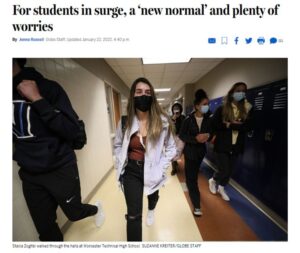
Smiles, tears, teacher walkouts, concerns about bullying — and about safety. The big story of the week is schools’ experience going mask-optional. At schools that have made the change in recent days, some teachers and administrators are going unmasked. Some kids are keeping their masks on — but not all of them for the reasons you might think. The responses range widely — but so far no reports of COVID spikes or widespread refusal to participate:
🔊 As New York Students Shed Masks, Elation Mixes With Trepidation (NYT)
🔊 Lipstick, smiles, anxiety on a Michigan school’s first mask-optional day (Bridge Michigan)
🔊 Smiles – and ambivalence – as mandatory masking ends (WBUR)
🔊 Middle schoolers can finally take off their masks. Why some really don’t want to (LA Times)
🔊 HS teacher separates masked students from un-masked (KOB 4 Albuquerque)
🔊 Mom of kindergartner cried when the district voted to lift the mandate. (CT Insider)
🔊 Cape schools’ mask policies vary as mandate lifted (Cape Cod Times)
🔊 Schools dropping mask requirements garner mixed reviews from students (KMSP Fox 9)
🔊 Rocklin Unified educators protest district’s rejection of mask mandate (EdSource)
Other big stories: A slew of districts like San Francisco and Detroit are keeping mask mandates, even while neighboring districts go mask-optional. Teachers in Minneapolis and St. Paul are preparing to strike. School closings loom in Oakland and NYC, two of many districts facing enrollment declines. Immigrant students from Africa and Pakistan have struggled escaping Ukraine, some reporting experiences of discrimination and racism. Meanwhile, U.S. students born in Ukraine or with close ties have struggled to focus on school.
See more about the mask-optional coverage in the media tidbits section below.
NO ACCESS? NO PROBLEM.
New commentary from The Grade
“It’s been deeply frustrating, the last two years, to be mostly blocked from first-hand reporting inside schools,” writes the Boston Globe’s Jenna Russell in this week’s new column, echoing a common complaint among education reporters. “Some days, it feels like doing the job this way is impossible.”
Read Russell’s first-person account of how she deployed a simple but ingenious workaround to give readers in-school details and “tell a much more student-centric story” than would otherwise have been possible — then go out and do something similar if your district won’t let you observe in person.
ICYMI: We also republished two commissioned pieces from last week: Educator Barbara Gottschalk’s plea for education reporters to stop comparing English learners to native-English speakers (originally placed in SmartBrief) and former Chalkbeat Colorado reporter Nic Garcia’s first-person column urging education reporters to “keep focused on the conflicts that matter” (originally placed in the Colorado Sun). Thanks to Gottschalk and Garcia and to our publishing partners!
THE INCREDIBLY HIGH COST OF DISABILITY TESTING
The best education journalism of the week, plus a runner-up and some bonus stories.
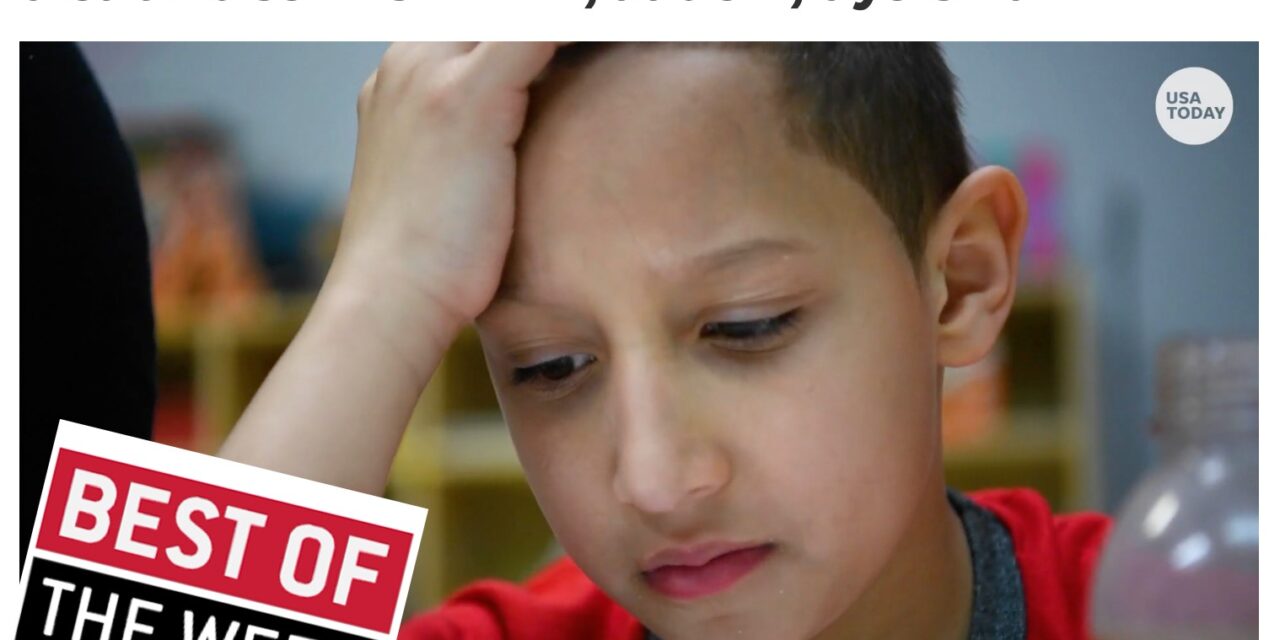
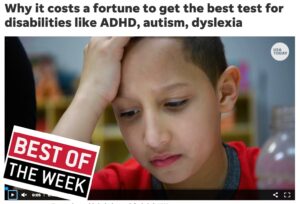
🏆 BEST: The best story of the week is Why it costs a fortune to get the best test for disabilities like ADHD, autism, dyslexia by Sarah Carr in USA Today and the Hechinger Report. Always expert at digging into stories like these, Carr examines the financial hurdles faced by countless families — rich and poor, urban and rural — in getting diagnoses for their kids’ learning disabilities. The diagnoses are crucial for getting kids the help they need, but the tests can be expensive. Carr does a great job at zooming out to look at the bigger picture, telling us that 9% of U.S. kids have ADHD and 5% to 15% have dyslexia, and then zooming in to tell the stories of individual families struggling to find the help their kids need — and then pay for it. “Dyslexia is not for poor kids,” said one parent. “This is a rich man’s game.”
🏆 RUNNER-UP: This week’s runner-up is Frustrated by OUSD closures, student leaders turn their gaze to school board elections by Ashley McBride in The Oaklandside. In this great student-centered story, McBride talks directly to students about the changes they want to see in their school system ahead of a November school board election. It’s the first time 16- and 17-year-olds will be able to cast their vote — a change that OUSD’s student union campaigned for in 2020. Oakland is facing a round of school closures and budget cuts and still reeling from the effects of the pandemic on learning. In response, a student coalition is putting together surveys and a school board election guide. “When I turn 16 and have the power to vote, I’ll be voting for the board members that are advocating for us,” said one student quoted in the piece. “When you don’t advocate for us, we’re not going to advocate for you when it’s election time.” It’s still uncommon to see stories that put student voices at the center, making their experiences more than just part of scene-setters. Kudos to McBride for doing the work.
BONUS STORIES:
🏆 New transparency bills would force teachers to post instructional materials (Washington Post)
🏆 Nationwide activism to oppose book bans is growing (PBS)
🏆 Inside The Divide Over The Future Of The Washington Teachers’ Union (DCist)
🏆 Teacher shortages, mask mandates: Every day still a test for pandemic principals (USA Today)
🏆 No More Extra Credit? Schools Rethink Approaches to Grades (AP)
🏆 Rejected (Chronicle of Higher Ed)
🏆 Lawmakers want to ban discomfort in school. But Black history isn’t always comfortable (NPR)*
*Published more than a week ago but too good to leave out.
MEDIA TIDBITS
Thought-provoking commentary on the latest coverage.
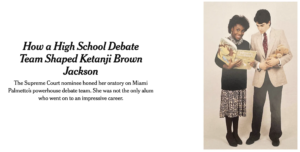
Above: The New York Times looked back at Supreme Court nominee Ketanji Brown Jackson’s school career and how a high school debate team shaped her.
📰 ALL EYES ON THE MASK-OPTIONAL EXPERIENCE: Stop reporting on mask mandate decisions and controversies and start reporting on schools’ mask-optional experiences, please? Another wave of districts in Massachusetts, Atlanta, Connecticut, and New York announced they were dropping their mandates. U.S. News is reporting that mask-optional districts now exceed those requiring masks. So we need to know, what’s it like being in a mask-optional school? Is it going worse than expected, or better? Are there any observable academic, social, participation, or attendance trends? I know we’re all tired of the media’s obsession with what one parent recently dismissed as “the mask thing,” but this is a key moment that warrants attention. Covering different mask-optional experiences will help inform readers and influence other districts’ decisions and timelines.
📰 NEW REPORT ON EDUCATION COVERAGE BETTER THAN I EXPECTED: In a follow-up to the recent Calvin University study on parents’ views of education coverage, a new report called Education news in the mirror describes “how local media are serving the parents who have the most on the line.” The team’s analysis of 1,500 articles from late 2020 and early 2021 gives local media a high score on the most basic question, according to Poynter’s Rick Edmonds. “Education reporting did give priority to stories about learning (especially in the context of the pandemic) and treated potential solutions as well as identifying problems and issues.” Whew! That was better than I expected. However, the new study also points out some serious challenges. “Media outlets that serve communities of color are more likely to focus on service- and solutions-oriented journalism” than other types of outlets, notes the American Press Institute writeup. “They are also more likely than mainstream news outlets to cover the intersection of race and education.” And in a Twitter thread describing the results, researcher Jesse Holcomb notes the prevalence of official voices, as well as breaking news rather than features or service journalism.
📰 STEP ONE: QUOTE THOSE MOST AFFECTED: “This feels like a basic tenet of journalism,” writes New York Times disability fellow Amanda Morris, “to include the voices of the groups that are affected by whatever issue you’re writing about.” Her piece, How to Report With Care on Disability, notes that “many articles about people with disabilities make it seem as if it is exceptional when they do things that nondisabled people do, such as get jobs, go to prom or compete in sports.” But it’s not. Want to learn more about covering students and educators with disabilities? Check out Amy Silverman’s 2018 and 2019 pieces on quoting and centering people with disabilities in education stories. Follow Morris at @AmandaMoMorris.
📰 WHY JOURNALISTS REFUSE TO ADMIT MISTAKES: People generally don’t like to be told that they might have made mistakes or to admit error, and journalists are, unfortunately, no different. That’s what seems to be happening in response to a new podcast from Serial called The Trojan Horse Affair, which tells the story of how the press got hold of a wild letter claiming that conservative Islamists had infiltrated British schools. “The resulting news coverage, which largely failed to question the letter’s authenticity, sparked a hysterical public response,” according to a new New York magazine story. Now, instead of grappling with its errors and complicity, the media response has been a combination of counter-attack and indifference. “Part of me thought British reporters would have to acknowledge our findings, even if through gritted teeth,” says one of the podcast producers. “That hasn’t happened.” Sound familiar?
Looking for media commentary and analysis all day, every day? Follow me at @alexanderrusso.
PEOPLE, JOBS, EVENTS
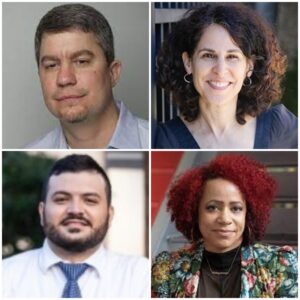
Above, clockwise from top left: Education Week’s Benjamin Herold, the New York Times Magazine’s Susan Dominus and Nikole Hannah-Jones, and the Texas Tribune’s Brian Lopez.
🔥 Awards & fellowships: EdWeek reporter Benjamin Herold was named to the J. Anthony Lukas Work-in-Progress Awards Shortlist for his forthcoming book “Disillusioned: How the Suburbs and Their Schools Undermine the American Dream.” The New York Times Magazine’s Susan Dominus won an ASME award for “I Feel Like I’m Drowning,” about high school students grappling with the isolation of pandemic learning. The New York Times Magazine’s Nikole Hannah-Jones received the NAACP’s Social Justice Impact Award. And Texas Tribune education reporter Brian Lopez was one of 25 journalists selected for the National Press Foundation’s Widening the Pipeline fellowship, where he will receive training in leadership and in-depth reporting. Congrats to all!
🔥 ICYMI: AL.com Education Lab editor Ruth Serven Smith spoke about her career at a College Media Association event today. EdWeek’s Eesha Pendharkar was scheduled to talk about finding racial disparities in education through data yesterday at NICAR. See the full schedule here. USA Today’s Chris Quintana talked about jobs that could qualify you for student loan forgiveness. KPCC LA held a virtual conversation Wednesday about kids’ mental health in the pandemic. EWA’s new cohort of “New to the Beat” reporters kicked off last weekend with a two-day workshop in D.C. The 74’s Beth Hawkins was on Minnesota Public Radio last week talking about the flood of FOIA requests being sent to school districts.
🔥 Job moves: The Chronicle of Higher Education’s Sarah Brown is moving up to the news editor position after seven years as a reporter. And the Washington Post’s Hannah Dreier — whom we interviewed in 2018 about her prize-winning ProPublica story on the intersection of immigration, law enforcement, and school — has joined the New York Times’ investigative team. Congrats to both!
🔥 Job openings: Chalkbeat Chicago is hiring a bureau chief to replace founding bureau chief Cassie Walker Burke. The Baltimore Banner is looking for education reporters to cover K-12 and higher education in Baltimore city, county, and beyond. The Arizona Republic is hiring a schools reporter to report on how K-12 issues are affecting kids, families, and teachers. The Post and Courier in Charleston, South Carolina, is hiring a daily news reporter for their Ed Lab. The Oregonian is hiring an education reporter. The Boston Globe is hiring a higher education reporter, as well as a digital producer for their Great Divide team. The Seattle Times is still looking for an Ed Lab reporter. Politico California is hiring an education reporter. Go apply! We’re sick of posting some of these jobs.
🔥 Upcoming: Apply by March 15 to attend three free data journalism workshop sessions from Poynter on how to track and analyze American Rescue Plan spending. The sessions will focus on public health, public safety, infrastructure, and environment, but I bet there will be some applicable tips for education journalists looking at how schools are spending the money, too. It pairs nicely with The Grade’s columns on smart ways to cover school recovery spending and avoiding the scarcity narrative that plagues so much education coverage.
THE KICKER
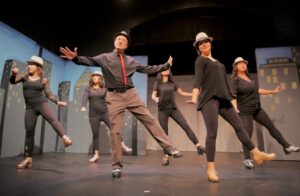
The secret is out! Longtime LA Times education reporter Howard Blume (in the red tie) is a master tap dancer who hosts a show and gives lessons. Now all of a sudden his Twitter avatar makes sense.
That’s all, folks. Thanks for reading!
Reply to this email to send us questions, comments or tips. Know someone else who should be reading Best of the Week? Send them this link to sign up.
Using Feedly or FlipBoard or any other kind of news reader? You can subscribe to The Grade’s “feed” by plugging in this web address: http://www.kappanonline.org/category/the-grade/feed/.
Read more about The Grade here. You can read all the back issues of The Grade’s newsletter, Best of the Week, here.
By Alexander Russo with additional writing from Colleen Connolly.
ABOUT THE AUTHOR
Alexander Russo
Alexander Russo is founder and editor of The Grade, an award-winning effort to help improve media coverage of education issues. He’s also a Spencer Education Journalism Fellowship winner and a book author. You can reach him at @alexanderrusso.
Visit their website at: https://the-grade.org/