How anger can help you produce better education journalism.
By Bekah McNeel
Not too long ago, I talked to ProPublica reporter Alec MacGillis about an incident in which the police had questioned him outside a McDonald’s in rural Texas.
He had been on assignment and had become so angered by the magnitude of the problem he was reporting that he needed to call a friend.
Sitting in his car in the parking lot of the McDonald’s, MacGillis lost track of time, scared the locals, and had to talk to the police.
That’s how angry his stories make him.
“My general approach seems to be to write my pieces at a slow boil,” MacGillis said in a phone interview. “Most of them are pieces that I did because something made me angry.”
Earlier this year, MacGillis wrote one of the most evocative education stories of the pandemic about a boy named Shemar and his disastrous experience with remote learning.
According to MacGillis, the story benefitted because he was angry. Angry that Shemar was struggling so, and angrier still that the middle and upper-middle class seemed to be determined to frame the pandemic as some kind of Year of Slow Living experiment, “cocooning” with family.
I’m angry, too. My stomach turns when I think about the level of comfort that’s long been afforded to some Americans at the expense of others. Segregation, inadequate special education, disproportionate discipline, mental health care deserts, illiteracy, and now the fallout from the pandemic—those are fighting words at my house.
I’ve been lucky enough to work with some great editors who could keep me within the bounds of fair, factual journalism, while helping me find the right moments to blister.
I know that other education journalists are also angry. I work with them and get (Zoom) drinks with them. I hear it in their voices, read it in their texts, and sometimes, though more rarely, I read it in their writing.
I’m angry, too. Segregation, inadequate special education, disproportionate discipline, mental health care deserts, illiteracy, and now the fallout from the pandemic—those are fighting words at my house.
I have the feeling that many of us who write about schools are, actually, quite angry, though we express it differently.
This profession is so steeped in its own ethical juices that the only way to survive as a workaday reporter or editor is to be conscientious by nature. Anger is how ethical people respond to injustice.
If you are the kind of person who can make a strong case for returning a Harry & David holiday basket from a PR firm, or going to jail rather than revealing a source, there’s a good chance that some of the things you hear at a school district rezoning meeting or a briefing on disproportionalities in pandemic learning loss are going to brush up against your sense of fairness.
If they don’t, Nikole Hannah-Jones has some thoughts for you, and you should stop here and just devote some time to that. “A lot of times, white journalists — their experiences of our educational system are completely different from the experiences of most of the kids that they cover,” Hannah-Jones said at a recent EWA webinar. “We would be willfully naive to think that that has not and does not impact coverage, but you can’t get around that.”
A good editor makes sure that while you are angry, you are not blinded by anger. That you are still fair to those who benefit from the unfair system, and skeptical of those who are tipping you off. The key is to make sure that every bit of anger is channeled in the service of the story.
I know that other education journalists are also angry. I hear it in their voices, read it in their texts, and sometimes, though more rarely, I read it in their writing.
The education beat isn’t uniquely infuriating.
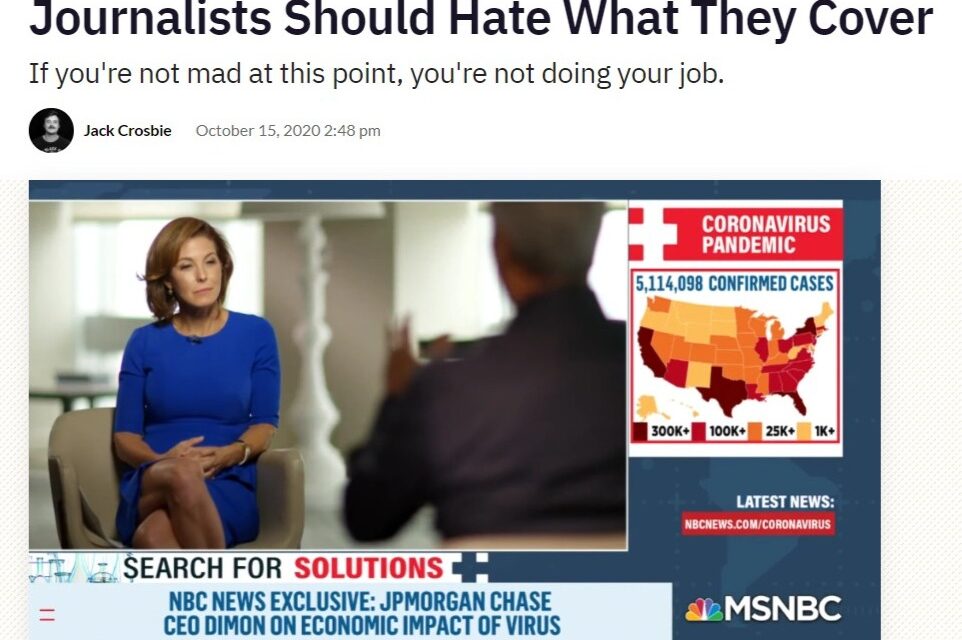
Anger at those in power is a natural and necessary by-product of journalism, Jack Crosbie writes on the Discourse Blog. “If you’re not mad at this point, you’re not doing your job,” he said.
But for beat reporters especially, who do feel that rage, you’ve been taught to suppress it, lest you fall into advocacy. As though being angry and doing something about it is the same thing.
Even with editors and data supporting us, reporters still fear unpleasant interactions with powerful or privileged people, be they superintendents, white PTA moms, or other journalists accusing us of activism.
It’s hard to see anger in beat reporting, and on some level maybe angry beat reporting comes down to the stories we choose, the quotes we include, and the tenacity we exhibit in pursuing the story.
That’s good. If we don’t translate our anger to the page, we tell the reader “there’s no problem with this. Nothing to see here.” But while we don’t want our readers to know how we feel about every single source or issue, some of our writing leaves them wondering if we care at all – if we see what they see.
It’s a shame that there’s not more room for angry writing about education because the kind of contained, slow-boil anger MacGillis describes can be extremely effective, particularly on the ed beat, which threatens to dry up and blow away sometimes, taking very important issues with it and leaving the comfortable to get more comfortable.
It’s a shame that there’s not more room for angry writing about education because the kind of contained, slow-boil anger MacGillis describes can be extremely effective, particularly on the ed beat, which threatens to dry up and blow away sometimes,
Sometimes, we have to find the anger. We can’t wait until the anger finds us. In education, the real scandals aren’t about rule breakers, but rule makers. The great scandals of education are scandalous because they are unjust while being entirely lawful.
When the San Antonio Express-News’s Krista Torralva wrote her front-page feature on segregation in San Antonio’s school districts this summer, she experienced both the fury that drives a good reporter and the editing process that, for better or worse, makes it so difficult to spot.
There’s a sentence in the piece that states: “Today’s school district boundaries evolved from almost 50 years of segregated real estate.”
That’s the edited version, Torralva confirmed via text message. The original version, which she later tweeted, left a slap mark: “San Antonio school district boundaries were designed to segregate by race. And those district lines haven’t changed since.”
“I think that was most inspired by anger,” Torralva said, “anger that this has not changed.”
The excellent piece was full of spicy quotes from politicians and educators so the final version was not lacking in heat. I see her editor’s point in letting the others do the sassing. But I relish the Twitter version, which is no less factual.
Meghan Mangrum of the Chattanooga Times Free Press stuck to what she heard from students at protests in the wake of George Floyd’s death, but led her story with some incisive curating:
“Mistreated. Unappreciated. Hated. Scared,” Mangrum wrote. “These are four ways that young children of color said they felt during a protest at First Horizon Pavilion in Chattanooga on Saturday afternoon.”
The trick, of course, is channeling that anger into effective reporting instead of shrill opining or caustic punditry, which, frankly, do not help.
Anger is your sixth sense when sniffing out a story, helping to guide you toward a core injustice.
Journalists should protect that anger, not allowing politicians, unions, or activists to tell us what to be angry about. It’s way too easy to play someone else’s blame game or settle for shallow shaming of the nearest authority figure. Our anger should be our own, because we’ve seen a fuller scope of what’s going on.
The education beat can be a series of reactions to the happenings within the education systems of our nation, states, and cities, or it can be driven by an interrogation of their outcomes. Interrogation is an angry business.
As a huge fan of solutions stories, I don’t think that anger and solutions are mutually exclusive, either. When I’m angry, I want nothing more than for someone to FIX THE PROBLEM, DAMN IT. If I’m seriously angry about something, I will point out the limits to the solution as well, a key part of solutions journalism that separates it from fluff.
The trick, of course, is channeling that anger into effective reporting instead of shrill opining or caustic punditry, which, frankly, do not help.
One of the main ways his reporting has benefitted from anger, MacGillis said, has been in the details. He shows the reader the losses and costs of the injustice, infuriating fuel to keep the burn going. But there’s accountability in that, too: “You have to have the kindling and the wood,” he said.
You have to have infuriating facts to write. After paragraphs and paragraphs of the detailed challenges Shemar faced to log on to his classes, the reader, like MacGillis, is longing for the kid to have a win.
So when you read that “he and his classmate had been sitting in their virtual space for 20 minutes, waiting for the teacher,” you just want to f—ing scream.
Related from The Grade
No, asking questions about remote learning isn’t ‘teacher bashing’
Reporting remote participation levels
What reopening schools is going to look like
Education reporters share their own back to school decisions
ABOUT THE AUTHOR

Bekah McNeel
McNeel is a freelance journalist who has been covering education for eight years. Her education reporting has appeared in The Hechinger Report, The 74 Million, The Christian Science Monitor, The Texas Tribune, Edutopia, and Texas Public Radio. Based in San Antonio, she also covers immigration, currently for Christianity Today. You can follow her on Twitter at @BekahMcneel.