In this week’s newsletter: Los Angeles has a billion-dollar sexual predator problem that seems likely to be mirrored around the country. No, angry parents and Asian-American voters didn’t determine the 2022 San Francisco school board recall. The case for covering the Weingarten/DNC controversy. And: Even some of the best reporters have crashed out covering the education beat!

A ‘TIDAL WAVE’ OF SEX ABUSE LITIGATION
The big education story of the week
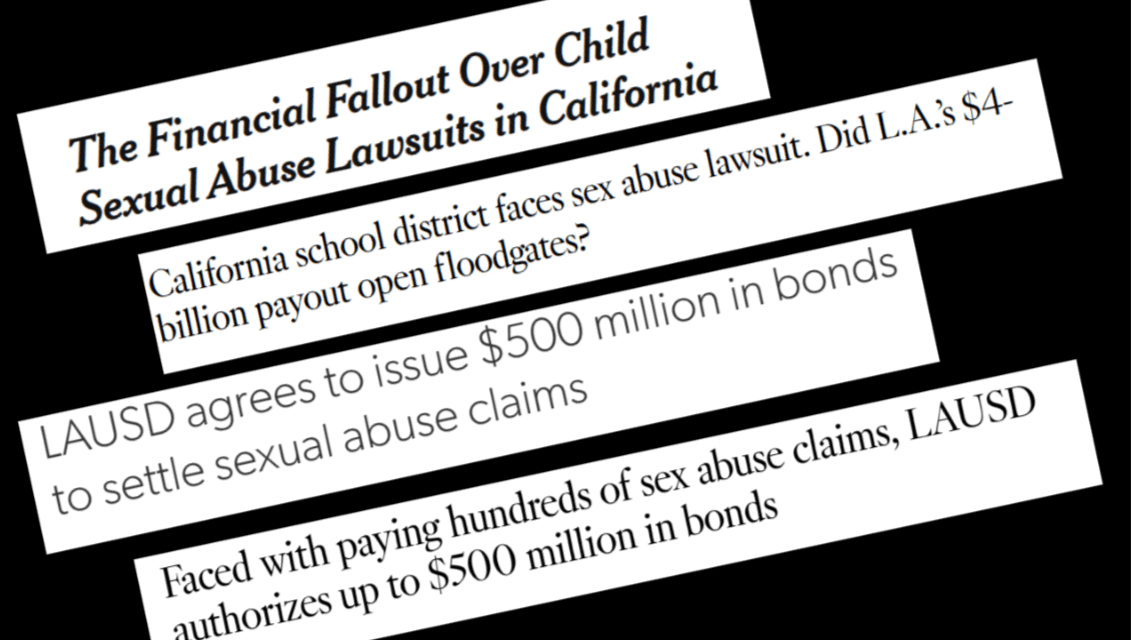
The big education story of the week is the billion-dollar sexual predator fund being created by LAUSD to help cover lawsuits that could reach $3 billion for California alone (LA Times, LAist, EdSource).
“The case against the Clovis USD comes amid a tidal wave of sexual abuse litigation that has left lawmakers scrambling to stop misconduct,” according to an LA Times article exploring the larger trend, with schools “struggling to pay settlements owed to victims suing over crimes that stretch back decades.”
If California’s sex abuse litigation problem doesn’t awaken the need to tighten protections against school predators — and for mainstream media to cover the story — then I don’t know what will. The problem of school sex abuse isn’t going away — and new statute of limitation laws mean that more old cases can be brought (New York Times, CBS News).
I get that school sex abuse is particularly uncomfortable to cover. But keeping kids safe is the first responsibility of school systems. Looking the other way is no excuse. Go here, here, here, and here to read about journalists and researchers who’ve addressed the problem. Other big education stories of the week include Democrats in disarray, AmeriCorps funding cuts hitting rural communities and teachers union head Randi Weingarten’s sudden departure from the DNC — a position that should probably have been disclosed more consistently by the union and reporters covering her. Follow @thegrade_ for daily news headlines, Monday through Friday.

TRANS KIDS, EMPTY SCHOOLS, & IDEA FAILURE
The best education journalism of the week
🏆 How the Transgender Rights Movement Bet on the Supreme Court and Lost (NYT)
🏆 Inside Chicago’s refusal to deal with its nearly empty schools (Chalkbeat Chicago)
🏆 5 student deaths rocked this HISD school. Here’s how the community responded. (Houston Chronicle)
🏆 We Started Grouping Students by Reading Ability vs. Grade. Here’s What Happened (The 74)
🏆 The promise unkept: How Congress failed America’s disabled students (Boston Globe)
🏆 Three Districts Took the Long View With Federal Relief Funds. (EdSurge)
WEINGARTEN, THE DNC, & MISSING MEDIA COVERAGE
I haven’t found any journalists who think that Weingarten’s longstanding membership in the DNC is a big deal, and to an extent I understand.
But the widespread failure to report or even disclose the relationship is an example of the longstanding problem of inadequate coverage of teachers union officials.
If Weingarten’s resignation was important enough to cover, how can it be that her role and influence weren’t important enough to report on in the past?
Also: Why let social media, ideological outlets, and nontraditional voices take the lead addressing the controversy when you could do it so much better?
It’s sad to see journalists and news outlets sideline themselves in an age where they’re struggling for relevance.

RECONSIDERING SFUSD: THE MYTH OF LOCAL CONTROL
America’s schools are highly decentralized systems governed by elected school board members. But this much-beloved system of local control doesn’t provide any guarantee of high-quality schools or ensure that parents’ and students’ concerns are represented.
In this week’s guest commentary, researcher Vladimir Kogan describes how San Francisco’s elected school board failed to meet its students’ needs and was eventually recalled. But — contrary to media accounts at the time — the recall wasn’t actually driven by angry parents or Asian-American voters directly affected by SFUSD’s controversial decisions.
According to Kogan, local control is a myth in San Francisco and many other places. The reality is that most of the people who vote in school board elections are not parents of school-age children and often focus on employment concerns and property values rather than student outcomes. It’s a dynamic that journalists should include more often in their coverage.
PEOPLE, JOBS, & EVENTS
Who’s going where and what’s happening?
📰 People: Sorry to see the Sun-Times’ Nader Issa leave the beat, but I’m glad that they’ve already named Manny Camarillo to be his replacement. Education reporter Kim Kozlowski is joining Bridge Michigan. Kudos to Lily Kepner, the Austin American Statesman higher ed reporter who won an award for watchdogging Texas colleges. Good to hear that Doug “Teach Like a Champion” Lemov is going to be co-hosting the Knowledge Matters podcast with Dylan William and Natalie Wexler. Welcome to the beat, Chalkbeat national intern Norah Rami! Welcome to EWA, Aisha Powell. 📰 Events: Oregon Public Broadcasting just published a three-part podcast about some of the Class of 25 students who aren’t graduating on time: Part 1, Part 2, Part 3. Book author David Zweig did a Reddit AMA Thursday morning on the failures of schools’ COVID response. Fun to see Amanda Ripley and Anya Kamenetz on a recent episode of How to Disagree. There are lots of education-related panels at #IRE25 in NOLA, including one about sensitive sources, another featuring Hannah Dreier, and a third about FERPA and records requests featuring NOLA.com’s Patrick Wall.
📰 Innovations, alternatives, and emerging platforms: For the first time ever, social media has overtaken TV as Americans’ top news source. Why, then is it so surprisingly hard to find new outlets and social media accounts that education-interested readers can follow? Nico Perrino, a vice president at the Foundation for Individual Rights and Expression (FIRE), hosts a video podcast called So To Speak that tackles education politics, academic freedom, civil rights, and of course free speech. Ballotpedia’s Hall Pass newsletter fills an interesting niche in the news ecosystem, using mainstream local coverage to plug readers into “the conversations driving school board governance, the politics surrounding it, and education policy.” They’re like Burbio, but for school board elections and ballot initiatives. Education researcher Paul Peterson has been around forever, but his weekly podcast Education Exchange is surprisingly focused on breaking developments, featuring newsmaker interviews with folks like David Zweig, Vladimir Kogan, Tom Kane and Steven Wilson. Drop us a line at thegrade2015@gmail.com if you know any other great examples.
📰 Quotable.
“Consider it a compliment that people are still trying to discredit this reporting 2 months later. The stories were based around public records and interviews with teachers, parents, and administrators.”
“A thing a lot of well-meaning people outside higher ed say about AI and college is: ‘You can’t put the toothpaste back in the tube! AI is here to stay!’ What they don’t understand is that university admins are the ones taking the toothpaste out of the tube.”
“HUGE THUMBS DOWN to this headline, which turns a tough issue into a base form of demagoguery.”
“The New York Post published 11 stories on the saga in less than a month, including a timeline of the teacher’s “extremely disturbing” behavior.”
📰 Books: “After years of reporting, I realized we’ve come to expect too much from policy,” notes Vox’s Rachel Cohen Booth. Her forthcoming book CAPABLE is “about how a well-intentioned distrust of agency has gone too far — sapping our prospects for structural change, and undermining well-being in the process.”

THE KICKER
We saved the best for last!
“I covered schools in Maryland for about a year, but I wasn’t very good at it,” the Washington Post’s Robert Samuels (above right) told me the other day. “I didn’t like talking to the same people every day.”
You’ve got to admire the humility of a Pulitzer winner at one of the biggest papers in the nation who can admit that it’s only the toughest among us who can hack the education beat!