
It had been five years since my three adult children were in the same state for my birthday. This year, by pure luck, all of them were living within two hours of each other in Michigan. I asked for one simple gift: their time. A birthday dinner with all of them and their partners. Easy enough, right?
We hopped on a group call to nail down a date, and the chaos began immediately. Allie had class every weekday and worked Saturdays. Luke was wide open but didn’t want to drive too far. Trey was out of PTO. Everyone was throwing out conditions, constraints, and caveats. Someone’s laptop battery was dying. Someone else had to leave for work. One of them pressured me to just pick a date, and the more they pushed, the less I could think. The noise, the pace, and the competing voices mixed into one big mental blur. I was beginning to think my simple birthday wish was impossible.
I ended the call with no decision and sat quietly for a moment. And in that small pocket of silence, everything sorted itself out. Once the noise dropped away, I could finally see the scheduling puzzle clearly. Within minutes, I had a date, a time, and a location for the family gathering I had been missing for years.
That brief moment of silence gave me the space to process information, weigh options, and make a decision I could not reach in the middle of the noise.
I didn’t need more input. I needed more space. In classrooms, the same thing happens. Students cannot think clearly when the noise and pace leave no room for their minds to breathe.
Inside the why
Teachers often assume silence means students are thinking. Sometimes it does. But just as often, silence is a pause students use to hide uncertainty, wait for someone else to do the heavy lifting, or avoid cognitive struggle. This is why asking for questions so often leads to stillness. The absence of talk looks like understanding when it may simply be hesitation. Without recognizing the difference, we can mistake the quiet for understanding and that assumption can stall deeper thinking before it starts.
This matters because the richest thinking does not happen in the rush to speak. It happens in the moments when students sort ideas, weigh possibilities, blend concepts, and find the words to articulate their ideas. When we move on too quickly, we cut off the very cognitive work we hoped to spark. Silence is not wasted time. It is the space where deeper reasoning has a chance to form.
But silence only helps when it is purposeful. Left unstructured, it allows some students to hide while others dominate. Students who need more time to process or prepare their words never enter the conversation. This inequity will persist until we redesign how we use time so every student gets the space needed to process and learn.
Research on wait time helps us understand where silence amplifies thinking instead of masking it. Mary Budd Rowe (1972) revealed that two pauses change everything: the one after a question and the one after a student responds. Walsh and Sattes (2017) later reframed these as Think Time 1 and Think Time 2, clarifying how teachers can use these pauses intentionally to deepen and expand student thinking.
An inside look
When silence becomes a strategy, it shifts from empty space to cognitive space. This isn’t to suggest quiet and compliant classrooms are an indication of quality teaching. Quite the opposite. However, intentional placement of silence allows students to assess their understanding, prepare ideas, and develop language they need to come to conversations prepared.
Below are four ways to make silence visible, intentional, and productive.
- Plan time for thinking
Thinking sits in the middle of a lesson, but it rarely gets planned. Use the Thinking Triangle to remember where time must be protected.
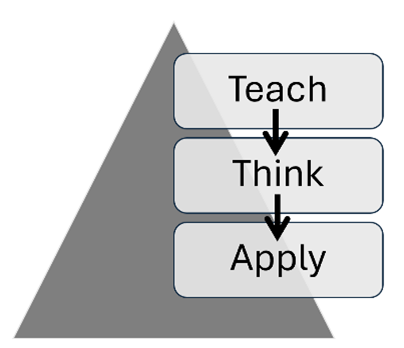
Most teachers plan for the teach and apply parts. The think step is assumed rather than scheduled.
When you intentionally build it in:
- Students retrieve from long-term memory
- They blend old and new information
- Responses become more accurate and complex
Even 5–7 seconds changes the quality of thinking (Shiau et al., 2024).
- Explain it to students
Think time works best when students understand why it is part of the routine. Use simple, transparent cues to help them honor the pause.
- Set the expectation. Let students know there will be moments when everyone needs space to think before anyone speaks.
- Maintain your classroom vibe. If your class is naturally free flowing and students rarely raise hands, you don’t have to change that. Just clarify that some questions require a brief pause before open conversation begins.
- Use a shared cue. Younger students might close their eyes while they think and open them when they’re ready. Older students may simply nod or stay still.
- Protect the thinkers. If you notice a few students still thinking, signal the class to hold their ideas. This builds awareness and respect for the process.
- Normalize the practice. Like any routine, think time becomes smoother with use. The more students understand its purpose, the more they will use the silence to prepare thoughtful contributions.
- Resequence teacher questioning
Most classrooms follow this pattern:
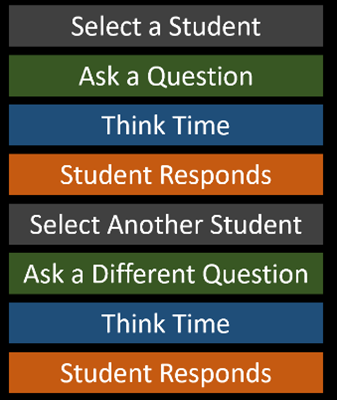
This unintentionally limits thinking to the named student and allows others to check out.
A small shift transforms the cognitive load.
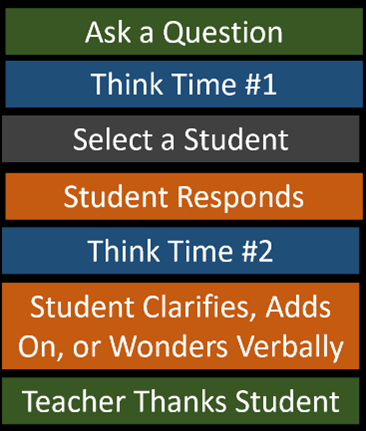
What this flip accomplishes:
- Entire class is provided think time instead of one student.
- The second think time honors student processing and deepens the student’s response.
- Students feel invited to refine ideas rather than deliver quick answers.
- Follow-up questions draw out student thinking rather than replace it.
- Teacher role shifts to activator of thinking.
- Make think time visible
Students still think independently, but externalize their ideas so they can see, reference, reflect, and adjust them as their learning progresses.
| Method | Description | Why it helps |
| Stop and Jot | Write a brief response or notes to themselves before discussion | Captures initial thinking and levels the playing field for slower processors. |
| Quick Sketch | Sketch a concept or example. | Externalizes thinking without requiring language. |
| One Person Talk | Practice their ideas quietly to themselves, mouthing or whispering them before entering the conversation. | Prepares students to share by letting them rehearse their idea and language quietly first. |
| Finish the Sentence | Silently complete a sentence stem in their minds (I think…, I notice…, I wonder…). | Gives structure to ideas and prepares students to express thinking with clarity. |
| One Idea – One Line | Write a single clear sentence. | Encourages clarity and gives them language before speaking. |
- Measure think time
Use concrete tools so think time is long enough to matter.
- Repeat your response three times Teachers process answers faster than students, which makes it easy to end think time too soon. Silently restating your own answer three times helps you hold the pause long enough for everyone to think.
- Use a visual timer: An online timer, a sand timer, or a Think Count (1–everybody think, 2–everybody think…) helps ensure you don’t overestimate or underestimate the pause.
- Take laps: Moving around the room during think time slows your instinct to jump in and allows subtle check-ins with students who may need reassurance or redirection.
Step inside
Turning silence into a strategic part of instruction takes deliberate attention. In the flow of a lesson, it’s easy to default to fast pacing or rely on quick responders. These questions help you examine the habits behind your timing and identify where intentional pauses can elevate student thinking.
- What is my perspective on how I offer think time?
- Where do I already embed think time into lessons, and how is that working?
- What causes me to rush my students? How can I mitigate that?
- When do I notice quick answers that shut down deeper thinking?
- How will I remember to honor think time when the pace of the lesson speeds up?
- Where could I add a second think time so more students enter the conversation?
- How can I access student thinking that happens silently?
Use these questions to step inside your own patterns and design silence that supports learning rather than interrupts it.
Remember this Inside Instruction truth: If we rush the silence, we rush the thinking.
References
Rowe, M.B. (1972). Wait time and rewards as instructional variables: Their influence on language, logic, and fate control. Journal of Research in Science Teaching, 11 (2), 81-94.
Rowe, M.B. (1986). Wait time: Slowing down may be a way of speeding up. Journal of Teacher Education, 37 (1), 43-50.
Walsh, J.A., & Sattes, B.D. (2017). Quality questioning: Research-based practice to engage every learner (2nd ed.). Corwin.
Shiau, A.Y.A., McWilliams, K., & Williams, S. (2024). The role of wait time during the questioning of children: A systematic review. Trauma, Violence & Abuse, 25 (5), 3441-3456.
Walsh, J.A. (2015). Using quality questioning to activate student thinking. Principal Leadership, 16 (3), 22-26.
ABOUT THE AUTHOR

Connie Hamilton
CONNIE HAMILTON is an instructional coach with years of experience as a classroom teacher and administrator. She is the author of seven books, including Hacking Questions: 11 Answers That Create a Culture of Inquiry in Your Classroom (Times 10 Publications, 2019).
Visit their website at: www.conniehamilton.org