All the best education journalism, media commentary, & newsroom changes.
In this week’s newsletter:
📌 Minneapolis and St. Paul make in-person learning optional
📌 Former education reporter Hannah Natanson has her home searched
📌 A trio of books address private, public, & home-based schooling
📌”You’re the two New York Times reporters. If you didn’t ask the question, firstly, why not? And secondly, what do you think?”
ICE-INSPIRED RETURN TO REMOTE
The big education story of the week:
The big education story of the week is the decision by Minneapolis school officials to offer remote learning options during the current ICE crackdown there (NYT, Sahan Journal, KARE 11, Star Tribune, MPR, EdWeek, The Hill).
Offering remote has previously been discussed in other places like Chicago (K12 Dive). However, potential downsides that many remember from the COVID era have kept other districts from following suit (AP). The only other district I know of that’s taken similar action so far is nearby St. Paul (Fox).
The presence of ICE has continued to hurt attendance in Minneapolis and other big-city school systems (Star Tribune, Fox News LA). In order to address attendance issues — ICE-related and otherwise — some districts are trying financial rewards for coming to school (Fox News). Meanwhile, the charter school that Renee Good’s son attends switched to remote learning over specific threats (Sahan Journal).
Other big education stories of the week include the Supreme Court hearing on transgender girls in sports (Politico, EdK-12 Dive, The 74), states’ and schools’ decisions in response to the new CDC vaccine recommendations (WHYY, Stateline, KUT Austin), and the early results from Australia’s teen social media ban (NYT, Reuters, BBC).
CA FUNDING, MASS. CHALLENGES, & HOUSTON SUPER
The best education journalism of the week:
🏆 If California has record revenue, why do school districts say they need more money?
This piece from the LAist’s Mariana Dale provides clear and easy to follow explanations for readers of the convoluted challenges in funding California’s schools, including dropping enrollment and federal uncertainty. It’s not sexy, but more reporters should take a step back and try — as this piece does — to explain the basics — including how readers can follow along with the budget process in their own school district. For another great example of service journalism read about LAist’s effort to provide a guide to schools below.
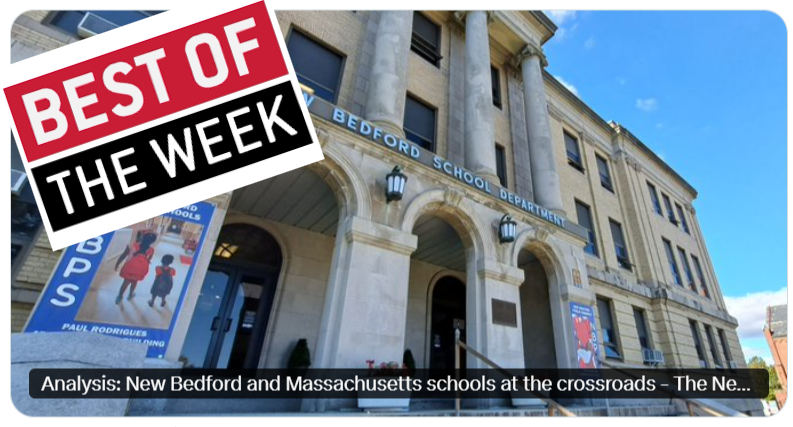
🏆 Analysis: New Bedford and Massachusetts schools at the crossroads
In a low-income school district like New Bedford, a recent increase in funding may have been necessary but not sufficient to improve academic performance, finds the New Bedford Light’s Colin Hogan. This skillful, data-driven cross of accountability and solutions journalism looks to the south for other potential policy improvements.
🏆 Exclusive: Mike Miles helped broker a nearly $1M deal for HISD-style reforms at a charter network
Sometimes an investigative piece is necessary just to raise a question — for example, why was the state-appointed superintendent of the largest school district in Texas helping to negotiate (apparently pro-bono) a deal between a charter network and a consulting firm? No one seems to have a clear answer, but this piece from the Houston Chronicle’s Nusaiba Mizan provides a lucid explanation of the stakes. See also: Mike Miles’ HISD takeover has major wins — and 1 fatal flaw.
Other stories we liked this week include Nearly $100 million gone. How Austin ISD spent bond money on schools it will soon close (Austin Current), Why Colorado’s governor says Democrats should embrace the GOP’s ‘free money’ (Politico), High school students fix up cars, then hand the keys to single mothers (Washington Post), and How Mississippi Transformed Its Schools From Worst to Best (New York Times). We also liked the Substack post Schools are getting worse in most red states from Matthew Yglesias.
INADEQUATE EDUCATION, DESPERATE PARENTS,UNREGULATED SCHOOLS, & CREDULOUS NEWS
What happens when you combine inadequate public education, parents desperate for their kids to succeed, entirely unregulated private schools — and credulous news outlets desperate for a feel-good story?
At least some of the time, the result is fraudulent academics and — eventually — scandal. That’s the story that the New York Times’ Katie Benner and Erica L. Green detail in their new book, MIRACLE CHILDREN, which is out this week.
In a new podcast, Benner describes how well the students did in college despite their poor treatment by the school and in the news. She also describes the necessary discomfort that journalists have to experience in order to do their jobs:
“If something looks too good to be true, it probably is,” says Benner. “And it’s okay to explore what’s really happening — no matter how the facade of a story makes you feel.”
(I’m hoping to talk with Green about her insights later today or over the weekend.)
PEOPLE, EVENTS, & MORE
📰 People: On Wednesday, the FBI raided the home of Washington Post reporter Hannah Natanson, whom readers of this newsletter may remember from her prior work covering education (including working on a Peabody-winning podcast about gun violence in schools). More recently, Natanson produced a first-person account of what it’s been like speaking to hundreds of federal workers during the massive downsizing of the federal workforce. Washington Post Executive Editor Matt Murray said the search was an “extraordinary, aggressive action.”
For a year, Washington Post reporter Casey Parks followed one of the transgender students whose participation in girls’ sports was debated by the Supreme Court this week. The resulting profile came out a few weeks ago and KUOW radio spoke with Parks and the student for two hours about the experience. A recent Miranda Dunlap story about the successes and challenges of an Appleton skilled trades program gets some well-deserved time in the spotlight.
In a creative public experiment, LAist reporter Mariana Dale and education editor Ross Brenneman have distributed 7,200 printed guides to help parents choose a school. (Other service journalism we noticed include Pittsburgh’s Public Source and WBEZ Chicago on ways to avoid garnishment for late student loan repayments, the Washington Post on how to know when kids are too sick for school, and Ballotpedia’s Hall Pass on upcoming school board races.)
📰 Events: Chalkbeat reporters Erica Meltzer and Matt Barnum spoke with the Department of Education’s Lindsey Burke about the future of education who promised special education will remain protected. EduCon Philadelphia is starting Jan. 30 at The Science Leadership Academy. Yesterday I spoke with Contrarian Boston about the challenges of Massachusetts schools.
📰 Jobs: The Arkansas Democrat-Gazette is hiring a public education reporter in Little Rock. The Daily Courier is hiring an education solutions reporter in Prescott Valley, Arizona. Eight months later, the Boston Globe is still hiring an editor for the Great Divide education team? The end of the Pittsburgh Post-Gazette strike in November meant union president and education reporter Andrew Goldstein is back on the job — at least until May, when the paper is scheduled to shutter.
BOOKS, NUMBERS, & JUICY QUOTES
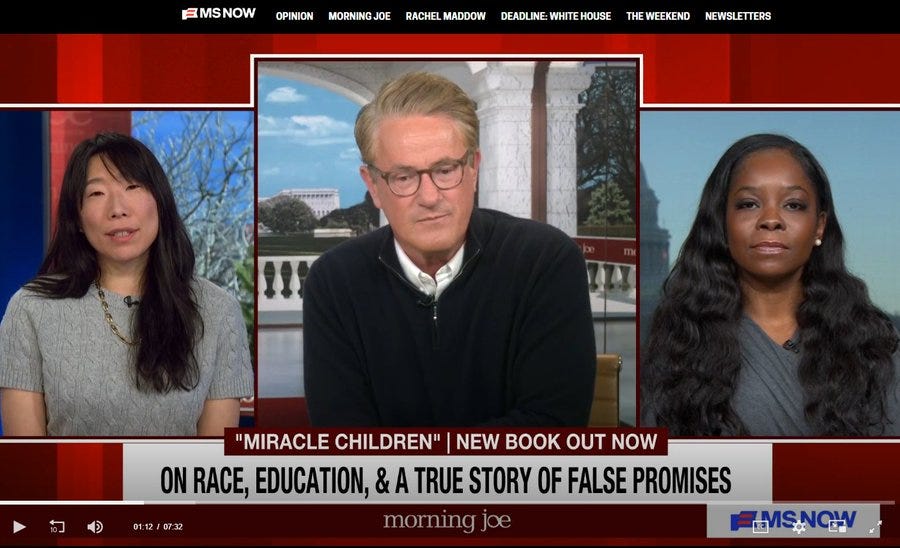
Above: Benner (left) and Green (right) on Morning Joe.
📰 Books & appearances: MIRACLE CHILDREN, the new book from New York Times’ Katie Benner and Erica L. Green came out this week. Benner and Green launched the book in Manhattan, appeared on MS Now’s Morning Joe cable show, and embarked on a book tour up and down the East Coast. The book was also reviewed in the New York Times.
Meanwhile, James Traub’s THE CRADLE OF CITIZENSHIP was also reviewed in the New York Times. Traub wrote about his defense of classical education in the Wall Street Journal and spoke about what he found on Keen On America podcast.
Last but not least, Stefan Merrill Block’s new memoir HOMESCHOOLED is out and is the subject of a recent Atlantic article about the perils of unregulated homeschooling. (The Times and Post have also published stories about the book in recent weeks.)
📰 Numbers: The last decade has been rough on reading scores across the NAEP. But each state has a few places that are beating the odds in some ways — see them here. College enrollment hit its highest point this decade, and community colleges led the way. Meanwhile enrollment dropped in K-12 schools in Massachusetts and Colorado. Schools are about $90 billion behind on capital and maintenance spending, per a new report. Alex Tabarrok in Marginal Revolution argues that Office of Civil Rights complaint numbers are being skewed by a few persistent petitioners.
📰 Quotes
“The biggest obstacle to restoring American journalism’s reputation for reporting the facts without fear or favor is that there’s minimal appetite for it.”
“The answer to America’s educational challenges will be found in Hattiesburg, Mississippi, not Harvard, Massachusetts.”
“You’re the two New York Times reporters. If you didn’t ask the question, firstly, why not? And secondly, what do you think?”
“Interviewed a state education official from a red state today who would not use the phrase ‘phone ban’ but preferred saying they support the “freedom to focus” in schools.”
KICKER
Always save the best for last.

“More than 100 high school students in North Carolina are competing in a masonry competition, and they’re absolutely nailing it.”