🏆 Best Education Journalism of the Week 🏆 (10/03/2025)
In this week’s newsletter:
📌 Shutdown sends shivers, but targeted cuts are the real worry.
📌 Blue states (and journalists) have been slow on literacy, says liberal journalist.
📌 A Des Moines superintendent’s arrest raises questions about oversight.
📌Chalkbeat layoffs? The rumors are true.
SHUTDOWN HEADLINES DESPITE MINIMAL IMPACTS
The big education story of the week:
The big education story of the week is the federal government shutdown, which prompted numerous outlets to provide “what does this mean for you?” stories (K-12 Dive, Politico, The Hill, AP, EdSource, Milwaukee Journal Sentinel, Denver Post).
However, not much is going to change for K12 schools in the near future, with the exception of schools with a lot of tax-exempt federal land. The most direct federal threat are targeted cuts to districts and programs that fall afoul of Trump administration policy goals, including those that assist multilingual students, provide teacher training, or host Latino leadership courses (The 74, Milwaukee Journal Sentinel, Miami Herald). The recently announced proposed $100,000 fee on H1B visa applications may drop the number of teachers available for rural schools (Chalkbeat, EdWeek, Colorado Public Radio).
Other big education stories of the week include successful cellphone bans (WHYY, NBC6, Union Democrat, SF Standard), the arrest and resignation of a Des Moines superintendent (New York Times, Wall Street Journal, Iowa Public Radio, AP), and PEN America’s annual report on banned books (NPR, AP, Time, USA TODAY).
BEST STORIES OF THE WEEK
The best education journalism of the week:
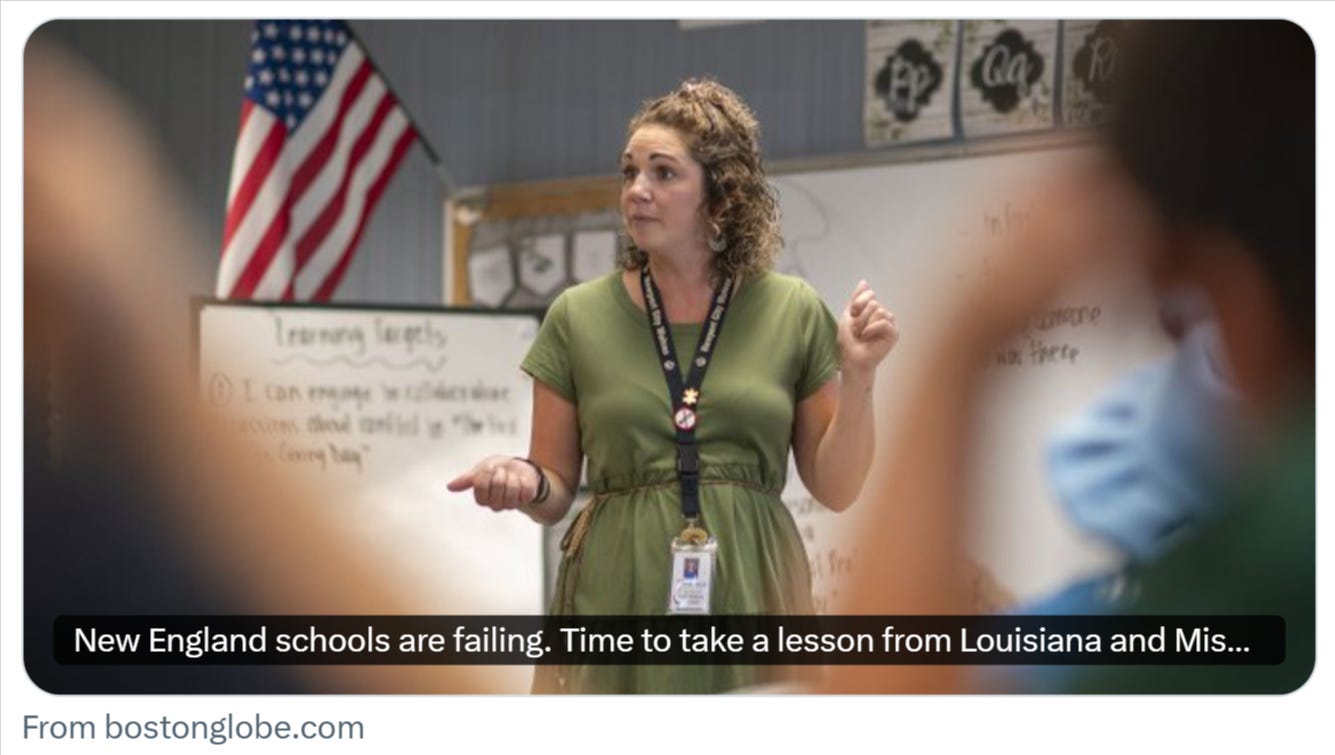
🏆 New England schools are failing — and ‘nobody seems to care’ is unafraid to ask why Southern states long known for terrible education outcomes are outperforming New England states in reading. Part of the answer is New England’s patchy adoption of educational reforms, particularly phonics for reading. This careful exploration may bring broader awareness to Northern states about what’s going right below the Mason-Dixon. (Christopher Huffaker / Boston Globe Magazine)
🏆 School systems are remaking the old yellow bus into a high-tech machine and School ride-hailing services may be nudging aside traditional buses are two stories about the future of school transportation that highlight the importance of rethinking the critical issue of getting kids to and from school. It’s good to see coverage of innovation in one of the most mundane but essential aspects of the American school system. (Kevin Hardy, Robbie Sequeira / Stateline)
🏆 Minuscule test score gains signal Oregon faces years of digging out from its post-pandemic academic hole provides a lucid explanation of the technical test data behind Oregon’s dragging scores and bright spots including Portland Public Schools. It also includes a useful caution about when testing data is unreliable given the state’s broad exemptions for exams. (Julia Silverman / The Oregonian/OregonLive)
Thanks for reading Alexander Russo’s The Grade, where we take a closer look at education news. Subscribe for free to receive new posts and support my work!
MOVING TO MISSISSIPPI, BLUE-STATE PARENTS?
The latest from The Grade
In this week’s new interview, The Argument’s Kelsey Piper talks about her recent story on blue-state reluctance to adopt structured literacy — and about the media’s failure to produce the kind of saturation coverage that has accompanied past success stories.
“I think a lot of people feel reluctant to write a story that makes the side they’re sympathetic to look bad,” says Piper during the half-hour conversation. And it’s hard for many people to grasp that things may have changed so dramatically in a state long known for inadequate education as Mississippi. “They think of it as like somewhere else.”
The state’s latest scores will doubtless be a source of much discussion in the coming weeks and months.
Other stories that we produced this week include ‘At this point, everyone’s a journalist, right?’, about one parent’s turn towards right-leaning outlets and social media in response to mainstream media indifference, and A defense of ‘Abbott Elementary’, a popular TV show which has been criticized for its upbeat approach.
Coming soon: I had a great conversation with Louisville Courier Journal education reporter Krista Johnson about her recent series on Louisville’s recent efforts to relieve Black parents from the effects of forced busing. Bellwether’s Nora Weber filled me in on how their recent report on education coverage came together — and why AP and ProPublica weren’t included.
PEOPLE, EVENTS, & MORE
📰 Layoffs: Chalkbeat managers finally confirmed the gist of what I’d started hearing last week about the layoff three staff members — a bureau chief, an editor, and a top manager: “We made some changes to our management and editing structure at Chalkbeat that preserve our reporting capacity, which created some needed cost savings,” wrote Chalkbeat’s Sarah Darville in an emailed statement that doesn’t entirely make sense. “We will miss those colleagues, and feel good about our ability to serve our communities going forward. We know what a challenging time this is for so many nonprofits and media companies, and we feel really fortunate to have robust support for our work.”
📰 Comings & goings: Speaking of Chalkbeat, a former Chalkbeat reporter, Colorado’s Yesenia Robles, tells me she was laid off in April and, after a brief stint at Colorado Public Radio, is now starting a PR job at Red Rocks Community College. Meanwhile, Chicago-based national education reporter Kalyn Belsha has been named as the new education editor at WBEZ, Chicago’s public radio station. Kate Grossman is the assistant managing editor overseeing education and other beats. Word is that Chalkbeat will fill Belsha’s spot. The Lexington Herald-Leader’s Monica Kast is now splitting her time between editing and statewide education coverage — and the paper is hiring to replace her. She’s not a traditional reporter, but you should follow Laura Powell for speedy coverage of the Des Moines superintendent story.
📰 Segments and podcasts: The NYT’s Natasha Singer was on The Daily to talk about kids, coding, and the lack of jobs coders are currently facing. USA TODAY’s Congress reporter Zach Schermele did some on-camera work talking about the shutdown. The folks at Fordham had Harper’s magazine cover story writer Chandler Fritz on their show to talk about what he saw teaching in an ESA-funded micro-school. Freelance reporter Matt Drange appeared on a well-attended webinar talking about his coverage of school sexual misconduct. Former education reporter Tom Toch and others discussed the new federal education tax credit via FutureEd.
📰 Events: Coming next week is IRE’s AccessFest 2025, an online event to foster “belonging, equity and inclusion in the journalism space – both within the newsroom and in news coverage.” Delece Smith-Barrow will be hosting a webinar on Oct. 27 about how the Knight-Wallace Fellowship “enriched my career and led me to my first k-pop concert in Seoul, among other adventures.”’
📰 Research and reports:
The 74’s Chad Aldeman reports that about one-third of schools at the top and bottom of rankings move toward the middle after 5 years — and about half shift after a decade.
The folks at Bellwether produced a depressing report showing how drama-laden topics like school shootings and political controversies have come to dominate education coverage.
A Nieman Lab report on pageviews versus impact features efforts by Open Campus to refine its impact measurement system.
📰 Quotes:
“The first state to combine the Mississippi education reforms with blue-state per pupil funding levels is going to create super children.”
“Public education is the goal — not the system.”
“I don’t think I did enough [to get schools back open].”
“Ride the train, send your kids to public school. It’s the only way.”
“The odds are very, very strong that eventually it’ll turn out that students in Mississippi & other ‘miraculous’ systems are being improperly offloaded from the books… That’s how educational miracles are manufactured.”
KICKER
Always save the best for last.

“I’m in my second year at Harvard, and it still surprises me how many people express confusion about how anyone could vote for Trump.”