
Research shows that teenagers are ready for big, abstract ideas about themselves and the world.
At a Glance
- Transcendent thinking is the capacity to deliberate on the abstract, systems-level, ethical, and personal implications of things people learn.
- Teens’ growing disposition to engage in transcendent thinking is particularly powerful for promoting learning now and as they grow.
- Brain scans of teenagers who engaged in more transcendent thinking showed that they went on to experience more growth in networks of the brain associated with executive functioning, internal reflection, and emotion, irrespective of IQ and SES.
- Growth in these brain networks in turn predicted identity development in late adolescence and life satisfaction as teens entered early adulthood.
- Teaching that spurs transcendent thinking could support youths’ deep scholarly learning and social-emotional development.
Los Angeles-area teenager Isela is participating in a private interview in our laboratory. Isela has just watched a short video of Malala Yousafzai at age 12, being interviewed with her father about her determination to continue her education despite Pakistan’s Taliban having forbidden it.
I ask Isela how the story makes her feel, to which she responds: “Um, this story makes me feel upset, how she wants to be a doctor and continue on with her education, but it makes her sad … knowing her journey would be very difficult.”
I nod, and after pausing for a few moments, Isela goes on: “And it’s crazy how it’s that powerful … I mean … it makes me think about my own journey in education, and how I want to go to college and hopefully be a scientist someday. And even more, I guess what really hits me is how not everyone is able to get this chance, to go forward with their life and get an education or do what they want to do with their life. I mean, it’s not right.”
Again, Isela stops to think. Her gaze wanders from the image of Malala on the computer screen in front of her to the tree outside the window beside my desk.
Then she turns back to me and continues: “Ah, I guess when I think more, yeah, it makes me feel upset that, um, others live in like certain parts of the world where they don’t want people to learn and they are trying to, like, hold them back, but then, uh, her story like inspires me to, like uh, work harder so that, uh, I can prevent those things from happening maybe. Everyone everywhere should have the chance … I mean, all human beings should be able to live free and choose their life future.”
As Isela first reacts empathically to the concrete details of Malala’s situation and then moves beyond these details to consider the “powerful” personal and ethical implications of the story, she reveals an important developmental milestone long associated with adolescence — the expanding capacity and motivation to engage in what we are calling transcendent thinking.
What is transcendent thinking?
Complex, reflective, and often deeply emotional and personal, transcendent thinking enables teens to use their emerging abilities to think abstractly as they begin to question who they and others are and what they believe in and stand for. They want to hash out not simply what is, but what could or should be. By asking why things work the way they do — and says who? and how come? — teens work to construct meaningful, generative, and emotionally invested narratives about themselves and the world. These narratives become the stuff of values, identity, and purpose, all part of a quest for deep understanding and a healthy transition to young adulthood.
At the University of Southern California’s Center for Affective Neuroscience, Development, Learning and Education (CANDLE), we are studying the neural and psychological processes involved in adolescents’ transcendent thinking and their effects on development and learning both in and out of school. Our work suggests that transcendent thinking involves coordinating different brain networks: those involved in effortful, focused thinking and those involved in internal reflection and free-form thinking. This happens under conditions of strong emotional engagement.
During transcendent thinking, some of the brain’s largest networks activate and deactivate in complex, dynamic patterns. Probably because of the neural work involved, transcendent thinking appears to grow the connections between these networks over time. This brain growth in turn predicts life satisfaction, achievement, and relationships in young adulthood. Our work sheds light on why and how young people can be among society’s most visionary, idealistic, and motivated citizens or some of its most self-absorbed. And it gives insights into how parents, schools, and community institutions can best support and empower them.
A special developmental period
For many years, it was thought that adolescents’ brains were not fully functional — akin to less experienced, less knowledgeable, and relatively emotionally unstable versions of adult brains. The process of becoming a mature adult, then, would involve amassing knowledge and skills and developing executive functions and self-control that would enable more “responsible” and dispassionate decision-making, curb teens’ reputed appetite for risk-taking, and help teens regulate their strong emotions.
New neuroimaging advances over the past several years have changed this picture, however. We now know that the hormonal changes associated with puberty launch a critical period of brain plasticity in which the brain is reorganizing itself based on experiences. Adolescence is a period of intense maturation and consolidation of the myriad connections and fiber tracts that allow brain systems to efficiently and appropriately “talk” to one another, co-regulate, and coordinate. Although adolescents’ brains have reached the overall size of adult brains, adolescents undergo subtle but extensive developmental changes in their brain networks. We’re still learning about these changes to brain networks, but it is clear that they relate to a critical period of cognitive, social, and emotional growth and have important lifetime implications for mental health and intelligence.
An expanding movement over the past decade has sought to understand how adolescents’ brain networks develop, and especially to understand the reasons for variation in brain development across individuals. At CANDLE, we are particularly interested in the role of adolescents’ developing dispositions of mind — their curiosity and willingness to consider multiple perspectives, big ideas, and broad implications.
The brain is in some ways like a muscle: How and how much you use it influences how it grows. If teens develop dispositions to think transcendently, we reason, they could potentially strengthen their brain network development by changing what they are inclined to think about day to day. When they see the news of migrants at the U.S. southern border, do they question how and why our immigration system works as it does? When they help their families shop for groceries, do they wonder what “organic” means and try to learn more about the intentions and impacts of this designation?
We set out to interview teens to figure out how they may leverage their strong emotions and social sensitivities in service of transcendent thinking. We aimed to test whether we could predict their future brain development based on this information.
The neural and psychological work of adolescence
Classic work in developmental psychology from the mid-to-late 20th century characterized adolescence in terms of newly emerging capacities for systems-level and abstract thinking. Together with teens’ social sensitivities and propensities for strong emotion, these new capacities enable what we call transcendence. The hallmark of such thinking is the ability to understand situations and information not simply in terms of their direct relevance to the current situation or topic, but to also integrate ideas across situations and topics. By making these connections, they come up with broader, generalizable principles or hidden personal lessons, and come to ask those difficult, curious questions about “why” and “how” and “how come?” and “who says?”.
Adolescents seem almost compelled to look for connections and deeper meanings. When they find them, their narratives and feelings are rich with ethical deliberations, inspiration, and strong personal conviction to better themselves so they can address injustices. Consider Isela’s reflections on the situation facing an ambitious girl in Taliban-controlled Pakistan. Isela’s narrative ranges far beyond her empathic, concrete reaction to Malala’s situation. She considers her own dreams and future, resolves to work harder so she can make the world better, and closes with an impassioned realization that “everyone, everywhere” should have the opportunity to “choose their life future.”
In previous studies, we showed that thinking about situations, issues, and oneself in a transcendent way, as Isela has done here, uses many brain systems in both teenagers and adults (Gotlieb, Yang, & Immordino-Yang, 2022). Among these systems are three major networks whose coordination is important for many aspects of psychological functioning: the executive control network, the default mode network, and the salience network (see figure 1).
Figure 1. Three major networks that contribute to transcendent thinking
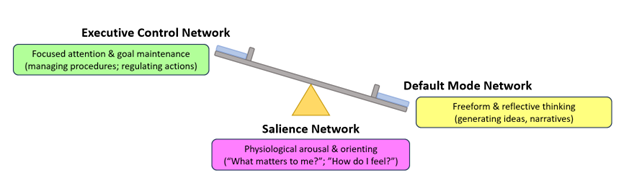
Processes associated with the executive control network and the default mode network trade off in a coordinated way, depending on what aspects of the situation are relevant to the individual—what seems emotionally important to them.
Source: Immordino-Yang, M. H., Kundrak, C., Knecht, D., & Matthews, J. (2024). Civic reasoning depends on transcendent thinking: Implications of adolescent brain development for SEL. Social and Emotional Learning: Research, Practice, and Policy, 4, 100067.
- The executive control network is involved in managing focused and goal-directed thinking and action; it keeps the thinker on task and attentive.
- The default mode network, which activates when you are relaxed and free to think, is engaged during all kinds of open-ended reflections that transcend the concrete and the “here and now.” These include recalling personal experiences; imagining the future; understanding how complex calculations, concepts, and systems work; appreciating stories; and even when just daydreaming or thinking creatively, outside the box. The default mode network is important for morality, identity, and for feeling social emotions that pertain to hidden qualities of mind and character, such as compassion, gratitude, and admiration for virtue. The default mode network trades off with the executive control network — the two are generally not active at the same time.
- The salience network is made up of regions that sense internal body states and contribute to managing physiological arousal. These brain regions tell you when you have a stomachache or that your heart is pounding, or they make you feel a jolt when you notice something you care about, like that a favorite song is playing or that you have made an error. The salience network weighs the relevance of information to facilitate further thinking (or not) and steers attention to what matters. Among the neural regions of the salience network are centrally connected network hubs, like city centers of the brain, that facilitate the toggling of other brain networks’ activity up and down. Think of this network as fueling motivation, and as driving thinking about the things that feel most important and compelling.
Figure 2 shows the regions and networks in the brain that were more active when individuals engaged in emotionally engaged transcendent thinking during fMRI brain scans.
Figure 2. Brain regions and networks involved in transcendent thinking.
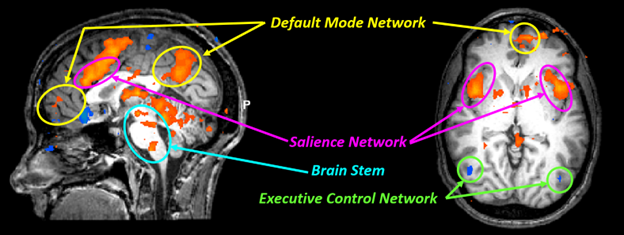
The brain-stem activity shown here (circled in turquoise) is associated with deep emotional engagement. It is notable that these regions were involved, as they are essential for consciousness and for regulating life processes like breathing and heartrate.
Source: Data are from Immordino-Yang, M.H., McColl, A., Damasio, H., & Damasio, A. (2009). Neural correlates of admiration and compassion. Proceedings of the National Academy of Sciences, 106 (19), 8021-8026.
A long-term brain development study
In our newly published five-year study, we privately interviewed 65 high school students ages 14 to 18 about 40 true stories of other teens from around the world, and asked the students, like Isela, to explain how each story made them feel (Gotlieb, Yang, & Immordino-Yang, 2024). The students then underwent fMRI brain scans that day and again two years later. We followed up with the participants twice over the next three years, as they moved into their early 20s.
The participating students were recruited from public high schools serving diverse, low-socioeconomic-status urban communities. We chose to study these specific youth because of the likelihood that they will face complex circumstances and social challenges. In addition, given their life experiences, we reasoned that these participants may have been uniquely positioned to notice the complexities of social environments.
All teens in the experiment talked at least some about the bigger picture — what lessons they took from a particularly poignant story or how a story may have emotionally moved them and changed their perspective on something. This indicated that all the participating teens could think transcendently. But some did it far more than others, and this made all the difference over time.
Brain growth over time
The more a teen grappled with the bigger picture and tried to learn bigger lessons from the stories, the more that teen would go on to grow their brain over the next two years. This brain growth — how a teen’s brain compared to their own brain two years earlier — predicted important developmental milestones.
In the later teen years, this brain growth predicted identity development, measured as the degree to which a teen reported that they think about who they are, what they stand for, and what kind of adult they would like to become. Conversely, transcendent thinking was negatively associated with a teen saying that they “just hang with the crowd” and “rarely try things on their own.” These are considered measures of identity “diffusion,” when a young person does not have a strong sense of self.
As young adults in their early 20s, about five years after their first interview and brain scan, youths with greater identity development reported greater life satisfaction and achievement. For example, they said they liked more the “person that they had become.”
Increased coordination in the brain
We collected several different kinds of brain data, and all of them show consistent effects. For instance, during both lab visits, we asked each teen to rest in the scanner for about 10 minutes while we captured data that would allow us to understand the resting functional connectivity or “cross talk” among their brain networks. We found that more transcendent thinking in the interview predicted a greater increase in coordination between the Executive Control and the Default Mode networks, suggesting that the “work” of transcendent thinking over time may have caused these two networks to communicate more efficiently, even when the teen was just relaxing.
We also conducted specialized neuroimaging, called diffusion tensor imaging, that allowed us to measure changes to the brain’s white matter fiber tracts, akin to the “wiring” that enables communication within and across brain networks. We found that more transcendent thinking predicted greater increases in the robustness of these fiber tracts.
Finally, we conducted high-definition structural scans of each teen’s brain, akin to three-dimensional images of their brain’s tissues. We found that in many key regions of the brain, particularly regions that serve as network hubs, more transcendent thinking in the interview counteracted the age-related thinning of the cerebral cortex over time. In about half of the teens, transcendent thinking even predicted increases in cortical volume.
For an analogy, if we were to think of the brain like a country, the resting functional connectivity analysis would be like a measure of how much travel there is between cities; the diffusion tensor imaging analysis would be like a measure of the quality of the roads; and the cerebral cortical thickness analysis would be like a measure of the size and quality of each city’s infrastructure. Put these measures all together, and we get a consistent picture of beneficial changes over time in teens who were doing more transcendent thinking.
Importantly, our findings were not explained by the teens’ IQs, their families’ financial means, or their parents’ education levels. They did not differ by gender or ethnic group. And, interestingly, transcendent thinking only predicted young adult outcomes if the teen showed intermediate brain growth and identity development. We could not predict young adult outcomes directly from teens’ transcendent thinking five years before.
What does this mean for our teens?
Together, these findings strengthened our confidence that our study reveals something quite profound: that a teen’s proclivity to expend effort on deep thinking and meaning-making may itself be a source of variation in brain development, and specifically in a kind of brain development that supports well-being. Ultimately, we believe that transcendent thinking may be to the adolescent mind and brain what exercise is to the body: Most people can exercise, but only those who do will reap the benefits.
To be clear, we do not think that participating in our interview changed teens’ brain development. Instead, we think that teens who showed more transcendent thinking in our interview were going about their daily lives with more curiosity and thoughtfulness, using their strong emotions to propel their deeper thinking.
Our study underscores the important role teens play in their own brain development through the meaning they make of the social world. This suggests that we need to attend more to how teens think and feel, and not simply to what they know (Immordino-Yang, et al., 2024).
Schools for transcendent thinking
Teens are hungry to think transcendently — to sink their teeth into complex, interesting content that invites them to explore big, emotionally powerful ideas. Innovative secondary school designs and developmentally oriented teaching practices engage students in choosing and pursuing open-ended, project-based coursework. These designs and teaching practices then leverage student interest to broaden exposure to new knowledge, concepts, skills, and questions. Such schools expect and support their students to make sense of all that they are discovering through writing, problem-solving, dialogue, and reflection. They support students working hard on mastering strong academic skills, but students feel they are working hard to satisfy their understanding, express themselves, or improve the world, rather than simply to pass a test.
We can see this model at work in the New York Performance Standards Consortium (www.performanceassessment.org), a group of public secondary schools that organize their curriculum around performance-based assessments, rather than around high-stakes standardized tests. Classes culminate in presentations and defenses of extended projects in front of panels of teachers, external evaluators, and other students. This kind of approach creates the conditions for adolescents to connect their emotional selves to their burgeoning intellect.
This approach is specifically designed to help students recognize the importance of academic issues and problems (think: salience network). It then helps students leverage this momentum to cycle between a tight focus on building-block skills and information (think: executive control network) and effortful, empowering, and often inspiring transcendent reflections that connect the work to big ideas relevant to systems and processes in the world (think: coordinated connectivity between the executive control and the default mode networks).
Transcendent thinking for mental health
Our findings also align with research in mental health. Recent clinical research has shown that the same brain networks involved in our study predict adolescents’ mental health vulnerabilities during the COVID-19 pandemic (Stamoulis, 2024), for example.
In the same vein, we asked our teen participants in an additional study to report any crime or community violence they had witnessed or heard about and then interviewed them about their understanding of the causes and possible solutions of such community problems (Yang et al., 2024). Exposure to violence among the teens was associated with thinning in the anterior middle cingulate cortex (ACC), a key region in the salience network involved in pain processing, motivation, and learning. This is consistent with brain studies of soldiers deployed to war and individuals suffering from post-traumatic stress disorder (Butler et al., 2018).
However, we also found a protective effect among teens who reflected more on the broader historical, cultural, or social context of the crimes they had witnessed, rather than simply blaming the individuals’ bad behavior in that moment. In other words, teens who thought more transcendently about this civic issue showed less thinning in the ACC (Yang et al., 2024).
Thinking that matters
What does this mean for society? Our schools tend to be preoccupied with what kids know and can do, and parents focus on helping their students succeed in this outcome-oriented system. It is true that teens need rich, relevant content to learn about and that students’ hard work in school will be important for their future opportunities.
But our studies add to a growing body of research suggesting that how teens think and feel — their developing dispositions of mind and heart —should be our ultimate focus. What good is it to know algebra, for example, if you have no inclination to use it when making financial decisions? What use is knowing about the U.S. Civil War if you have no capacity to think deeply about the ethics and motivations behind that conflict and how that history shaped our modern landscape, values, and institutions? Why learn science if you cannot use that approach to decipher fake from evidence-based recommendations during the next pandemic? Infusing support for transcendent thinking into academic teaching could have powerful impacts on what and how teens learn and think, now and throughout their lives.
In transcendent thinking, teens rally their knowledge and skills, and their strong capacities for emotion and social meaning-making, to dive deeply into the values, beliefs, and intentions that imbue their worlds with meaning. They struggle to make sense of the complex inner workings of the natural and social systems that govern our society and planet. For a while, they let go of appearances and actions and instrumental tasks and they settle into a mental space where they are safe to explore ideas and deeper questions. In the process, they build purpose and identity. In that space, they invent possible worlds and selves; grapple with possible alternatives and perspectives; and conjure the understandings, ethics, and narratives that will carry them, and us, forward.
References
Butler, O., Yang, X.F., Laube, C., Kühn, S., & Immordino‐Yang, M.H. (2018). Community violence exposure correlates with smaller gray matter volume and lower IQ in urban adolescents. Human Brain Mapping, 39 (5), 2088-2097.
Gotlieb, R.J., Yang, X.F., & Immordino-Yang, M.H. (2024). Diverse adolescents’ transcendent thinking predicts young adult psychosocial outcomes via brain network development. Scientific Reports, 14 (1), 6254.
Gotlieb, R., Yang, X.F., & Immordino-Yang, M.H. (2022). Default and executive networks’ roles in diverse adolescents’ emotionally engaged construals of complex social issues. Social Cognitive and Affective Neuroscience, 17 (4), 421-429.
Immordino-Yang, M.H., Kundrak, C., Knecht, D., & Matthews, J. (2024). Civic reasoning depends on transcendent thinking: Implications of adolescent brain development for SEL. Social and Emotional Learning: Research, Practice, and Policy, 4, 100067.
Immordino-Yang, M.H., Nasir, N., Cantor, P., & Yoshikawa, H. (2023). Weaving a colorful cloth: Centering education on humans’ emergent developmental potentials. Review of Research in Education, 47 (1), 1-45.
Immordino-Yang, M.H., McColl, A., Damasio, H., & Damasio, A. (2009). Neural correlates of admiration and compassion. Proceedings of the National Academy of Sciences, 106 (19), 8021-8026.
Stamoulis, C. (2024). Underdeveloped vulnerable brain circuits and their mental health correlates predict adolescent emotional and stress responses during the COVID-19 pandemic. Journal of Adolescent Health, 74 (3), S93.
Yang, X.F., Hilliard, K., Gotlieb, R., & Immordino‐Yang, M.H. (2024). Transcendent thinking counteracts longitudinal effects of mid‐adolescent exposure to community violence in the anterior cingulate cortex. Journal of Research on Adolescence, 35 (1), e12993.
This article appears in the Summer 2025 issue of Kappan, Vol. 106, No. 7-8, pp. 48-54.

ABOUT THE AUTHOR

Mary Helen Immordino-Yang
Mary Helen Immordino-Yang is the Fahmy and Donna Attallah Professor of Humanistic Psychology; professor of education, psychology, and neuroscience; and director of the USC Center for Affective Neuroscience, Development, Learning, and Education at the University of Southern California in Los Angeles.