A new book explores how academic, scientific, and journalistic communities failed to assess tradeoffs and became narrowly focused on epidemiology.
By Alexander Russo
Budget cuts! Layoffs! DEI rollbacks!
Recent weeks have shown how easy it is for education journalists to focus on Trump-related news.
So it’s something of a miracle that the complicated and uncomfortable topic of America’s questionable COVID response has not gone entirely unnoticed on the fifth anniversary of the pandemic’s arrival.
Many of the pieces I’ve seen have been superficial “remembering what happened” stories, but a few have attempted to reassess past responses and glean lessons for the future. (And The Grade’s month-long series revisiting COVID coverage has so far included reporter self-reflections and a first-person essay about the toxic long-term effects of now-questionable school shutdowns.)
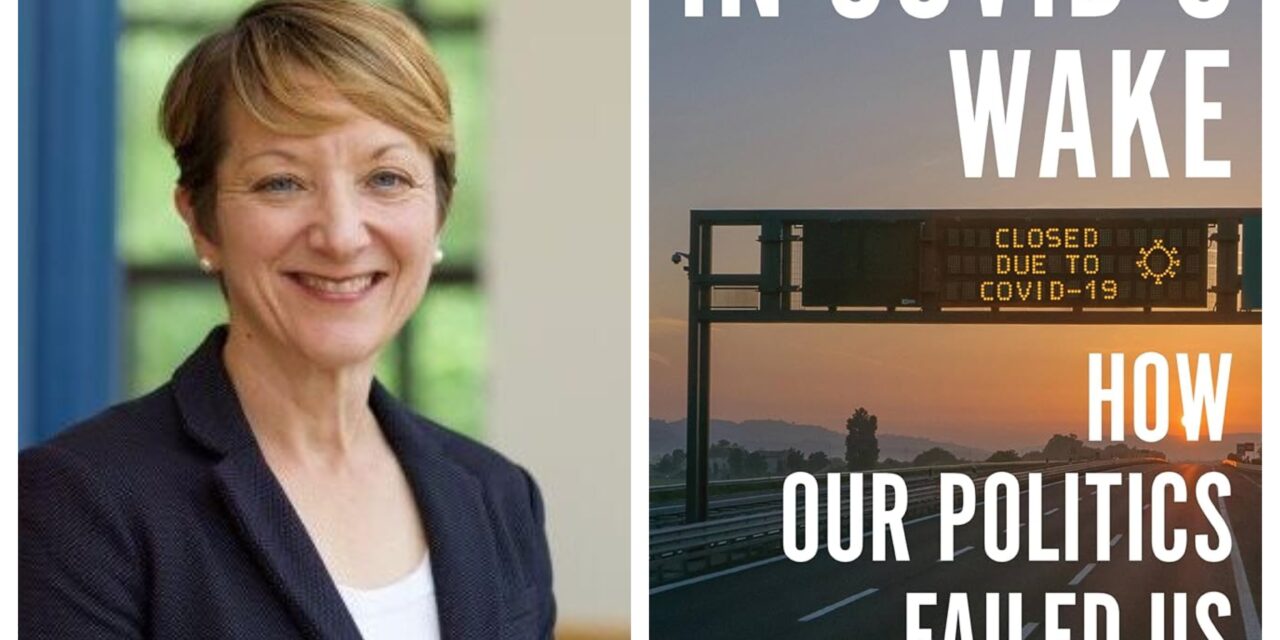
Enormously helpful to a deeper consideration of the nation’s COVID response has been In Covid’s Wake: How Our Politics Failed Us, a new book from Princeton University Press by Frances Lee and Stephen Machado that’s been featured in recent pieces from the Undark, Public Discourse, and the BostonGlobe.
In the interview below, co-author Lee explains that journalism’s failure to question, compare, and explore disagreements and trade-offs was part of a larger collapse that also affected the academic and scientific communities.
Mainstream news focused on short-term epidemiological concerns and failed to make ongoing use of regional and international comparisons.
Thoughtful discussion of effectiveness and tradeoffs was most often found in alternative media.
Most troubling of all, the meaning of “public health” was narrowed down to infection prevention rather than societal well-being.
The meaning of “public health” was narrowed down to infection prevention rather than societal well-being.
Conducted by phone and online, this interview has been edited for clarity and length.
Alexander Russo: What’s been your overall experience in the past with being covered by the media?
Frances Lee: Sometimes there are occasions when it’s clear that the journalist is calling for a particular perspective, and I’m not always in a position to provide it. So I suppose I feel like sometimes I get leading questions from journalists. But I haven’t run into circumstances where I felt that my views had not been accurately portrayed.
Russo: What’s your experience over the last couple of weeks since the book came out?
Lee: I’ve been very happy. I was expecting a more hostile reception than we’ve received thus far, in that the book is pretty critical of the policies adopted during the pandemic, the effects that they had on society, and the failure to consider the costs at the time the decisions were made. So we expected a fair bit of blowback. But instead, it feels like we are pushing on an open door and that there is a willingness to look back and take stock of what was done well and what was not done well.
Russo: What methods did you use to reach your conclusions about the media’s role?
Lee: The book doesn’t do formal content analysis or conduct a quantitative study of media coverage. In reconstructing our narrative history, we attended closely to media coverage of the pandemic and policy choices around it as published in major national newspapers and newsmagazines. In looking at whether and when journalists considered tradeoffs involved with pandemic policy, we looked at transcripts of White House Coronavirus Task Force press conferences and examined the questions journalists were asking. Did they ask officials about collateral effects of school closures, etc.?
“We expected a fair bit of blowback. But instead, it feels like we are pushing on an open door.”
Russo: For people who haven’t read the book, what’s the gist of what you found about the media’s role during the pandemic?
Lee: A central question of the book is the role of what we call the “truth-seeking department” of a liberal democracy and how well they perform. We see journalists as one part, academics as another, and science agencies as a third. And we ask, ‘How well did they perform? Did they question those in power? Did they push a narrative? To what degree were they open to competing points of view?’ The book is about the policy process around the pandemic response, with particular attention to these institutions in society that exist for the purpose of helping Americans understand the choices in front of them.
Russo: How well or how poorly did the media part of the truth-seeking department perform?
Lee: They all did similarly badly. There wasn’t enough critical thought in any of these settings during the pandemic. There was a reluctance to face up to trade-offs, to the complexity of the choices, and to the winners and the losers of these policies.
There are reasons why that’s the case. Journalists and academics who touched on this topic would find themselves subject to a lot of negative blowback and reputational attacks. So there are incentives at work here.
Russo: One of the people I talked to recently is a journalist named David Zweig, who wrote several memorable stories during the pandemic. Who else stands out in your mind as a journalist who was willing to face the consequences involved in addressing the trade-offs?
Lee: We found ourselves turning a lot to alternative media. It was hard to find these questions being raised in the New York Times, the Washington Post, or in mainstream news magazines. There was just not very much. Alec MacGillis stands out at ProPublica. As an academic who writes for a public affairs audience, Emily Oster also stands out.
“There was a reluctance to face up to trade-offs.”
Russo: Did you find others on health or science desks who stood out in any way?
Lee: It’s hard for me to think of any that stand out for asking tough questions, pointing out the fact that schools in Europe had reopened — or that schools down South and in the Mountain West and in the Great Plains reopened in the fall of 2020 — and really following up on that to show that there was no public health crisis associated with school reopening.
The lack of interest in the policy variation that existed around the country during 2020 really stands out. It’s as if many journalists didn’t notice that large shares of public school students were back in school. There were even schools that reopened in Montana and Wyoming in the spring of 2020. Private and religious schools tended to reopen before public schools, as well. Why was there not more interest in following up on this topic, given its critical importance?
Russo: Were you surprised by what happened, or is this a familiar phenomenon that’s been studied? Is there an academic term or an area of study for this phenomenon?
Lee: There was a lack of follow up and disinterest in rather obvious questions. We saw a kind of narrative-driven reporting in which journalists would take up stories that fit the narrative and wouldn’t take up stories that didn’t. There were a lot of preconceived ideas about what was happening in the pandemic.
I think people had blinders on in some ways. I recall that when there was debate about states reopening, there was an expectation that there would be a crisis after states reopened, as illustrated in an Atlantic story (Georgia’s Experiment in Human Sacrifice). There wasn’t a disaster. But news outlets didn’t go back to follow up and look what happened after these dire predictions. There was a lot of fear-mongering.
I don’t think this behavior was nefarious. I really believe it was just the lenses that people were bringing to the crisis. It was very much structured through a view of who were the good guys and who were the bad guys. The scientists and public health officials were the good guys and the politicians were the bad guys. Choices about pandemic policy were seen as “lives versus the economy.” There were these very simple dichotomies that I think structured the narrative. Stuff that was orthogonal to that just didn’t get sufficient attention.
Russo: Were school closings debated any better or any worse than the other topics you examined, including the virus’s origins, vaccine mandates, mask mandates?
Lee: There are broad similarities across them all. But the one thing I would say about school closing is that they were the longest lasting of the non-pharmaceutical interventions, at least here in the U.S. Public schools started closing before the lockdowns. The first public schools closed on March the fifth, and all public schools in the US were closed by March 25. That’s well in advance of many state lockdowns. And they stayed closed long after other forms of lockdown were over. Half of the public schools in the US were still closed in March 2021.
The school closure NPI was in place for much longer and therefore should have been subject to much more critical journalistic review, just simply because of how long the policy was in place and then how geographically variable the practice became, providing a lot of leverage for anybody who wanted to look into what was happening [at the schools that had reopened]. But there just wasn’t as much of that as one might expect.
“Choices about pandemic policy were seen as ‘lives versus the economy.'”
Russo: There are two journalists at the New York Times whose work folks seem to debate a lot. One is David Wallace-Wells, who’s a staff columnist at the Times. The other is a health and science writer named Apoorva Mandavilli.
Lee: I haven’t studied it closely, but I do know their work.
Journalists often frame the retrospective debate as between “maximalists” and “minimalists,” almost implying that those who favored a different approach were minimizers of the problem. But the fundamental question is whether school closures were even working to contain the spread of Covid. In January of 2021, the CDC put up a study on its website pointing to the negligible impact of open schools on community spread. That’s why I object to the terms “maximalist” versus “minimalist,” because “maximalist” seems to suggest that you’re getting the maximum benefit out of these NPIs. But in most cases, they were not effective or we don’t have evidence that they made a difference. Places that closed schools for longer did not fare better.
Journalists tended to interpret data in a more alarmist manner, frightening parents and teachers. Alarming stories probably garnered more reader interest. The NYT had to do quite a few corrections of Mandavilli’s reporting, and they usually were corrections noting that the risks had been overstated.
Russo: The issue of language comes up a lot. Besides “maximalist,” are there words that people used obliviously or carelessly that had an unintended effect?
Lee: I think the way in which non-pharmaceutical interventions of all kinds were described as “precautions” overlooks the risks that those measures are creating for society. These policies had major harms, and so by describing them as “precautions” you’re missing out on the disruptions to society and people’s livelihoods and student learning. These policies might be considered cautious, but only on one dimension. They were not cautious [overall]. These were drastic measures. When taking such sweeping measures, one has to ask: on what basis of evidence do you conclude that these measures have a reasonable likelihood of working? And that evidence needs to be revisited over time.
There was not much of a body of evidence, at all, that closing schools would protect society from the spread of a respiratory virus. There’s still not a body of evidence. So it was just a kind of a folk wisdom that this seemed like a mechanistically plausible approach. Meanwhile, there were large shares of people who had to work in person all through the pandemic. So much of society had to go forward as normal, and yet the institutions that serve society, like schools, were so disrupted.
Russo: The term that ends up being the most misleading to my mind came up in an interview with a former NPR journalist named Anya Kamenetz, who said – I’m paraphrasing – that education reporters tried to take on the role of public health reporters, rather than keeping focused on the educational, social academic needs of young people.
Lee: I’ve noted that a number of public health officials have described their role in this narrow manner since the pandemic, in look-back pieces such as the David Wallace-Wells interview with Tony Fauci, or reflections after the fact from Francis Collins, where they portray public health as focused only on the spread of a single disease. But that’s not how public health has traditionally been understood. Public health was about the overall health of the public, not just on one dimension. And so a broader minded public health is one that thinks about people – all people – and considers their health holistically. Such a view must take into account the social determinants of health, like education.
Russo: So then public health came to be narrowed down to epidemiology?
Lee: Yes, that’s right, and the spread of just one infectious disease but not public health generally, writ large.
“The way in which non-pharmaceutical interventions of all kinds were described as ‘precautions’ overlooks the risks.”
Russo: What was your initial reaction to the pandemic, as a professor and personally?
Lee: My initial reaction when the university was shut down and we were sent home for Spring Break was that the virus has spread so far that I didn’t see how what they’re proposing to do was going to end this thing. I didn’t see an end game. We do this, and then what next? The virus is still going to be there, still going to be spreading. It had already gone too far. So I had a sense that we were taking all these “heroic” measures and imposing such harm on society, and it just wasn’t going to work.
I’m not an activist, but I was upset a lot of the time by what seemed to me to be folly. I was pretty afraid of getting sick, but I just didn’t think the spread of the disease was stoppable. I could read the data and see that my daughter, who was just a middle schooler, was not likely at risk. That was pretty clear. But from early on I thought that this virus was going to go through society like the previous pandemics have.
Russo: Have you seen anyone reconsider or reckon with their decisions or pronouncements or their coverage — any journalist or public official, academic?
Lee: There have been some mea culpas, including one from Francis Collins at a Braver Angels panel that we quote from in the book. Collins acknowledges that policymakers didn’t always tell people that they were uncertain about what would work. He said that they should have said that we’re doing the best we can right now, but that our recommendations might shift in the future. He recognized that policymakers lost a lot of credibility because of that.
Previously from The Grade
Learning from COVID (reporter reflections)
How the pandemic response destroyed the learning culture in one Baltimore high school (former school librarian essay)
Complacency and inertia (MacGillis interview)
‘We could have been a lot louder,’ says NPR’s Anya Kamenetz
How media coverage turned vulnerable kids into an invisible threat