In this week’s newsletter: A positive pandemic recovery story — and journalists willing to tell it. It’s not just the kids who are missing a lot of school. A look at a state teachers union that’s behind recent strikes (and opposed to literacy reform legislation). Surprising advice on covering immigrant kids. And a Wall Street Journal reporter appreciates Harvard students mocking the media obsession with their school.
GOOD NEWSGETS COVERED
The big story of the week
The big education story of the week is the news that Chicago public schools — and Illinois students more generally — have recovered from the pandemic faster than other districts (Chalkbeat, Sun-Times). Thankfully, journalists are willing to report the findings.
Other states that have had a particularly strong recovery, according to the Harvard/Stanford Education Recovery Scorecard, include Alabama, Mississippi, and Louisiana (WTTW Chicago Public Television). Among the largest school districts in the nation, Cincinnati and Nashville public schools have fared among the best (Cincinnati Local 12, The Tennessean).
The news is not so good for other state and local school systems, such as Oregon (Oregonian). Just north of Chicago, for example, Wilmette and Skokie students have recovered much faster than Evanston students (Evanston Now).
All the usual caveats apply, but it’s good to see news outlets making use of the research to find out how their states and districts have fared. Some outlets like the Tri-City Herald have taken things a step further, exploring the relative success of individual schools.
Other big education stories of the week:
📰 POLICE OUT, NATIONAL GUARD IN: School committee members in Brockton, Massachusetts, caused an uproar this week when they called for the National Guard to post at a high school that has seen a rise in fights, substance abuse, and students skipping classes (Boston Herald, Boston.com, WCVB, Boston Globe). Meanwhile in Chicago, the Board of Education signed a resolution that would direct the public schools CEO to remove police officers from all schools by the start of the next school year. It follows Mayor Brandon Johnson declaring his support for removal of officers last month (Chicago Sun-Times, Chalkbeat Chicago).
📰 CELL PHONE BANS: More and more districts are considering and implementing limits on cell phone use in schools — and other measures to help students focus (WBUR Here & Now, CT Insider, Progress-Index of Petersburg, Virginia, NJ.com). A Canadian high school that banned cell phones a year and a half ago is seeing fewer conflicts between teachers and students and more time to focus on teaching and learning (CBC). The British government has issued new guidance to pressure schools to ban cell phones (BBC, Engadget, The Guardian). Similar legislation in Oklahoma is proceeding (The Oklahoman).
📰 NO ESSER EXTENSION: The Boston Globe’s Steph Machado broke the news that the federal government will not issue any extensions for schools to spend their ESSER funds ahead of the deadline this fall (Boston Globe). Education Secretary Miguel Cardona announced it during a visit to a community college in Rhode Island. It’s bad news for any schools that are behind on their spending and leaving potentially thousands on the table to help kids recover from pandemic learning loss.

Above: Sarah Mervosh’s teacher absenteeism piece is our best of the week.
THE OTHER ABSENTEEISM
The best education journalism of the week
The best education story of the week is Teachers Are Missing More School, and There Are Too Few Substitutes by the New York Times’ Sarah Mervosh.
Mervosh digs into the intersecting reasons why, which include a heavier childcare burden for working mothers, people taking more sick days, and, of course, exhaustion. It’s not just students. In states and districts across the country, teachers are missing school at higher rates than before the pandemic.
Sober assessments from administrators underline the issue. “That used to be a really rare occurrence,” one superintendent says of teachers taking unpaid days off. “Now it is weekly.”
The piece also considers the national shortage of substitute teachers, the last defense against temporary school closures or cafeterias full of poorly supervised children.
The story flits from Houston to Newton to Des Moines, creating a helpful national survey, but it also settles down in specific districts to look at how they’re grappling with the problem. And Mervosh documents solutions being attempted, including paying subs more than $50 an hour in Sacramento to assigning permanent subs to each school in Columbus.
One solution not included: expanding the pool of possible teachers by reconsidering onerous and expensive certification and credentialing requirements.
Also check out Chalkbeat New York’s recent reporting on how misclassification and denied sick pay have suppressed wages for substitutes.
Other great education stories this week — and why we like them:
James Vaznis chronicles the Massachusetts Teachers Association’s growing power and leftward ideological shift in a behind-the-scenes piece that lends important context to recent strike activity in the state (Boston Globe). See also this Boston Herald piece about parent anger over the Newton strike and this Globe piece about a literacy reform bill opposed by MTA.
Holly Korbey brings nuance to the science-of-learning discourse with this research-dense yet lucid story about schools’ failure to provide math support to struggling students at anywhere near the level of reading support (The 74). Let’s not forget about math, she reminds us.
In a vivid story about last month’s flooding in San Diego, Kristen Taketa highlights schools’ role as community hubs in the wake of disaster, offering a variety of services (including food, clothing, and mental health care) to affected families (San Diego Union-Tribune).
This inspiring radio feature from Jenny Brundin takes listeners on a tour of a Colorado elementary school that went from being threatened with closure to receiving a top rating from the state. Each scene looks at a different element of the school’s rigorous strategy, such as hour-long instructional debriefs between teachers and the principal (Colorado Public Radio).
In a piece full of enthusiastic students and supportive educators, Maricarmen Cajahuaringa takes us inside a Spanish-language broadcast show at a Connecticut high school, showing how the program doubles as an information source for parents and exposure to a career in media for kids (Connecticut Public Radio).

Above: Eight reporters and a researcher share advice on covering migrant students newly arrived in American schools.
COVERING IMMIGRANT EDUCATION
Our latest columns and commentary
All-star reporters including Melissa Sanchez, Hannah Dreier, Jenny Brundin, Becky Vevea, Bianca Vázquez Toness, Zaidee Stavely, Sophia Qureshi, and Jo Napolitano share their best advice about covering newcomers to American schools.
Among the most vivid pieces of advice? Don’t assume that school enrollment is going to be easy. Don’t adopt officials’ “crisis” narrative. Don’t assume that parents should want to keep their children’s names out of the story.
Also this week: Journalism researcher Jesse Holcomb urges education journalists to reconsider the traditional approach to covering schools and to focus on parents’ information needs.
“A lot of education coverage is, well, news,” notes Holcomb in this new interview that cites a handful of community-minded startups as models. “There might be some problems associated with that.”
It’s the third installment in our current series on parent-focused schools coverage. See here and here.

Above: AL.com Ed Lab reporter Trisha Powell Crain (left) will speak with Birmingham Mayor Randall Woodfin (right) about a college tuition granting program at SXSW EDU next month.
PEOPLE, JOBS
Who’s going where and doing what
🔥 Impact: Reporting in The 74 from Asher Lehrer-Small (now at Houston Landing) on schools’ roles in submitting child abuse reports that devastate families was cited in a landmark class action lawsuit in NYC about the city’s child welfare agency violating families’ rights. And Courier Journal education reporter Krista Johnson writes, “I feel like @JCPSSuper was pointing/eluding to my reporting in a few different points during his State of the District address.” Kudos to both!
🔥 Career moves: Meghan Mangrum is back on the education beat, teamed up with longtime education journalist Scott Elliot at the Fauquier Times in Northern Virginia. NPR’s education team has a new addition with reporter and producer Hiba Ahmad, who comes from the Weekend Edition team. Check out her most recent story on teacher training programs that don’t use research-backed reading methods. And The 74 announced that Emmeline Zhao will be their new Chief Creative Officer. Before now, she was the projects and multimedia director at The 74. Congrats to all!
🔥 Awards: Nashville Public Radio’s Meribah Knight, along with colleagues Ken Armstrong of ProPublica and Daniel Guillemette of Serial Productions, won a Polk Award for their podcast “The Kids of Rutherford County.” “Of all the awards, this one means a lot because it puts a premium on reporting,” she wrote on X. “When I was young, I worried I might be more style than substance. To young reporters—keep grinding, keep learning.” For more, check out our Q&A with Meribah back in 2021 when her reporting on the topic was first published.
🔥 Job openings: Politico is hiring an enterprising education reporter who is “eager to navigate Capitol Hill.” Chalkbeat Detroit is still looking for a reporter “who can dig deep in covering Detroit schools (district and charter).” The Baltimore Banner is hiring an early childhood education reporter. Check previous editions of this newsletter for more jobs that may still be open.

Above: Journalist-artist Jill Barshay drew this helpful chart to explain her most recent Hechinger Report column about how daily absences accumulate into chronic absenteeism.
APPEARANCES, EVENTS, & NEW RESOURCES
What’s happening and new research
⏰ Podcasts & segments: Ten years ago, Houston Public Media published a series featuring a mother and daughter attending college together. Last week, they caught up with them. Matt Barnum was on the Wall Street Journal’s Tech News Briefing podcast talking about an AI-powered education chatbot that struggles with basic math. Colorado Public Radio’s Jenny Brundin was featured on NPR Morning Edition for her reporting on schools facing challenges accommodating migrant students. And ProPublica’s Alec MacGillis was on EWA Radio discussing his stories that go deep into how the pandemic has impacted students.
⏰ Books: EWA public editor Emily Richmond announced she has a new book coming out called “Inside the Gate: The U.S. Military, White Supremacy, and the Battle for Public Education.” And in case you missed it, NPR’s Ayesha Rascoe edited a collection of essays that’s been out since January celebrating the impact of HBCUs. She was interviewed on stage recently by St. Louis Public Radio’s Marissanne Lewis-Thompson, the journalist behind a 2022 podcast series on Black homeschooling that was featured on NPR.
⏰ Research: EdSource reported on research from UCLA and others showing that immigration enforcement negatively impacts students’ academic performance and social experience in school. And according to EdSurge, a 2022 report sheds light on how testing requirements get in the way of hiring teachers.
⏰ Fact check: PolitiFact Florida dissected claims that a school district sent home permission slips for teaching kids Black history, which apparently arose from confusion over the Parental Rights in Education law signed by Gov. Ron DeSantis in 2022. Miami-Dade County Public Schools spokesperson Elmo Lugo told PolitiFact that “the permission slip was sent home ‘because guest speakers would participate during a school-authorized education-related activity,’ not because it involved a Black author.”
⏰ Resources: Resolve Philadelphia has some great resources for journalists, including an interview transparency process fact sheet (“ways for journalists to incorporate engagement and transparency before, during, and after interviews with private citizens”) and a word choice flowchart. Check them both out.
THE KICKER
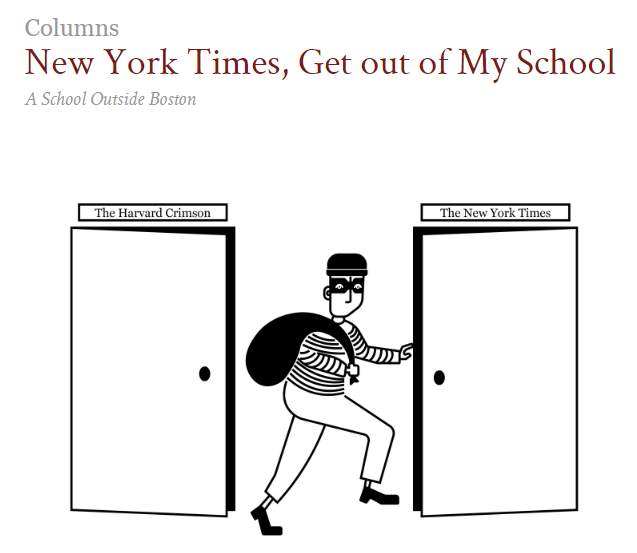
“I realize there’s something kind of absurd about a journalist posting a link to a Harvard student’s piece about how journalists are too obsessed with Harvard, but this from @thecrimson is too funny to not share.” -The Wall Street Journal’s Melissa Korn
That’s all, folks. Thanks for reading!
Reply to this email to send us questions, comments or tips. Know someone else who should be reading Best of the Week? Send them this link to sign up.
Using Feedly or FlipBoard or any other kind of news reader? You can subscribe to The Grade’s “feed” by plugging in this web address: http://www.kappanonline.org/category/the-grade/feed/.
Read more about The Grade here. You can read all the back issues of The Grade’s newsletter, Best of the Week, here.
By Alexander Russo with additional writing from Colleen Connolly and Will Callan.
ABOUT THE AUTHOR

Alexander Russo
Alexander Russo is founder and editor of The Grade, an award-winning effort to help improve media coverage of education issues. He’s also a Spencer Education Journalism Fellowship winner and a book author. You can reach him at @alexanderrusso.
Visit their website at: https://the-grade.org/