In this week’s newsletter: Liberal school culture war wins. The “not-so-normal” school year that was 2022-23. The fundamental unfairness of two-tier education systems. New reports on ed school literacy training and school spending. New series on reading problems in Oregon and funding issues in Pennsylvania. Not one but two open jobs in Houston! And a free literacy documentary screening for Juneteenth.
BOOK BAN PUSHBACK
The big story of the week
The big education story of the week is the small but noticeable surge of school culture war battles that have favored liberal — or at least moderate — voices.
Illinois has passed a new law declaring that libraries will lose state funds if they ban books — the first of its kind in the nation — but almost certainly not the last (AP, St. Louis Public Radio, US News). Alabama has failed to pass its “divisive concepts” bill for the second time in a row (Alabama Reflector). Data from last fall’s school board races show that conservative candidates won just 39% of 1,834 contests, while liberal candidates won races in conservative counties more than a third of the time (Washington Post).
Meanwhile, the LAUSD school board president went viral for her impassioned speech against conservative advocates who fear LGBTQ students and teachers (Washington Post). The Virginia Beach school board approved an LGBTQ resolution and voted down library policy changes (Virginian Pilot). Educators and community leaders were able to blunt right-wing efforts in Middletown, Ohio (Christian Science Monitor).
Is the tide really turning in some places, or are media outlets waking up to the news? It’s probably a bit of both. Though concerned about trans athletes and pronouns, supermajorities in the U.S. support LGBTQ rights (CT Mirror, Gallup, Progress Network). Some mainstream national outlets are depicting both the positive and negative trends around LGBTQ youth well-being (New York Times). However, conservative communities like Temecula, Calif. continue to act against perceived threats to traditional values (Daily Beast, LA Times).
Other big education stories of the week:
📰 HOW WELL DO TEACHERS TEACH?: Results from the annual teacher prep report from the National Council on Teacher Quality were released this week with some poor reviews on reading instruction in particular (Boston Globe, Chalkbeat, Philadelphia Inquirer). The good news? NCTQ data show 23% of teacher prep programs are getting it right when it comes to teaching kids to read. North Carolina universities and Colorado teacher prep programs were singled out as doing better than most (WFAE, Chalkbeat Colorado). However, some of the largest public universities and the most expensive or competitive admission schools have the worst grades.
📰 DISTRICT FINANCIAL STRUGGLES: Districts across the country are facing dire financial straits, risking insolvency and job cuts in the face of enrollment losses and the looming ESSER cliff (Chalkbeat Chicago, Chalkbeat Detroit/Bridge Michigan, Minnesota Reformer, GBH Boston). A new report from FutureEd shows that while nationally districts have spent about half of ESSER funds, questions remain over how well the money is being spent (LAist, LA Times).

NO FAIR — & NO FUN
The best education journalism of the week
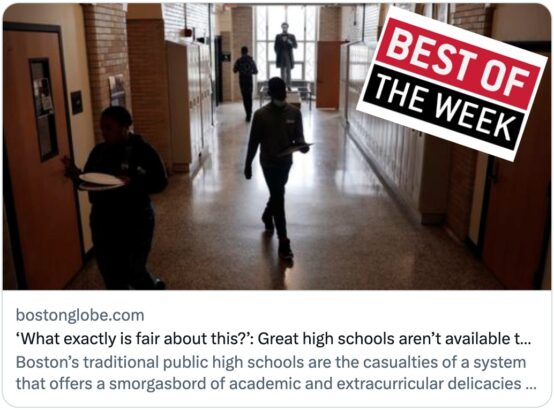
The best education journalism of the week is ‘What exactly is fair about this?’: Great high schools aren’t available to all Boston kids, by the Boston Globe’s Deanna Pan, which focuses on the inadequate academic and extracurricular offerings at smaller open enrollment high schools in the Boston Public Schools system.
Focused on Burke High School student Justis Porter, the story details the many inadequacies of Boston’s traditional high schools, many of them under-resourced and dwindling in enrollment.
Full of in-school details and vivid quotes, the piece contains a mix of grim realities and glimmers of hope and progress. Four years later, this is in some ways a prequel to the Globe’s 2019 Valedictorians Project, which described in searing detail the challenges experienced by even the most successful graduates of non-exam Boston schools.
Other great education journalism of the week:
🏆 Oregon fails to turn page on reading [Part One] (Oregon Capital Chronicle)
🏆 Open enrollment in Ohio: Who wins and who loses? (WKBN Ohio)
🏆 More states use taxpayer dollars to help people pay for private school (Stateline)
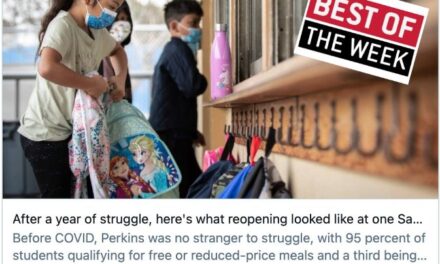
🏆 School uses phonics curriculum to catch up kids’ reading post-COVID (AP)
🏆 One of the poorest cities in America was succeeding in an education turnaround. Is that now in peril? (Hechinger Report)
🏆 We need to rethink discipline in schools (Vox)
🏆 First-time teachers apply lessons learned to next steps (Atlanta Journal-Constitution)
RESTORATIVE JOURNALISM
Our latest columns and commentary
It’s criminally easy to write a school culture wars story — and almost guaranteed to generate pageviews. People are worried. There are heroes and villains. The rhetoric is heated. But the reality is that not all communities are experiencing school culture wars and even those that are don’t result in the same dynamics and outcomes. And writing those stories can be soul-deadening.
That’s why it was so great to see Courtney Martin’s recent Christian Science Monitor cover story about what happened in Middletown, Ohio. For The Grade, she wrote a first-person reflection on finding, reporting, and writing that story with humility and joy: Finding the quiet stories underneath the screaming. Journalists covering school culture wars should definitely read what Martin has to say — and try some of the techniques and approaches she describes.
Note: I didn’t win a Mirror Award, but the winners are an impressive lot and I’m glad that media reporting and commentary are the focus of at least one journalism contest. You can check out my entry here. (I know, I know: I really should have submitted Greg Toppo’s columns.)
RECRUITING TEACHERS TO CALIFORNIA’S TOUGHEST SCHOOLS
Coverage of promising school innovations & signs of progress
💡 To attract teachers to poorer neighborhoods, California is paying for credential programs and giving teachers more administrative authority in so-called community schools. This story takes a hard, statewide look at where those efforts have succeeded and failed (CalMatters).
💡 This piece about school-based health clinics combines detailed anecdotes with research findings to make a case for the positive impact such facilities — which have grown in number, but often struggle financially — could have on students’ mental wellbeing (Chalkbeat 6/8).
💡 Student activists who recently graduated from Southern California high schools take center stage in this story — essentially five miniature profiles — about the tangible changes they pushed for in their schools and districts (LAist).
💡 With the aid of clear description and plenty of photos, readers of this dispatch from outside Kansas City can imagine participating in a high school program that for 15 years has been giving kids hands-on experiences in fields like aerospace engineering and food science (The 74).
Yes, it’s true! There’s a new custom story alert function added to the Solutions Journalism Story Tracker. Now the solutions stories you most want to see can come to you automatically.

Above: USA Today ed reporters Alia Wong and Kayla Jimenez were back in classrooms to report their impressive series, “the not-so-normal year.” See a thread from Alia with her impressions of what she saw, including this telling piece of student art. Despite some of the bad news, she reports, “being at schools again was so fun+inspiring. … I loved talking with kids; I’ll always cherish their wisdom+humor+curiosity.”
PEOPLE, JOBS
Who’s going where and doing what
🔥 Reporters’ voices:
- “Every time I thought I had all the numbers, I found out there was another channel of homeschooling not being tracked by the government,” writes Mercury News education reporter Elissa Miolene about her experience reporting on homeschooling in California. But it’s a rich topic to mine, considering the data isn’t clearcut. “What aren’t we tracking, and how many children are being educated in non-traditional formats?”
- “Turns out it’s true: You can learn a lot about the present by understanding the past,” writes Chalkbeat’s Matt Barnum, who recently returned from a year as a Spencer Education Journalism fellow during which he read a lot about prior eras of education policy. “And also there is nothing new under the sun, at least not completely. I hope to bring that perspective to my reporting.”
🔥 Career moves: Stateline News’ Madyson Fitzgerald published her first piece on school book bans. Former Chalkbeat honcho Scott Elliott will be heading a new nonprofit and publishing two local newspapers in suburban Washington, D.C. The LA Times’ Karin Klein, who wrote about education for the editorial board (and also edits for The Grade), announced she is retiring from the paper. A decade ago, I wrote a column praising Karin’s ability to “write in plain English for a general audience that may or may not care about education.” I’m grateful she’s going to continue making The Grade better each year.
🔥 Job openings: Former Houston Chronicle education reporter Jacob Carpenter, now a team leader for the new Houston Landing, tells us “there are few cities in America where education journalism is more vital.” But they need reporters. Both the Houston Chronicle and Houston Landing are hiring. The Cicero Independiente in Chicagoland is hiring a youth and schools community reporter. Any other big job openings out there? Let us know.
🔥 Impact: Congrats to NBC News’ Erin Einhorn and her colleagues whose reporting on teens in the foster care system in Michigan inspired legislators to introduce three bills to help ensure they can graduate high school. And another congrats to the Arizona Center for Investigative Reporting’s Maria Polletta and the Hechinger Report’s Tara García Mathewson, whose reporting on schools suspending students for being absent led to the introduction of a bill to end the practice. The bill failed to pass this year, but kudos to their reporting with real-world impact.
🔥 Layoffs: I’m told the LA Times education team hasn’t been impacted by their recent round of layoffs. LAist also announced this week it would cut more than 10% of its staff, but I hear the education team has been spared there, too. So far this year, 17,436 media jobs have been cut, marking the highest year-to-date level of cuts on record, according to Axios.

Above: You can stream the documentary “The Right to Read” for free on Monday, Juneteenth. Register here to watch.
APPEARANCES, EVENTS, & NEW RESOURCES
What’s happening and new research
⏰ Appearances: The Tampa Bay Times’ Jeff Solochek was on WBUR On Point talking about whether schools should ban smartphones in the classroom. The Miseducation podcast (produced and reported by students) also took on the topic of phone bans (see episode 6). WHYY released the first episode of its newest season of “Schooled” on education funding. Linda Wertheimer was on the Jesuitical podcast talking about her recent story on efforts to get prayer back into public schools. In the latest episode of EWA Radio (and Kavitha Cardoza’s last as host), CD Davidson-Hiers talked about her mental health journey after covering trauma in education.
⏰ ICYMI: The 74 hosted a webinar Wednesday on how an Indiana high school is preparing kids for careers in STEM, featuring reporter Jo Napolitano. Yesterday, the Edunomics Lab hosted a webinar discussing where we go from here, with districts hiring more staff than ever despite having fewer students. VOX Global Indy and Chalkbeat Indiana held an in-person event Tuesday on the future of local news featuring bureau chief MJ Slaby. WHYY Philadelphia organized a live event recently featuring Black men in media — something I wish EWA would do given how few Black men are on the education beat.
⏰ Research & reports: In the wake of last week’s school closures due to wildfire smoke, take a look at this Journalist’s Resource roundup of research on indoor air quality in schools. Students polled by Gallup gave their schools middling marks (The 74, CNN, Gallup). Chalkbeat’s Matt Barnum looked at the mixed-bag research on whether retention policies are good for students. And the Hechinger Report’s Jill Barshay took a deeper look at the report last week that showed charter schools have improved over the last 15 years.
Books: The New York Times reviewed Mattie Kahn’s book “Young and Restless” about “the role of young women and girls in America’s uprisings,” including in battles over the right to an education.
THE KICKER

Yep, that’s former HuffPost education reporter Rebecca Klein in the New York Times (near the center)! Now publisher of the upstart New York Focus, she describes the experience as “the thrill of my life.”
That’s all, folks. Thanks for reading!
Reply to this email to send us questions, comments or tips. Know someone else who should be reading Best of the Week? Send them this link to sign up.
Using Feedly or FlipBoard or any other kind of news reader? You can subscribe to The Grade’s “feed” by plugging in this web address: http://www.kappanonline.org/category/the-grade/feed/.
Read more about The Grade here. You can read all the back issues of The Grade’s newsletter, Best of the Week, here.
By Alexander Russo with additional writing from Colleen Connolly.
ABOUT THE AUTHORS

The Grade
Launched in 2015, The Grade is a journalist-run effort to encourage high-quality coverage of K-12 education issues.
Alexander Russo
Alexander Russo is founder and editor of The Grade, an award-winning effort to help improve media coverage of education issues. He’s also a Spencer Education Journalism Fellowship winner and a book author. You can reach him at @alexanderrusso.
Visit their website at: https://the-grade.org/