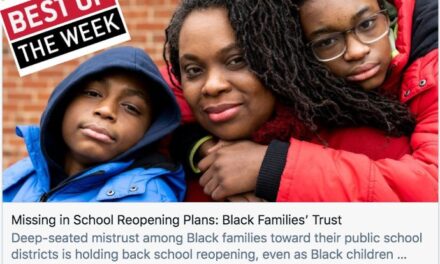
Education journalism can do better at providing useful information focused on families’ needs.
By Greg Toppo
Back in the day, I was a huge fan of Alton Brown, the charismatic TV chef whose weekly Food Channel show would vividly explain the chemistry of yeast respiration or the architecture of green bean casseroles, then guide viewers step-by-step through the process of whipping up an amazing loaf of bread or dazzling casserole.
A devoted student of Southern foodways, he’d insist that he had no patience for kitchen tools that did just one job: banana slicers, garlic presses, meat claws, bacon-bowl makers, that sort of thing. He derisively called them “unitaskers” and hated them.
“You buy these items,” he joked in 2015, “you use them, and then they simply pile up until you have to tear down your house and build another one.”
I’ve been thinking about Brown lately as I consider my work and that of my fellow education journalists. I think we’ve got a ‘unitasker’ problem, one that’s keeping us from serving readers, listeners, and viewers better.
I think we’ve got a ‘unitasker’ problem, one that’s keeping us from serving readers, listeners, and viewers better.
If you had sampled our output prior to March 2020, you’d have found us reporting on a rich and splendid variety of topics, from teacher quality to student safety to federal funding, school board politics, building design, reading instruction, inequality, and on and on.
Since the dawn of the coronavirus pandemic, however, we’ve given much of that up, writing an awful lot about the virus and its effect on kids and classrooms. With good reason, of course: Parents want to know whether their kids are safe and learning. Educators and the public want to know much the same.
But in so many newsrooms, the topic has overwhelmed everything else. There have been variations, of course, but by and large in 2020 and 2021, we became the banana slicers of journalism, writing the same stories over and over again.
So I was dismayed but not surprised when a new report appeared last month that found just 1 in 5 parents considers news media to be the most useful source of information about COVID and schools.
Many parents are now relying on “non-media sources,” according to the report from researchers at Michigan’s Calvin University. Press releases, emails, and other communications from school and government agencies, institutions, or even community groups, are seen as the most useful source by nearly twice as many parents as news media is: 36% to 19%. The remainder – 44% – find them both equally useful.
Let that sink in a moment. For more than two years, we’ve written millions of words about COVID and schools. Yet nearly twice as many parents say they stay better informed about this topic by opening an email, scanning a text message, or reading a tweet from their school, district, or PTA.
Obviously, a PDF spreadsheet detailing what’s for lunch on Thursdays is “useful,” but it offers a different kind of utility from a well-reported story that lays out exactly which cut of meat is in those mysterious tostadas, or which schools are doing a better job than others feeding students.
However, the data seem definitive, and the pandemic presents us with an important moment: If the people most affected by our coverage are finding other sources more useful, perhaps we need to believe them and rethink our offerings.
If the people most affected by our coverage are finding other sources more useful, perhaps we need to believe them and rethink our offerings.
Barring a new COVID variant that once again closes schoolhouse doors in 2022, schools will likely remain open and in session for the foreseeable future, with masks mostly optional.
So let’s envision something different: a rich, robust approach to education journalism that helps us avoid the unitasker approach when the next big disruption hits.
First things first: Let’s think about who is making news decisions. The old saying goes that when a publisher (or, better yet, his wife) hits a pothole, the next day’s lead story is all about the urgency of street repairs.
How are newsroom biases affecting story choice, and how might we shift from offering coverage focused mostly on institutions and power to coverage focused on families?
New York City’s news startup Epicenter has taken a family-focused approach in its newsletter: while one recent issue led with the end of mask mandates, it pivoted to changes in high school admissions. More recently it covered both busing for special-needs students and the grim reality (in a few schools) of Mayor Eric Adams’ “Vegan Fridays” meals. In February, it offered a reader-friendly explainer for parents on what to do once their child gets his/her/their 32-digit school lottery number. That sort of offering can only find its way to the surface if the people making coverage decisions either are parents or are attuned to what parents want.
How might we shift from offering coverage focused mostly on institutions and power to coverage focused on families?
Let’s also be more intentional about how we cover neighborhoods, which will always surface different responses to the same news events.
The news startup Canopy Atlanta devotes each issue of its newsletter to just one neighborhood. It relies on community members to help choose story topics and refines the ideas via a community editorial board. For the stories themselves, Canopy trains “Journalism Fellows” to work alongside experienced journalists.
Shifting gears a bit, let’s imagine that a future pandemic strands our kids at home again. In 2020 and 2021, school closures forced millions of parents to become their kids’ teachers.
Beyond pointing out this obvious phenomenon, which we did so consistently and so well, how well did we rise to the challenge of helping them? Without becoming curriculum developers, how can we use our content to strengthen parents’ abilities? If a 56-second TikTok video can effectively teach the Pythagorean theorem, anything is possible, it seems.
I’ve been struck recently by the clarity and beauty of The New York Times’ 2021 “Close Read” series of digital interactives, which crack open the beauty and complexity of great art works. How could we bring these ideas to topics that vex students and parents?
In 2020, The Oakland REACH, a parent group, launched its Virtual Family Hub, which offers not just academic instruction but tech training among other benefits. What might a family hub designed by a news organization look like, and how might it offer a measure of community goodwill?
In March, six editorial staffers at The Wall Street Journal produced a 148-page guide to student loans. Its subtitle: “Navigating the Myths and Misunderstandings About College Debt.” It’s available free on the Journal’s website.
More broadly, let’s consider parents’ needs beyond their kids’ daily school requirements. Can we help them upskill or even find a new career? For instance, NPR in February offered tips for parents and caregivers who want to go to college. One recently surfaced complaint about mainstream media is that, well, too many journalists are college graduates, unlike many of their potential readers. We can’t give back our diplomas, but perhaps we can offer readers a way to earn theirs.
In the Calvin study, the researchers note that parents want more “solutions-focused reporting,” pointing out that parents face “a bewildering set of circumstances in navigating their children through the education system, and journalists have a unique opportunity to serve as a guide.”
It especially urges news organizations serving parents of color to take this seriously, as they’re less likely to have access to “more powerful information networks, leaving parents of color especially reliant on traditional news media sources for their education news needs.”
Let’s commit to a broader vision of what constitutes ‘useful’ news.
For what it’s worth, the Calvin University researchers on March 1 offered a follow-up study that found local education outlets provided both coverage that revealed problems and “solutions to those problems.” It especially praised local news organizations focused on serving communities of color, singling out their emphasis on solutions, their service journalism, and their attention to “matters of race in the educational context.”
Let’s emulate these outlets by taking audience and community engagement seriously. A school district or parent group may be better suited to telling parents when the food pantry is open or how class schedules are changing, but we are in a better position to help parents see a wide variety of big-picture issues, from accessing government accountability to coping with the stress of schooling.
In other words, even when the next pandemic or other disaster hits, let’s commit to a broader vision of what constitutes “useful” news.
It certainly won’t be easy to keep our focus within the context of a crisis, but let’s commit to taking steps that will make each of our newsrooms look less like a banana slicer and more like a tool that, though it dispatches bananas, does much more: a sharp, sturdy, well-balanced, all-purpose chef’s knife, one that with the flick of a wrist can chop, sliver, slice, and dice whatever appears in front of it.
Our readers, listeners, and viewers deserve better – and as Alton Brown would say, we won’t have to tear down our houses and build new ones.
Greg Toppo is a longtime education journalist and author most recently of Running With Robots (co-authored with Jim Tracy). You can follow him on Twitter at @gtoppo.
Previously from Toppo:
People are fighting. Is that news?
Previously from The Grade:
Putting parents front and center
Education journalism is stuck. What’s holding it back?
Rethinking K-12 education coverage for the post-pandemic era
ABOUT THE AUTHOR

Greg Toppo
Greg Toppo is a longtime education journalist and author most recently of Running With Robots . You can follow him on Twitter at @gtoppo.