In this week’s newsletter: Schools attempt to restore order. A local reporter praises national coverage of one town’s culture wars. An ed reporter on strike confronts the reporter who’s now covering his beat. New research reveals where learning loss has been greatest, down to the district level. The Pulitzers are out — with one glaring omission. And a reporter shares his own cringey kicker.
RESTORING ORDER
The big story of the week
The big education story of the week is schools’ efforts to respond to student behavior challenges taking place in classrooms and hallways — including fights, weapons possession, physical assaults, and (very occasional) shootings.
Some of the responses reported this week include taking away students’ cell phones, punishing student absences, bringing in metal detectors, improving threat assessment, bringing school police back on campus, and banning backpacks (Washington Post, Canton Repository, Virginia Mercury, Oregonian, Chalkbeat Colorado, Wisconsin Public Radio, CNN).
Concerned students, parents, and educators are looking for solutions that aren’t overly punitive or alienating. Some view these new efforts as too harsh or overly reliant on untried new technology (PBS NewsHour, The Intercept). Meanwhile, many districts are confronting disproportionate discipline rates among different schools and groups of students (Houston Chronicle).
Other big stories of the week:
📰 READING OVERHAUL IN NYC: In a huge shift, New York City is now going to require schools to use one of three approved reading curricula that focus on the “science of reading.” The change is meant to raise the city’s dismally low literacy rates. Half the schools will need to comply by this fall, with the other half slated to begin the following school year (Wall Street Journal, New York Times, Gothamist, NY1, Chalkbeat NY, Patch, The Hill).
📰 OAKLAND SHUTDOWN: The teachers strike in the 34,000-student Oakland school district is now in its seventh day (Mercury News, AP, ABC7). The two sides are locked in a stalemate over the union’s “common good” demands, which seek to address racial equity, homelessness, and environmental justice — frustrating some parents who want their kids back in school (Mercury News, ABC7). Some organizations like the NAACP have called for an end to the walkout (Oaklandside, San Francisco Chronicle). The district claims the union’s demands would cost more than $1 billion (SF Chronicle).
Asked about covering the strike, Mercury News education reporter Elissa Miolene describes her effort to go deeper, “looking at smaller pieces of the community impacted.” She wrote about the experiences of Oakland high school seniors who are three weeks away from graduation. For more, listen to the Chronicle’s Jill Tucker discussing the strike.

COLORADO CULTURE WAR
The best education journalism of the week
The best education story of the week is Tyler Kingkade’s ‘Trump was great at this’: How conservatives transformed a Colorado school district for NBC News. The piece details how a group of conservative candidates won control over the 2,000-student Woodland Park school board 18 months ago — and what happened next.
After initially adopting a conservative social studies curriculum, hiring a conservative superintendent, and approving a new charter school, the district attempted to suppress educators’ concerns about decisions targeting counselors and social workers. But now it’s facing criticism from conservative community members concerned about hasty decisions and lack of transparency.
“I thought [Kingkade] did a really good job,” says Colorado Public Radio’s Jenny Brundin, who first reported the story earlier this year, noting the number and variety of people the NBC reporter speaks to and the narrative and emotions he describes.
While Brundin says that she’s generally tried to stay away from over-covering school culture wars in order to keep the focus on “what is actually going on in classrooms,” Woodland Park made clear that efforts to overthrow established school boards “have real and profound consequences on districts” that will impact students.
More great education stories published this week:
🏆 Life inside a fourth-grade classroom in the Appleton school district (Post Crescent)
🏆 How Much Do School Support Staff Make in Each State? (Spoiler: It’s Not a Living Wage) (EdWeek)
🏆 D.C. school enrollment boom helped by rise in adult learners (Washington Post)
🏆 A Philly charter school manipulated its lottery to keep kids out, a top administrator says (Philly Inquirer)
🏆 Opinion: A $15.8 million mistake: Why S.F. can’t pay its teachers on time (San Francisco Chronicle)
🏆 San Francisco students could see Algebra I back in middle schools (San Francisco Chronicle)
REPLACED
Our latest columns and commentary
This week’s new piece is education reporter Andrew Goldstein’s first-person account of what it’s like being out on strike, having his beat covered by a reporter who has remained on the job — and eventually running into that reporter at a press event.
“I had been anticipating a moment like this for months, waiting to give someone a piece of my mind,” writes Goldstein, who remains on strike from the Pittsburgh Post-Gazette.
📌 Note: Hard to believe it, but The Grade launched eight years ago. Thanks to everyone who’s read and supported the effort along the way. 📌
LATER SCHOOL DAYS EASE PANDEMIC STRESS
Coverage of promising school innovations & signs of progress
💡 At least nine states and several large districts are looking into later school start times as one way to address pandemic-exacerbated psychological strain on students (AP).
💡 A Colorado elementary school that was under threat of closure five years ago has seen significant improvement after tweaking its math curriculum and introducing close monitoring and training for its math teachers (Chalkbeat Colorado).
💡 At a time when only one in five computer science degrees goes to women, an AP CS course at a southwest Denver high school enrolls mostly girls, who are drawn to its emphasis on teamwork and problem-solving (CPR).
💡 By 2022, three years after the Washington state legislature created alternative high school graduation routes, 49% of graduates had completed a CTE pathway, exploring careers like biotech, nursing, early childhood education, and agriculture (Seattle Times).
Read more about the importance of covering promising innovations and preliminary successes.

PEOPLE, JOBS
Who’s going where and doing what
Above, clockwise from top left: Chalkbeat Chicago’s Mila Koumpilova, host of “Stolen: Surviving St. Michael’s” Connie Walker, the New York Times’ Eli Saslow, and the Washington Post’s John Woodrow Cox.
🔥 Awards & fellowships: Chalkbeat Chicago’s Mila Koumpilova was named a 2023-24 Knight-Wallace fellow. She will look at how cities can strengthen programs for unemployed young people who aren’t enrolled in high school or college. John Woodrow Cox and others at the Washington Post were awarded a special citation from the Dart Center for Journalism for their coverage of gun violence and its impact on children. “We applaud him for his deep sensitivity, compassion, and unparalleled body of work.” Congrats to both!
🔥 Pulitzers: While I was disappointed not to see any Pulitzer recognition for APM Reports’ “Sold a Story,” sincere congrats to the the Austin American-Statesman and USA Today for their coverage of law enforcement’s flawed response to the Uvalde school shooting, Washington Post’s Eli Saslow for feature writing that often features children and schools, and Connie Walker for season two of “Stolen: Surviving St. Michael’s,” about her family’s own history with Canada’s residential schools for Indigenous children. It’s great to see so many education-related pieces recognized for their excellence.
Career moves: The LA Times new early education team is now complete! Former Kaiser Health News senior correspondent Jenny Gold will be a reporter, and former EdSource reporter Kate Sequeira will be the audience engagement journalist.
🔥 New ventures & collaborations: In 2021, former local TV news producer Jeannette Andruss co-founded Spotlight Schools, which she says is the only newsroom exclusively covering TK-12 education in Orange County, Calif. A parent of two school-aged kids, Andruss wanted to supplement education coverage in the area that she says is sparse and often focuses on sports and culture war conflicts. And if you’re in Colorado, check out “Last Resort,” a four-part investigation by Chalkbeat Colorado, the Colorado Sun, and KFF Health News into the collapsing system of schools serving the state’s most vulnerable students.
🔥 Job openings & fellowships: South Carolina’s Post and Courier is hiring an editor for their Education Lab. Houston Landing is hiring a Houston ISD reporter. Looking to sharpen your accountability reporting chops? MuckRock is hiring for its six-month FOIA fellowship. Chalkbeat Newark’s Jessie Gómez highly recommends it.
APPEARANCES, EVENTS, & NEW RESOURCES
What’s happening and new research
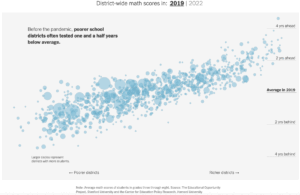
Above: New research shows district-level information about how student achievement looked before and after the pandemic.
⏰ District-level learning loss research: By the spring of 2022, the average student was half a year behind in math and a third of a year behind in reading — exacerbating pre-existing inequalities among districts. School closures and hybrid learning played a major role but were far from the sole factor. These are the findings from new research from Stanford and Harvard, whose researchers call for major increases in instructional time before losses become permanent. The project now includes a district-level view of the pandemic’s effects in 40 states (plus D.C.) and an interactive map comparing neighboring school districts. The results have been written up in the opinion sections of the NYT and the Idaho Statesman and reported on NPR’s Morning Edition.
⏰ Podcasts & segments: The first of two bonus episodes of “Sold a Story” was released yesterday with emails and voice messages from listeners. Stay tuned next week for the second episode. The Daily’s Sunday Read this week was all about “The School Where the Pandemic Never Ended.” WNYC’s The Brian Lehrer Show had two ed-related segments this week: What Do You Remember from History Class? and NYC Schools Chancellor Discusses New York City Reads.
⏰ Correction: The diversity recommendations featured in last week’s BOTW newsletter come from the Reuter’s report, not from the News Literacy Project.
⏰ Research: A new study published in Early Childhood Research Quarterly shows that elementary students “do not particularly benefit from being taught by teachers of the same race or ethnicity.” A new poll released by Democrats for Education Reform shows overwhelming support among voters — particularly Black and Latino voters and parents — for more options in the public school system. The 74 reported on exclusive data showing that the vast majority of the country’s largest school districts have yet to recover from the pandemic drop in enrollment. And Georgetown’s FutureEd has two new pieces out: one showing how schools can combat student absenteeism and another showing that 23 states, districts, and state agencies have spent at least half of their ESSER funds.
⏰ Food for thought: On NBC’s Meet the Press, Voto Latino’s Maria Teresa Kumar said the economy and education are likely to drive voting in the next election: “A lot of parents right now are seeing that their kids are way far behind. They’re saying, ‘Who’s talking to me about education? The Republicans are.’” On NPR, the founder of an FBI active shooter program noted that media coverage makes mass shooting risks seem much larger than they really are.
⏰ Books: Preorder now Cara Fitzpatrick’s book “The Death of Public School: How Conservatives Won the War Over Education in America.” Coming next year is Benjamin Herold’s “Disillusioned,” which “pulls back the curtain on suburban public schools and school boards.”
THE KICKER

|
|
ABOUT THE AUTHOR

Alexander Russo
Alexander Russo is founder and editor of The Grade, an award-winning effort to help improve media coverage of education issues. He’s also a Spencer Education Journalism Fellowship winner and a book author. You can reach him at @alexanderrusso.
Visit their website at: https://the-grade.org/