Follow-up supports for teachers help them sustain and build on what they learned.
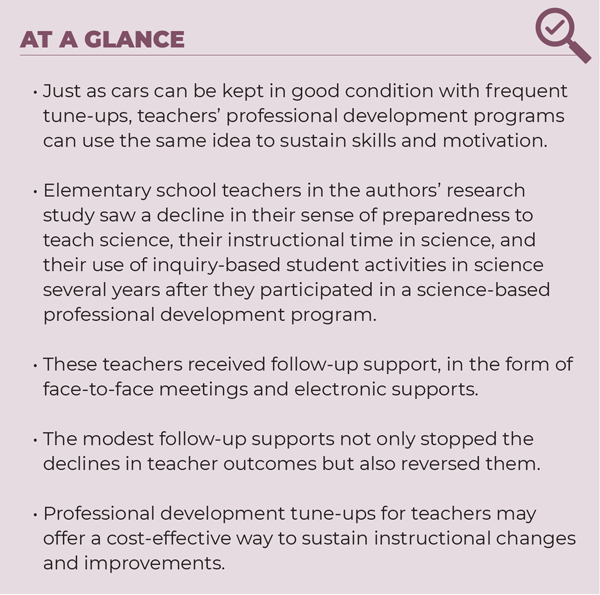
Cars are expensive. To preserve their investment, owners get regular tune-ups to keep their vehicle in good operating condition. Tune-ups can prevent major repair costs and help the car perform well in the long run. In contrast, professional development programs for teachers often require the investment of significant upfront time and resources but fail to find ways to extend positive outcomes. Our research, funded by the National Science Foundation (NSF), suggests that using the tune-up concept for professional development may offer a cost-effective way to sustain instructional changes and improvements.
Our professional development tune-up
To determine the value of a professional development tune-up, we looked at 49 elementary teachers from 30 California schools located in 19 rural districts who had previously completed a three-year state-funded, science-based professional development (PD) program. The teachers completed one of four different PD programs, which ended between 2010 and 2014.
Each program used a survey and self-efficacy assessment to collect longitudinal data after the program ended. By 2017, the teachers’ sense of preparedness to teach science, their self-efficacy, the instructional time they spent in science, and their use of targeted instructional strategies and inquiry-based student activities in science had all declined. Could follow-up support stop these declines?
To find out, we provided a program of follow-up support that began in 2018 and extended to 2020. The support included five activities.
Refresher sessions
First, teachers participated in two-day face-to-face refresher sessions during the summer that focused on the Next Generation Science Standards (NGSS) as well as topics teachers identified in needs assessments. All 49 teachers attended in the first summer, but some had to drop out due to medical issues and personal and professional conflicts, leaving 43 in the second summer. These sessions included opportunities for teachers to collaborate on lessons, share strategies, connect with new colleagues, and reconnect with participants from their original PD programs.
In interviews, teachers praised these sessions, especially the focus on NGSS and opportunities to collaborate. They appreciated the model lessons and “the grade-level demonstrations of how to teach an NGSS lesson.” These demonstrations helped teachers feel more prepared to teach investigative lessons and to modify their prior science instruction to fit NGSS standards. As one teacher pointed out:
We got more ideas and we got to problem solve and see things differently and say, “Oh, I never thought of a certain concept in a certain way.” It was seeing someone else’s perspective and seeing how they taught it and what works for them. I really don’t have that at my school.
After-school meetings
We offered after-school face-to-face meetings twice during each academic year, with teachers organized by location into four groups of four to 18 teachers. These two-hour sessions allowed teachers to continue to collaborate on lesson design, analyze instructional strategies, and share ideas. In feedback surveys and interviews, teachers said that opportunities to learn with and from their peers and to gather feedback on lesson planning were key benefits of the sessions. They also valued the camaraderie and the chance to maintain connections with teachers outside of their schools.
Webinars
As a follow-up to the after-school meetings, teachers could attend synchronous webinars offered approximately once a month, typically in the late afternoon when teachers were still at school. The webinars, led by a science content expert or PD leader, focused on topics the teachers requested. Fifteen teachers participated in at least one webinar, with five attending multiple sessions. Those who attended appreciated being able to ask specific questions about lesson planning and to “meet with people of similar grade levels without having to go somewhere.”
Electronic support
We also offered four forms of electronic support to teachers:
- A dedicated email address for teachers to ask questions of science curriculum experts.
- A private Facebook group page for collegial support and sharing ideas and resources.
- A monthly electronic newsletter that focused on topics related to NGSS and included links to professional development resources.
- An online repository of materials for sharing lesson plans and other documents.
In general, teachers used the electronic resources less than we expected, but those who did use them found them valuable. Only one teacher sent a question to the dedicated email address. Most teachers said they didn’t find it necessary or had access to similar forms of support. Two-thirds of teachers joined the Facebook group, and they said they valued it, but the number of postings was small. One teacher pointed out that she easily could glance through the postings, and, after making a post, would “get my question answered right away.” Two-thirds of teachers accessed at least one newsletter, with the most popular items being classroom lessons shared by teachers. In interviews, teachers described the newsletters as valuable for generating ideas and assisting with lesson planning. Many teachers saved the newsletters for future reference, and some shared ideas from the newsletter with other teachers at their schools. The online repository housed teachers’ NGSS-aligned lesson plans for all participants to access, and teachers appreciated “having these lessons available so that we can use them in our classroom once they are complete.”
Funds for supplies
Teachers also received up to $150 each year to purchase science instruction materials and supplies. They used the money for a wide range of items that reflected their needs and grade levels. For example, they purchased consumable items, such as rubber bands, mealworms, and balloons, and durable items such as safety glasses, microscopes, and chemistry sets. In interviews, teachers described the funds as “awesome,” “wonderful,” and “a godsend” in allowing them to “give authentic hands-on kinds of experiences to our children.”
Reversing the downward trend
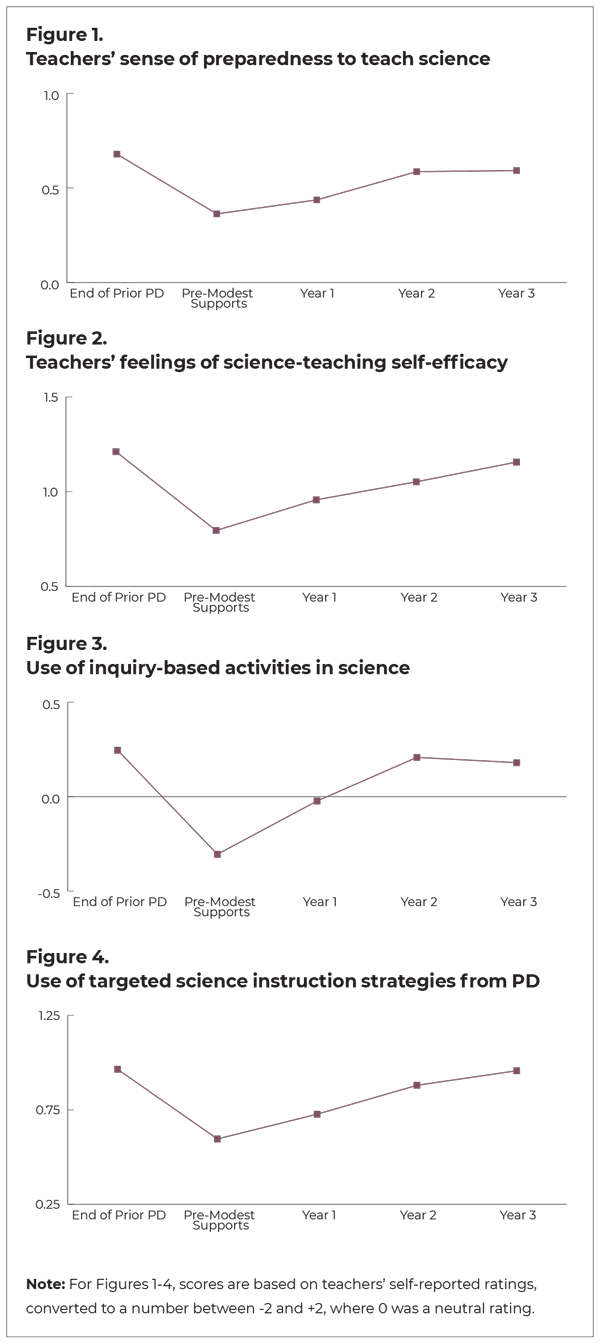
At the end of the original professional development program, immediately before the follow-up began, and in each of the three years that follow-up supports were provided, we asked teachers to rate their sense of preparedness to teach science, their self-efficacy, and their use of targeted instructional strategies and inquiry-based student activities. We converted teachers’ responses to a number between -2 and +2, where 0 was a neutral rating. As Figures 1-4 show, teachers’ confidence in teaching science and their use of strategies from the PD were declining, but the modest follow-up supports stopped the declines.
The results showed similar patterns on all the scales, with an initial decrease during the period of no support and an increase each year of the modest supports. Thus, the follow-up support not only stopped the declines in teacher outcomes but also reversed them. These improvements started as early as one year into the program. By the end of three years, the outcomes increased almost to the high level achieved at the end of the previous intensive PD programs. While these changes may appear small, they carry meaningful consequences over extended periods.
Implications for professional development
Our results reinforce the value of providing PD follow-up support to sustain instructional changes. They suggest that even modest follow-up support can stop a downward trend in instructional outcomes and teacher self-efficacy years after PD programs end. Thus, a professional development tune-up is a viable way to maintain instructional changes over time.
Given the limited resources typically available for professional development, administrators will want to spend them strategically. Rather than using funds exclusively for initial professional development programs, leaders should consider allocating some money for teachers who have recently completed a PD program and would benefit from follow-up supports. This is a cost-effective way to increase the value of those earlier expenditures.
Costs for the follow-up fell into three main categories: personnel, facilities, and materials. Personnel costs included project staff who organized the follow-up supports and PD leaders who facilitated the refresher sessions, after-school meetings, and synchronous webinars. The primary costs for facilities depended on the location of the summer sessions and travel, food, and lodging costs. Materials included costs for the newsletter subscription, funding for teacher science materials, and supplies for summer and after-school sessions.
Professional development programs for teachers often require the investment of significant upfront time and resources but fail to find ways to extend positive outcomes.
The teachers in our program strongly preferred face-to-face activities and took less advantage of electronic resources. However, face-to-face sessions tend to be significantly more expensive than online options. The after-school face-to-face meetings required more PD leaders and, consequently, were four to five times more costly than the synchronous webinars. This program happened before the start of the pandemic, so teacher attitudes toward online support may have shifted.
An adaptable approach
With a range of options available, districts can design these follow-up supports to meet their specific needs and budgets. Just as the frequency of automobile tune-ups and maintenance depends to some extent on driving conditions, supports needed to sustain professional development outcomes will vary depending on teachers’ personal circumstances, teaching assignments, and school contexts.
Offering different options for follow-up support ensures that the tune-up responds to teachers’ various teaching assignments, school contexts, and personal circumstances. In interviews, teachers expressed appreciation for the range of options. One teacher summarized:
I don’t know what else this project could have rolled out. You sent us away on a summer [face-to-face session], you touched base with us, social media, newsletter, this interview. I mean, these [follow-up supports] have been rolled out really beautifully. . . they’re just really thought through and supportive.
Some supports may be valued and used by only a small group of teachers, but, if the costs are minimal, as with some electronic resources, it may make sense to include them as options.
Extending the value of PD
Teachers’ reflections on the value of follow-up supports echoed their reflections on the benefits they gained from their original PD programs. They mentioned the importance of “collaborating with teachers from other schools,” “giving each other ideas,” and talking about science with “grade-level peers.” They appreciated the feedback on their lesson plans and described feeling “highly prepared,” “more confident to teach science,” and better able “to take those strategies into the classroom.” They were less intimidated and more confident about “the implementation of NGSS,” and they learned “that the engineering component isn’t as scary as [they] thought it was.”
Beyond instructional plans and pedagogy, teachers lauded the networking and “lifelong connections” with other teachers. Those connections eased the isolation they felt in their small schools and “renewed [their] excitement to teach science.” The professional development tune-up bolstered not only teachers’ actions but also their attitudes about teaching science.
School districts invest substantial amounts of money and time on professional development programs. The results of this study demonstrate that professional development tune-ups provide a cost-effective way to sustain changes in teachers’ self-efficacy and instructional strategies. We are continuing this line of research with a larger group of teachers in four different states and over an extended five-year time frame. This type of research will deepen the understanding of sustainability of professional development outcomes and ways to provide ongoing teacher support.
Note: This material is based on work supported by the NSF. Any opinions, findings, and conclusions or recommendations expressed in this material are those of the authors and do not necessarily reflect the views of the foundation.
Video Summary
Watch a short video describing these findings at https://youtu.be/zSwMtIYxchw
This article appears in the May 2023 issue of Kappan, Vol. 104, No. 8, pp. 31-35.

ABOUT THE AUTHORS

Judith Haymore Sandholtz
JUDITH HAYMORE SANDHOLTZ is professor emerita in the School of Education at the University of California, Irvine.
Cathy Ringstaff
CATHY RINGSTAFF is a senior research associate at WestEd, San Francisco, CA.
Jessica Triant
JESSICA TRIANT is a research associate at WestEd, San Francisco, CA.