In this week’s newsletter: Schools are scrambling to come up with ways to support students’ mental health needs. Students are struggling to catch up on what they missed during the pandemic. A small but growing number of parents are acting like reporters. And the AP and New York Times announce two big new hires to lead their education teams.
MENTAL HEALTH STRUGGLES
The big story of the week, according to us:
The big story of the week is students’ mental health struggles. A new CDC report shows a significant increase in student feelings of sadness and hopelessness and thoughts (or attempts) of suicide during the pandemic. Schools are trying different solutions to address it, from increased spending on mental health to a delayed start to the school day:
🔊 CDC: Mental health of US high school students worsened during the Covid-19 pandemic (CNN)
🔊 CDC warns of a steep decline in teen mental health (Washington Post)
🔊 With students in turmoil, US teachers train in mental health (AP)
🔊 Teens Report Emotional and Physical Abuse by Parents During Lockdown (New York Times)
🔊 Later school start times eyed to address youth mental health crisis (ABC News)
🔊 One way to address student mental health? Bring the clinic to school. (Chalkbeat Detroit)
🔊 Schools spend millions on wellness, mental health (Dayton Daily News)
🔊 Students and parents plead for state investigation after local school board rejects plan for school-based mental health center (Hartford Courant)
🔊 Texas schools don’t have enough mental health providers. As leaders fail to fix it, kids suffer. (Houston Chronicle)
Other big stories this week: Results from the Wisconsin school board elections were more mixed than they might initially appear (Wisconsin Examiner, Madison.com, AP, US News, ProPublica). The American Library Association released its list of the 10 most challenged books (NPR, New York Times, Newsweek). And after eight days, the teachers’ strike in Sacramento has ended with an agreement for increased pay and better health benefits (Sacramento Bee, Wall Street Journal).

BANANA SLICERS
New commentary from The Grade
Have education writers become banana slicers, single-purpose tools overly focused on a narrow set of issues that aren’t necessarily parents’ and students’ top concerns?
That’s what worries contributor Greg Toppo in this week’s new column, which calls on education desks and outlets to deepen and expand their coverage to be as useful as possible.
“If the people most affected by our coverage are finding other sources more useful,” writes Toppo, “perhaps we need to believe them and rethink our offerings.”
ILL-PREPARED
The best education journalism of the week, plus a runner-up and some bonus stories.
🏆 BEST: The best story of the week is After the pandemic disrupted their high school educations, students are arriving at college unprepared by Olivia Sanchez in USA Today and the Hechinger Report. The leap from high school to college is already a challenge for many students, but after two years of pandemic-disrupted learning, new college students are struggling more than ever. Sanchez follows a math major who was among a group of students who failed the math placement exam, despite the fact that she always excelled in the subject in high school. And she’s not the only one. Her calculus professor says this year’s freshman class has been the most challenging he’s taught in his 50 years as a professor. This is a great story showing the long-lasting impacts of learning in the pandemic. For many students, it’s not just a matter of catching up.
🏆 RUNNER-UP: This week’s runner-up is Millions of Ukrainian children are still in school despite the war by Anya Kamenetz for NPR. Kamenetz shows us a virtual class whose students are scattered — some in Ukraine still, others in Poland and Germany, even in Canada. Despite a war that has upended their lives, millions of kids and their teachers are still logging into class. It’s a story of resilience and one that shows the importance of school as a stabilizing force in kids’ and families’ lives, even during a war. But the conflict remains top of their minds anyway. One boy, for example, explained the difference between “there is” and “there are” with this sentence: “There are a lot of dead Russian soldiers in Odessa.” Kamenetz’s reporting is outstanding in this story, with many telling details like this one. I’d love to see more reporting on education in Ukraine and among the growing refugee community in the U.S., including Afghans and Ukrainians.
See also: Their country is at war but they’re supposed to be learning: How Ukrainian students in US are coping (USA Today)
BONUS:
🏆 Laws require language support for students. Many SC districts are ‘exploitative’ instead (The State)
🏆 Student math scores touch off ‘five alarm fire’ in California (EdSource)
🏆 California math wars get ugly: Accusations of racism and harassment ignite battle between Stanford and Cal profs (SF Chronicle)
🏆 Students Continue to Flee Urban Districts as Boom Town Schools and Virtual Academies Thrive (The 74)
🏆 If you can’t name Biden’s Education secretary, you probably aren’t alone (Politico)
MEDIA TIDBITS
Thought-provoking commentary on the latest coverage.
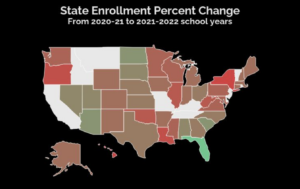
Above: “Out of 40 states and the District of Columbia, few have seen more than a 1% increase [in enrollment] compared to 2020-21, when some states experienced declines as high as 5%.”
📰 PARENTS AS REPORTERS: Some observers welcome the trend in which parents and advocates are increasingly taking on roles once limited to journalists, including making public records requests and writing their own news coverage of school decisions and events. Others are deeply concerned about the possible blurring of the lines. So you won’t be surprised that reactions ranged widely in the aftermath of NYC parent advocate Daniela Jampel standing up and asking Mayor Eric Adams about his seeming reversal on masking young kids. Right-leaning outlets loved the critical light the event shed on liberal NYC. Anti-mask advocates proclaimed that Jampel was only doing what local news outlets have failed to do. One local journalist expressed admiration for Jampel’s “gumption” in pulling off the stunt. However, local media coverage generally seemed gleeful about her being fired from her city job and cast Jampel in a negative light. Some noted that the toddler masking topic was being covered. For the record, Jampel — also deeply involved in the campaign to reopen NYC schools to in-person learning — tells me she simply walked into the event and did not misrepresent herself. Read her latest statement.
📰 PROBLEM AT THE POST: The latest complaints about the Washington Post’s Valerie Strauss come from charter advocates concerned about an opinion piece about proposed new regulations that she posted. But you don’t have to be pro-charter schools to see the problems created by having Strauss operate as beat reporter, columnist, and opinions editor. Strauss is a talented journalist, but having her take on so many different roles has repeatedly proven to be a problem. There’s a reason no other education desk or outlet cross-assigns its editorial staff this way. The new team of editors at the Post or other higher-ups should reconsider how she’s deployed. Want more? Check out my columns about this here, here, and here.
📰 REFUGEE KIDS IN SCHOOLS: Not so many Ukrainian refugees are showing up in the U.S. (yet), but growing numbers of Afghan students are here and more immigrant and refugee kids may show up soon. And they will need to be educated. That’s not always happening, at least according to this Des Moines Register story about an Afghan refugee family, which finds that none of the eight Safi children who are school-age are in school. Interested in writing about this? Check out Brookings’ Top priorities for the refugee education response across Europe.
Looking for media commentary and analysis all day, every day? Follow me at @alexanderrusso.

PEOPLE, JOBS, AWARDS
Who’s doing what, going where.
Above: Chrissie Thompson (left) and Sarah Garland.
🔥 Big moves: USA Today education editor Chrissie Thompson is moving over to the AP, where she’ll head their new foundation-fueled education initiative. Here’s an interview she did with The Grade last winter about her team and her approach. And after 12 years at the Hechinger Report, Sarah Garland is moving to the New York Times, where she’ll be an assistant editor for the metro desk overseeing education and other beats. You can join us in congratulating Thompson here and Garland here.
🔥 Job openings: USA Today has already posted the education editor position to replace Thompson, and they’re still hiring a K-12 enterprise reporter to replace Erin Richards. No word yet on what Hechinger will do once Garland departs. Meanwhile, the Dallas Morning News’ Eva-Marie Ayala is looking for a “die-hard education nerd” to replace Corbett Smith, who is moving to Sacramento. Chalkbeat Chicago is hiring a bureau chief. There are also job openings at Honolulu Civil Beat, KJZZ Phoenix, the Austin American-Statesman, the LA Times, the Oregonian, and Voice of San Diego . Check previous editions of the newsletter for other listings that may still be open.
🔥 Departures: Yesterday afternoon, Chalkbeat publisher Bene Cipolla announced that she was leaving the organization after five years. No word yet on who might replace her, if anyone. The Connecticut Post isn’t hiring a strictly education reporter to take over for Cayla Bamberger, who is now covering education for the New York Post. The job is open as a local reporter position, and we’re told it will still include education. And KQED education reporter Vanessa Rancaño is moving over to the housing beat, and we’re told they won’t immediately hire a replacement. Editor Julia McEvoy currently reports on education for the station.
🔥 The newest group of Spencer Fellows has been announced! Congrats to Chalkbeat’s Matt Barnum, Bloomberg News’ Janet Lorin, NBC News’ Erin Einhorn, and EWA’s Emily Richmond. Congrats also to Chalkbeat’s Cassie Walker Burke, Yana Kunichoff, Mila Koumpilova, the Sun-Times’ Stephanie Zimmermann, and the Daily Herald’s Madhu Krishnamurthy for being named finalists in the Peter Lisagor awards.
EVENTS
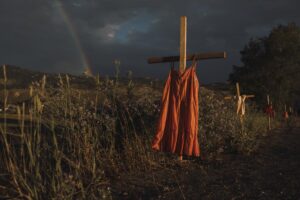
Above: This haunting image commemorating the Native American children who died at a residential school in Canada won the prestigious World Press Photo award.
⏰ Coming soon: Washington state’s nonprofit news outlet Crosscut is launching a new season of their podcast This Changes Everything focused on how the pandemic has upended the lives of students. And don’t miss CT Public Radio’s Jacqueline Rabe Thomas on April 12 talking about education and housing: “Come for a discussion about this landmark school desegregation case. Stay for the conversation around the problems we still live with.”
⏰ Segments: NPR broadcast an interview with the 2022 national superintendent of the year about the challenges schools and students are facing. Slate interviewed Politico’s Helena Bottemiller Evich about the school lunch debate. ABC’s Linsey Davis moderated a discussion about critical race theory and how the culture wars in America’s schools seem to be expanding. And education journalist and author Linda K. Wertheimer was on the podcast “On Religion” talking about her book “Faith Ed: Teaching About Religion in an Age of Intolerance.”
⏰ Recent events: Hechinger Report editor Liz Willen and a few other education journalists, including EdWeek Market Brief’s staff, were at ASU-GSV this week. At SXSW EDU, EdSurge invited K-12 and higher ed experts to talk about demoralized educators and how to move forward. You can listen here. And EWA led a presentation on whether (and how much) money really matters in improving education. Watch here.
⏰ Resources and reports: McKinsey and Company has a new report out on how COVID-19 caused a global learning crisis. The Brookings Institution looked at how districts are spending pandemic aid. EWA compiled a tip sheet on school finance reporting tools and databases. And while most schools are now open, Burbio is tracking the absence of extracurricular activities and other pre-COVID school norms.
THE KICKER
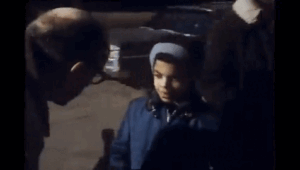
There’s “always an education angle,” notes EdWeek’s Evie Blad about this archival footage of a very young Prince talking about the 1970 Minneapolis teachers strike.
That’s all, folks. Thanks for reading!
Reply to this email to send us questions, comments or tips. Know someone else who should be reading Best of the Week? Send them this link to sign up.
Using Feedly or FlipBoard or any other kind of news reader? You can subscribe to The Grade’s “feed” by plugging in this web address: http://www.kappanonline.org/category/the-grade/feed/.
Read more about The Grade here. You can read all the back issues of The Grade’s newsletter, Best of the Week, here.
By Alexander Russo with additional writing from Colleen Connolly.
ABOUT THE AUTHOR

Alexander Russo
Alexander Russo is founder and editor of The Grade, an award-winning effort to help improve media coverage of education issues. He’s also a Spencer Education Journalism Fellowship winner and a book author. You can reach him at @alexanderrusso.
Visit their website at: https://the-grade.org/