|
While school-based COVID transmission levels have been relatively low, and outbreaks relatively rare, school district vaccination, testing, and infection notification programs remain works in progress. These ongoing adjustments are the bane of many parents and teachers’ existence — and they are the big story of the week:
🔊 Across America, Schools Cram for Their Covid Tests (New York Times)
🔊 Only 22% schools are in state’s weekly COVID-19 testing program (Denver Post)
🔊 A rocky start for Philly schools (Chalkbeat Philadelphia)
🔊 As deaths of two mothers stir outrage, Chicago promises to boost COVID testing (Chalkbeat Chicago)
🔊 Not All School Districts Implementing COVID Test & Stay Program (CBS Boston)
🔊 Pa. plan to keep kids in schools: More bus drivers, vaccine clinics and COVID-19 tests (Penn Live)
🔊 Michigan changes how it defines COVID-19 ‘outbreak’ at schools (Detroit Free Press)
🔊 State representative urges Mass. leaders to deploy National Guard for school COVID-19 testing (Boston Globe)
Meanwhile, school food programs are struggling mightily. See coverage in the NYT, AL.com, Washington Post, Education Week, KUT, and Boston Globe.
Did someone forward you this newsletter? You can sign up here. |
|
PANDEMIC IMPACT
Best education journalism of the week.
|
|
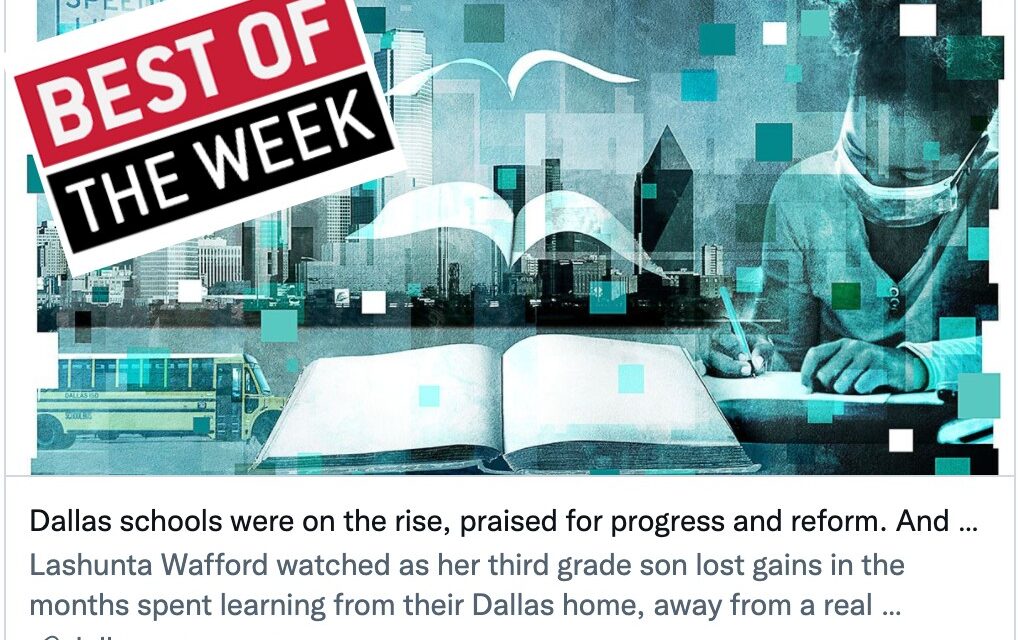
| 🏆 BEST: The best story of the week is the Dallas Morning News’ Dallas schools were on the rise, praised for progress and reform. And then the pandemic hit by Emily Donaldson, Talia Richman, and Corbett Smith, part of the Ed Lab’s “State of the City” series. Kids may be back in classrooms now, but the recovery from the pandemic is likely to take years. A decade of academic gains in math has been erased, and five years of gains in reading, too. Of course, the biggest impacts of all this falls most heavily on the city’s most vulnerable students. “Unfortunately, we’re still a tale of two cities and if we lose this generation, this whole city is going to go backwards,” the DISD superintendent said. This is one of the best and most nuanced stories on the topic of catching kids up we’ve read so far.
🏆 RUNNER-UP: This week’s runner-up is Sheriff’s Deputies Settle Schoolyard Disputes. Black Teens Bear The Brunt, a KPCC/LAist and ProPublica collaboration by reporters Emily Elena Dugdale and Irena Hwang. A months-long effort, it features data showing that sheriff’s deputies in the Antelope Valley region disproportionately detain and cite Black teens on public school campuses and includes interviews with more than two dozen current and former students. The impact on these students can last far longer than the initial punishment. “They’re turning the principal’s office into the police station,” one lawyer said. Law enforcement officials defend their efforts, noting that most referrals come from school staff.
BONUS STORIES:
🏆 Behind the teacher shortage, an unexpected culprit: Covid relief money (NBC News)
🏆 Boston students see few signs of federal recovery money (Boston Globe)
🏆 Why America has a school bus driver shortage (The Hustle)
🏆 Diverse Group of Parents Demands Better Reading Instruction (The 74)
🏆 Nearly 50 area students remain trapped in Afghanistan (Sacramento Bee)
🏆 How students are adjusting to being back at school (Washington Post)
🏆 Back to High School, After Missing So Much (New York Times)
🏆 Schools struggle with behavior as students return (Chalkbeat)
|

DIVERSE SOURCES &
IN-SCHOOL REPORTING
New from The Grade |
|
|
The first of two pieces we published this week came from journalist Kathleen McNerney, calling for education reporters to go out and find more diverse, harder-to-find sources.
“The key is being out in the field, connecting with students in their homes or hang-out spots,” writes the former WBUR education editor. Indeed.
The second piece is my call for education reporters to get back to reporting inside classrooms. Eight weeks into the school year in some parts of the country, we still have too little idea what school reopening looks like from the inside of a classroom.
As Boston Globe reporter Jenna Russell told me, in-school coverage is the reporting that “lets us tell stories that are real, rooted in actual educational experience, with all its sparks and rough edges, and it is critical to real accountability reporting.”
Thanks to John Bailey for including this week’s column in his COVID-19 Policy Update newsletter. |
MEDIA TIDBITS
Thought-provoking commentary on the latest coverage. |
|
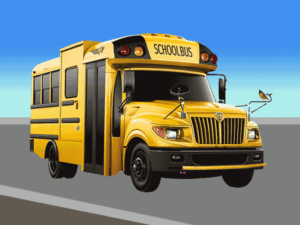
| Above: Zachary Crockett wrote a great explainer for The Hustle on what’s really behind the school bus driver shortage we’ve been hearing about across the country. He writes that it isn’t a new phenomenon, and it’s tied to systemic problems in the labor market. Give it a read if you haven’t already.
📰 ENROLLMENT STORIES ARE PARENT STORIES: News outlets are reporting enrollment declines in places like Los Angeles and Chicago, and more such reports seem likely to be on the way. It’s an important story to cover, but I hope that reporters and editors will find new ways to cover it that don’t focus narrowly or exclusively on the effects of enrollment changes on districts. Historically, news outlets tend to tell stories from the school system’s perspective. But it’s just as relevant and revealing to tell an enrollment change story from the perspective of students and parents. Where are they sending their kids now? Why did they switch or move away? How do they feel about the decision?
📰 DOOM AND GLOOM: When it comes to this year’s school reopening, the New York Times and other outlets still seem inordinately focused on setbacks and struggles. The latest example is this NYT article depicting readers’ experiences so far, which features a downcast headline and is mostly (but not all) doom and gloom: ‘I’m So Tired’: Readers Respond to Schools Reopening is the headline, and the Twitter card that first appeared when we shared it on social media featured the quote ‘Why does it have to be so difficult?’.
📰 IS IT OK TO ASK ED JOURNALISTS IF THEY’RE PARENTS? AL.com’s Ruth Serven Smith kicked off an interesting debate on Twitter when she wrote about reporters being asked if they’re parents. Sometimes it’s an honest question, she notes. Other times, it’s an effort to discredit reporters. Reporters and readers weighed in on all sides — you should, too. Want more? U.S. News’ Lauren Camera wrote a moving 2018 piece about the advantages and challenges of being a parent and an education reporter. |
|
Take this six-question survey and help us figure out what to do better in 2021-22. There’s still time! |
|
PEOPLE, JOBS, KUDOS
Who’s going where & doing what?
|
|
|
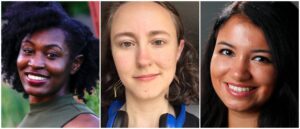
Above: Aaricka Washington, Emily Hays, and Colleen Wright have recently left their positions at Chalkbeat Indiana, the New Haven Independent, and the Miami Herald.
🔥 Departures: Aaricka Washington is leaving Chalkbeat Indiana to move to Los Angeles, where she’s looking for full-time or freelance work. The New Haven Independent education reporter Emily Hays has left for a breaking news reporting job in Illinois, she tells us. Maya McFadden is her replacement. Colleen Wright left the Miami Herald in July for the Tampa Bay Times. “It’s been the honor of a lifetime serving my hometown paper and my community,” she wrote. “It’s a dream I had since 17.”
🔥 Jobs: The Minneapolis Star-Tribune is hiring a metro reporter to cover statewide K-12 education.The Atlanta Journal Constitution is hiring an education reporter to replace Kristal Dixon, who left to become one of the co-authors of the new Axios Atlanta newsletter. The Seattle Times Ed Lab is hiring a reporter now that Hannah Furfaro has moved over to the new mental health reporting team. WBUR, Boston’s public radio, is hiring a new education editor to replace Kathleen McNerney, who recently left to start freelancing. Any new job opening out there that folks might want to know about? Let us know.
🔥 Kudos to former L.A. Times education reporter Sonali Kohli, who, after leaving the paper in June, is now editing and mentoring Cal State student journalists for the CalMatters College Journalism Network. Omar Rashad was also hired as a senior fellow to help develop the network.
🔥 New follows: Local Matters, a weekly newsletter featuring some of the best local reporting of the week and founded in part by former education reporter Bethany Barnes, is now on Twitter. I’m also now following Emily Rizzo, a freelance journalist covering education for WHYY and Next City. |
|
APPEARANCES, EVENTS
What just happened & what’s coming next?
|
|
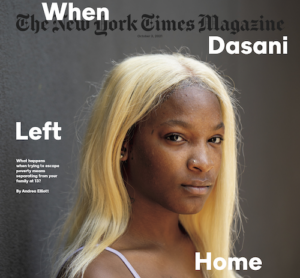
| Above: The New York Times Magazine cover story featuring Dasani Coates.
⏰ Books: Andrea Elliott’s book about the formerly homeless Brooklyn girl named Dasani is coming out next week, and an excerpt is the cover story for the New York Times magazine (above). When the original series about Dasani came out, U.S. News reporter Lauren Camera says she “diagramed every story… hoping to unlock a bit of the majesty in her craft.” The New York Times’ Erica Green says she remembers Dasani “becoming a one-word standard. It cemented for me that we don’t cover issues and subjects, we cover realities and humans.”
⏰ Media appearances: Freelancer David Zweig, who’s writing a book about schools’ response to COVID, testified before Congress about how different countries have addressed schools during the pandemic. The Oregonian’s Betsy Hammond was on WBUR public radio’s On Point to talk about what happened when Oregon dropped some of its graduation requirements. The Dallas Morning News’ Talia Richman was on NBC DFW to talk about Dallas ISD’s teacher evaluation program and its critics and challenges. And the Houston Chronicle’s Hannah Dellinger was on the Houston Matters radio show to talk about COVID in local schools.
⏰ Upcoming: The annual Grantmakers for Education virtual conference (Oct. 12-22) has two journalism-focused panels, one on impact journalism featuring Dallas Morning News Ed Lab editor Eva-Marie Ayala and and the other on the importance of funding journalism, featuring former U.S. News education writer Tom Toch. You can also register now for EWA’s next webinar Oct. 5 on data and COVID learning disruption.
⏰ Trying to better understand the data behind COVID outbreaks and schools? Check out this recent piece from The Journalist’s Resource’s Denise-Marie Ordway on how teachers and school staff play a central role in COVID-19 outbreaks on campus, according to research.
Did someone forward you this newsletter? You can sign up here. |
|
|
|
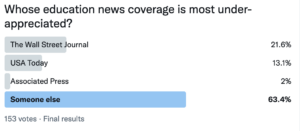
Asked whose education news coverage is “most under-appreciated,” a small and highly self-selected group of respondents did not favor the listed options, which were The Wall Street Journal, USA Today, and Associated Press. Some suggestions were the New York Post, the San Francisco Chronicle, and Chalkbeat. Click here to see what else was said — and add your recommendation.
|
|
|
That’s all, folks. Thanks for reading!
Reply to this email to send us questions, comments or tips. Know someone else who should be reading Best of the Week? Send them this link to sign up.
Using Feedly or FlipBoard or any other kind of news reader? You can subscribe to The Grade’s “feed” by plugging in this web address: http://www.kappanonline.org/category/the-grade/feed/.
Read more about The Grade here. You can read all the back issues of The Grade’s newsletter, Best of the Week, here.
By Alexander Russo with additional writing from Colleen Connolly. |
|
|
|
|
|