|
|
| NOT SO FAST!The big education story of the week |
|
| MISSING STUDENTS; THE PLIGHT OF CHILDCARE WORKERSThe best education journalism of the week |
|
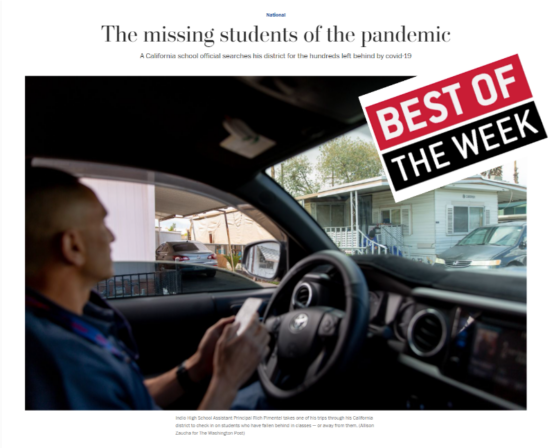
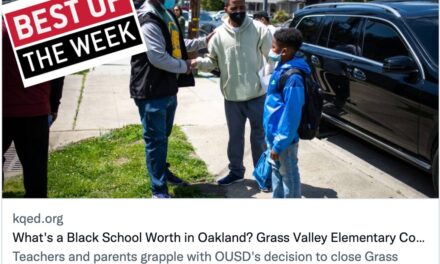
| 🏆 BEST: This week’s best story is The missing students of the pandemic by Eli Saslow in the Washington Post (above). The story follows an assistant principal at a California school serving mostly low-income and Latino students where attendance fell from 94% to 70% during the pandemic. He spends one day a week driving across the Coachella Valley looking for hundreds of missing students. The story puts a human face on the toll of missing students and includes one of the most haunting lines in pandemic education coverage: “ ‘Visit unsuccessful,’ he wrote. ‘Student’s location unknown.’ ”🏆 RUNNER-UP: The runner-up this week is Eliza Shapiro’s Why Child Care Staff Had to Show Up While Teachers Worked Remotely in the New York Times. In it, Shapiro asks a crucial question that was often forgotten in the last year: Where do the child care workers, who have been supervising and caring for children in person, fit into the reopening debate? “We were deemed essential workers,” said one woman who runs a Brooklyn child care center for mostly low-income Latino students. “But if teachers are in Department of Education schools, they were not essential workers.” The story examines the hierarchy among school workers and the inequities that exist there. It received a lot of praise from readers, but also a critique from media critic Dan Kennedy who said stories like this perpetuate the myth that all teachers have been working remotely.To get daily education headlines and education news events, follow @thegrade_. |
|
LINGERING QUESTIONS FROM THE REOPENING SUMMIT
New from The Grade |
|
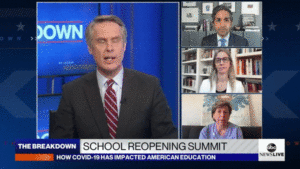
| In this week’s column, I suggested some key questions about Wednesday’s national school reopening. Would the Biden administration strengthen or weaken its support for the three-foot rule and the full-time in-person definition of a reopened school? Why were Tulsa, Cleveland, New York City, and Cajon Valley, Calif., school districts featured? The Biden reopening effort continues to experience numerous challenges, according to Politico and other outlets, including some issues you may not have considered: aging bus drivers and vaccine scarcity. However, the summit itself went off without much of a hitch. It certainly didn’t hurt things to announce the release of $81 billion in new money on the same day. You can read write-ups from The 74 and US News. |
|
| 🎁 There were two great stories this week about places where schools have been open for months: Rural California schools have been open for months. It’s taken a learning curve by Hailey Branson-Potts in the Los Angeles Times and Some Schools Have Been Open for Months. Here’s What They Learned by Sarah Toy and Douglas Belkin in the Wall Street Journal. While much attention is focused on the struggles to reopen, these stories provide necessary context and evidence that schools can indeed open.🎁 Don’t miss Nader D. Issa’s Toxic CPS-CTU feud simmers under surface of latest reopening talks. Things are going from bad to worse in Chicago, and this story details the backstabbing, hypocrisy, and ill will being acted out behind the scenes and in public. It’s not pretty, but it makes for great reading.
🎁 The Boston Globe’s A year of grit and despair focuses on a year in the life of one class of newcomers, immigrant English learners who are already at risk of not completing their education. “Sheer grit would carry some of the 11 students in Mr. Espínola’s class through the crisis,” write Bianca Vázquez Toness and Jenna Russell, “but grit was not enough. Some would falter, some would fail, and some simply disappeared.” |
|
 |
| MEDIA TIDBITSThought-provoking commentary on the latest coverage. |
|
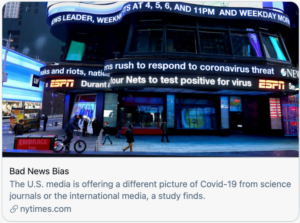
| 📰 BAD NEWS BIAS: For months, I and others have been raising the possibility that COVID coverage has been excessively negative, overemphasizing risks to teachers and school outbreaks. But I’m hoping this week’s New York Times’ write-up might cause more folks to pay attention. “When Covid cases were rising, the news coverage emphasized the increase,” writes David Leonhardt. “When cases were falling, the coverage instead focused on those places where cases were rising.” Yes, it’s an irony that the piece was published in the Times, which has been among the worst offenders. But some journalists have already responded, and perhaps others are still going to do so. Still not convinced? NPR’s recent story about how “fearmongering vaccine stories go viral” details how factually accurate but misleading stories from established news outlets dominate social media. “On some days, 25% or more of the top vaccine stories on social media were about a person who died after being vaccinated.”📰 SOBERING BUT INCOMPLETE REOPENING DATA: The results of a new U.S. Department of Education survey released Wednesday found that nearly half of students are still being taught remotely (EdWeek, Washington Post), and highlighted significant disparities among kids receiving in-person instruction (AP, NPR). Some remote students are getting very little live instruction (Chalkbeat). However, many big city districts where reopening has been slower did not participate, and the survey does not tell us whether in-school instruction is provided by a teacher in the classroom or remotely. The survey is not able to tell us whether lower rates of participation in classroom-based education are attributable to parent preference or lack of availability.
📰 “LEARNING LOSS”? Confused about this whole “learning loss” debate? You’re not alone. I’ve asked a few researchers to comment on whether it’s appropriate for reporters to use it. “We’re using the term learning acceleration and recovering lost learning time to communicate that kids are always learning,” LPI’s Linda Darling-Hammond told me. “We don’t want a deficit frame when they return to school, but we do want to recover that time and accelerate their learning.” Stanford’s Sean Reardon thinks it’s OK to use the term, as long as it’s clear you’re talking about groups rather than individuals’ regression. “We can talk about learning loss when students don’t learn as much as they would have in the absence of the pandemic,” writes Reardon. “I do think people might interpret it as ‘knowledge loss’ or ‘skill loss’ — as if individual students know or can do less now than they could a year ago. so, as always, journalists and researchers should define their terms in context.” |
|
 |
NEW JOBS & GOOD NEWS
Who’s going where & doing what? |
|
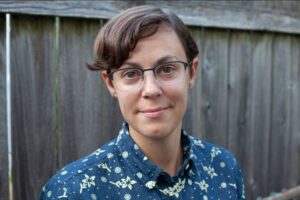
| Above: Big congrats to freelance writer Casey Parks who just won a J. Anthony Lukas Prize Project Award for her book “Diary of a Misfit.” “I cried a lot a lot when they called to tell me I’d won,” Parks wrote on Twitter. “I’ve spent twelve years working on this, mostly believing myself incapable.” In a 2018 interview with The Grade, Parks shared techniques for making characters more than archetypes – even on deadline.🔥 Comings and goings: Olivia Sanchez, former local government reporter for the Capital Gazette, is the Hechinger Report’s newest Washington reporter. Seattle Times Ed Lab alum Claudia Rowe is now writing education op-eds for Crosscut. CalMatters is hiring a K-12 education reporter to replace Ricardo Cano, who’s headed to the SF Chronicle (and another beat). Also, here’s the education reporter job posting at the Texas Tribune since Aliyya Swaby left her post last week.
🔥 Former Spencer Education Journalism fellow Mitra Kalita went from leading coverage of the world at CNN to connecting her neighbors in Queens. “What good am I as a journalist if I don’t use those skills of journalism to better uplift my neighborhood?” she said. Chalkbeat CEO Elizabeth Green talked to Dame about her trajectory from beat reporter to the C Suite, all in the pursuit of local education coverage. Anya Kamenetz talked about teens and mental health Thursday on Twitter Spaces (think Clubhouse, but on Twitter) with NPR Life Kit.
🔥 Good news from EdWeek’s Scott Montgomery, who says that the outlet is interviewing for two new race and equity reporters. One of them will replace Christina Samuels, who covered the beat from 2018 until her departure for Hechinger in January. The other will replace Cory Mitchell, who left in February for the Center for Public Integrity. Daarel Burnette II was named Assistant Managing editor last fall, replacing Lesli Maxwell, who is now ME. Maxwell replaced Kathleen Kennedy Manzo, who left EdWeek last year. You can see the current masthead here.
Did someone forward you this newsletter? You can sign up here. |
|
EVENTS, RESOURCES
What just happened & what’s coming next? |
|
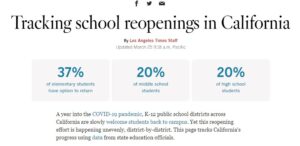
| Above: The LAT has a cool new school reopening tracker. As of Thursday, just 37% of elementary students have the option to return. The LAT is also launching a newsletter focused on education, written by Sonja Sharp with support from the ed team.⏰ Join Dallas Morning News’ Education Lab leader Eva-Marie Ayala for a conversation about solutions to help students succeed on Wednesday at 1 p.m. Eastern. The panel will include students, parents, education experts, and educators. Details, including registration for the virtual discussion, are here.
⏰ Poynter’s Director of Training and Diversity Doris Truong debuted a new monthly newsletter last week, The Collective, focused on diverse voices within and outside the newsroom. It aims to “to lift up and amplify voices we aren’t always hearing — something we have to do a lot more of in our industry and with our work,” Local Edition newsletter’s Kristen Hare says.
⏰ Also: There’s a new community on Slack for journalists who want to make newsrooms antiracist. |
|
 THE KICKER THE KICKER |
|
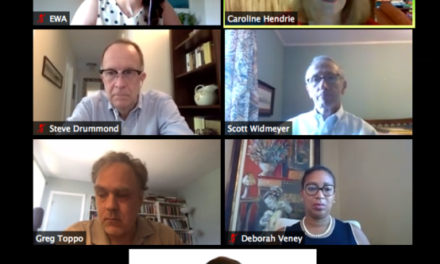
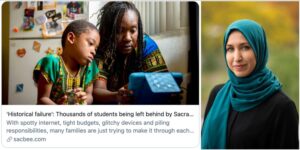
| The Sacramento Bee’s Sawsan Morrar (above right) is closely following the reopening story as well as looking at socioeconomic inequities in programs like free lunch programs. A school district began to deliver meals to students’ homes after a story she wrote mentioned the issue. “If we helped only one family, that’s enough,” Morrar told us. |
|
| By Alexander Russo with additional writing from Michele Jacques and Colleen Connolly. |
|
| That’s all, folks. Thanks for reading! |
|
|
|
|
|
|