| BEST OF THE WEEKThe week’s best education journalism, all in one place. |
|
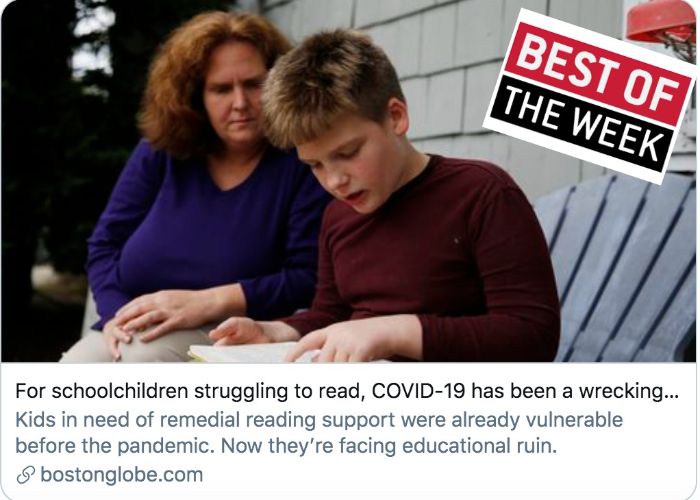
| 🏆 BEST: The best story of the week is the Boston Globe’s For schoolchildren struggling to read, COVID-19 has been a wrecking ball by education editor Sarah Carr. The lack of accountability she describes is stunning. The lack of necessary services will likely make you angry. The runaround parents get is indefensible. “Some of the families I interviewed went into the pandemic with a clear sense of their child’s disability,” writes Carr. “Others had mistakenly been told for years that their child had an emotional or behavioral disability.” New York Times education reporter Eliza Shapiro describes Carr’s piece as “easily one of the most important of the pandemic.” New York Daily News’ Michael Elsen-Rooney called it “vital reporting.”🏆 RUNNER-UP: This week’s runner-up is Covid, Schools, and the High-Stakes Experiment No One Wanted by Sandra Upson in Wired magazine, which has published several important pieces during the pandemic. Centered on an Orlando elementary school, Upson takes us along on a school reopening roller-coaster ride with great reporting and vivid writing: “To be an elementary school principal is to be an emperor in a snow globe,” she observes. Asked about the experience, Upson says she never came to the clear conclusion about reopening that she assumed she’d discover. “It’s deeply maddening that we have collectively learned so little about how to manage schools in a pandemic.”
🏆 BONUS: On Thursday, the NYT published an impressive seven-piece package called 13,000 School Districts, 13,000 Approaches to Teaching During Covid, featuring some districts that have become familiar (Los Angeles; Washington, D.C.; Providence, Rhode Island; Cherokee County, Georgia) and others that may not be (Edison, N.J.; Lubbock, Texas). My favorite among them is The Board Voted to Keep Schools Closed. Parents Revolted, Jill Boseman’s depiction of the conflict among parents and educators in Wausau, Wisconsin. Check out the behind-the-scenes look at how they did the series. |
|
| HOW TO TACKLE UNCERTAINTY & FEAR |
|
| There aren’t a ton of truly veteran education reporters still working at newspapers these days, so it was a great pleasure to hear from the San Francisco Chronicle’s Jill Tucker about what it’s like covering a tough topic at a particularly challenging time. “What’s different about covering education during the pandemic isn’t the controversy or mastering new material,” Tucker said. “It’s working in and around intense levels of fear.” In this interview, she tells us how she does it.ICYMI: Last week, contributor Colleen Connolly wrote about how education reporters can use solutions journalism to escape the remote learning rut. The Solutions Journalism Network’s Matthew Kauffman recommends marrying data with solutions for stellar reporting. “Education is a great beat for data-oriented solutions reporting,” he tells us. There are lots of data, and education writers “have a keener sense than most of the bigger picture and are more inclined to dig more deeply into a topic.” |
|
| REOPENING/REMOTEThe big story of the week — again. |
|
| MEDIA TIDBITSThought-provoking commentary on the latest coverage. |
|
| Above: CNN’s Anderson Cooper interviews Amanda Gorman, the young poet whose performance at the Biden-Harris inauguration captivated so many of us. There’s a great education story behind Gorman. An LA Times profile of Gorman reveals that she attended a diverse private school in LA and her mother is a middle school social studies teacher. Proving once again that life is complicated, Gorman’s mom appears to work at a local charter school. 📰 ALARM BELLS OVER THE CINDY MARTEN NOMINATION: Weeks after his announcement, we still don’t really know how Miguel Cardona came from out of nowhere to be the new administration’s Ed Sec nominee. And there are some important questions about deputy secretary nominee Cindy Marten from journalists who covered her in San Diego. “When her handpicked comms director joked about murdering a Voice of San Diego reporter, she declined to fire him,” tweeted managing editor Sara Libby, referencing this unsettling 2016 situation. “In 10 years as a reporter, I’ve never worked with a more hostile, dishonest, obstructionist, gaslighting comms office,” former VOSD education reporter Mario Koran told us, pointing to Marten’s poor record when it comes to transparency. Now is the time to start the accountability reporting — not in six months or a year.
📰 MISTAKEN ASSUMPTIONS ABOUT PODS — AND TEACHERS UNIONS: Asked about the implications of a new survey of parents for education coverage, Harvard education professor Martin West pointed out the obvious need for systemic data and highlighted findings that raise questions about coverage of upscale pods and the backlash against teachers unions. Pods turn out to be relatively common among less affluent families. And parents’ perceptions of the quality of the teachers in their local schools have edged up slightly, according to West. Ditto for parent perceptions of teachers unions. “If anything, parents’ views of union influence have grown more favorable.” What else are we getting wrong about the coverage? I fear the list is long.
📰 DISTRICT-DEPARTING FAMILIES: It’s no longer news that districts are reporting lower enrollments, but who are the families that are leaving the system and where are they going? What does the experience look and feel like? There’s been some coverage from the Christian Science Monitor, TIME, and other outlets, but much of it is from the end of summer. My weekend query generated roughly 150 responses from parents and others.
📰 “HOOEY” TO COVERAGE CRITICISM: Education journalists including USA Today’s Erin Richards and the SF Chronicle’s Jill Tucker reject criticism that their coverage has been overly sanguine about reopening risks. “That’s hooey,” tweeted Richards. “We’ve accurately reported the scientific findings as they’ve changed.” The general consensus to reopen “has been among the health experts, not journalists,” noted Tucker.
Missed some previous editions? You can see the archive of past newsletters here. |
|
 |
PEOPLE, AWARDS
Who’s going where & doing what? |
|
| Above: The Texas Tribune’s Aliyya Swaby was on Jeff Pearlman’s podcast “Two Writers Slinging Yang” where she talked about “building trust with sources, why more reporters should learn how to interview children and the process of telling a story about a child who considered suicide.”🔥 Ed reporters on other beats: The Washington Post’s Hannah Natanson covered the Biden inauguration, but getting there wasn’t easy. Politico CA’s Mackenzie Mays wrote about inequality and a tale of 2 Californias. And U.S. News & World Report education reporter extraordinaire Lauren Camera wrote this deeply personal thread about a childhood friendship fractured by political radicalization — and what happened when she tried to confront her friend’s strongly held beliefs.
🔥 The Seattle Times’ Joy Resmovits is wasting no time in her recent transition from Ed Lab editor to reporter. This week, she published a three-story series on learning loss in Seattle. Her thread offers behind-the-scenes insights into how it came together. Read Part 1 on how much learning students have missed, Part 2 on how one district is using a strategy for “gifted” students for everyone, and Part 3 on standardized testing.
🔥 About that alarming front-page New York Times story on screen time: NPR’s Anya Kamenetz offered some suggestions for parents, including “don’t panic” and “practice harm reduction.” Greg Toppo also took issue with the piece, accusing it of “misplaced fretting” and challenging the whole notion of screen time: “When we discuss nutrition, we don’t talk about ‘plate time,’ ” Toppo tweeted. “We ask, ‘What did you eat?’ ”
🔥 Welcome to the ed beat! Southern Maryland News reporter Madison Bateman is switching beats from government to education. So long, Krista Torralva, who’s leaving the San Antonio Express-News for another beat at the Dallas Morning News. “I gave this beat my all,” she tweeted. “So much respect to all the devoted education reporters.” Read the whole thread here.
🔥 RIP, Robert Rothman, formerly of Education Week. “Bob was a beautiful writer and kind, caring soul fueled by a super smart brain,” wrote Danica Petroshius, a former Hill staffer who worked with him over the years.
Did someone forward you this newsletter? You can sign up here. |
|
EVENTS
What just happened & what’s coming next? |
|
| ⏰ Jobs: Education Week is hiring two education reporters to cover school finance and race and opportunity. EdSource is still looking for an executive director. The Hechinger Report is hiring a DC-based higher education reporter. Searchlight New Mexico is hiring an investigative education reporter. And the San Antonio Express-News is looking for an education reporter to replace Krista Torralva.⏰ Audience engagement: Chalkbeat NY and The City are holding virtual open newsroom events with community members and readers on Jan. 27 and 30 to talk about special education.
⏰ Helpful reports: The Center on Reinventing Public Education’s Robin Lake shared its Evidence Project report on failing students, calling it “very sobering stuff.” EdWeek’s Evie Blad sent out an alert on its latest tracker showing where teachers are eligible for vaccines. Editor-in-chief of EdNext and Harvard professor Martin West reported on parents’ experiences of the pandemic.
⏰ Watch for Tuesday’s release of the EWA “State of the Education Beat Report,” with the New York Times’ Erica L. Green and others.
⏰ Don’t forget! There’s just over a week left to apply for the Spencer Education Fellowship. It’s the education beat’s Golden Ticket. |
|
 THE KICKER THE KICKER |
|
| The Hechinger Report engagement editor Nicole Dobo shared this sweet story about a time when she was a local reporter in Delaware and Joe Biden was vice president. |
|
| By Alexander Russo with additional writing from Michele Jacques and Colleen Connolly. |
|
|