Hyper-negative coverage by the largest U.S. media outlets may be playing a role in terrifying the public and keeping kids out of schools.
By Alexander Russo
Despite increasing COVID infection rates, New York City public schools are reopening today for in-person instruction after a two-week break.
However, despite parent protests in other parts of the country, NYC schools appear to be the exception to the general trend. With the pandemic raging, more and more U.S. school systems seem to be cutting off or delaying in-person instruction.
On the surface, shutting down might seem to make a lot of sense. But several European nations have managed to reopen schools. U.S. school reopening efforts have not generated outbreaks or contributed to community spread in the ways that were expected.
These tentative successes, plus ever-growing concerns about the impact of a prolonged shutdown on vulnerable kids, suggest that U.S. schools can and could or should be open.
There are many plausible explanations for why that isn’t the case, including anti-Trump sentiment in blue states, our highly decentralized system of education, teachers union opposition, and long-standing mistrust of school systems.
However, there may be one other major factor at play: excessively negative coverage of the COVID crisis by the largest U.S. news outlets, such as the New York Times and NBC News.
Long suspected by me and a few others, the pervasively negative coverage of these large U.S. news outlets appears to be confirmed by a new report by Dartmouth and Brown researchers who compared domestic coverage to English-language coverage produced in other nations.
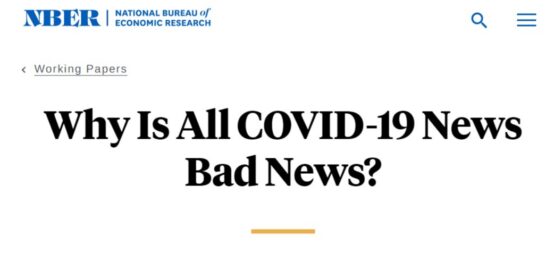
Above: A new NBER working paper, “Why Is All COVID-19 News Bad News?”
For weeks now, if not months, some of us watching media coverage have believed U.S. media coverage of schools was amplifying fears and focusing attention on dramatic but atypical situations: outbreaks, parental reluctance, deaths of school staff.
Now, a new study finds that major U.S. media coverage of COVID has been extremely negative — much more so than that in other English-language publications outside the U.S. or smaller U.S. media outlets.
Titled Why Is All COVID-19 News Bad News?, the report was published last month as an NBER working paper. The gist of its findings are that the largest U.S. mainstream outlets have covered the COVID crisis in a way that is measurably more negative than other places, at least when it comes to English-language outlets.
“Ninety-one percent of stories by U.S. major media outlets are negative in tone versus fifty-four percent for non-U.S. major sources and sixty-five percent for scientific journals,” notes the report.
Not only was the coverage more negative in the U.S., it remained so in the face of ostensibly good news: vaccine development, declining case rates, and school reopening efforts.
“Ninety percent of school reopening articles from U.S. mainstream media are negative versus only 56 percent for the English-language major media in other countries,” according to the working paper.
It’s not just liberal or conservative outlets that skew negative, the report finds. Fox News skews just as negative as CNN.

Above: Green line at the top shows the highly negative US coverage, compared against English-language news outlets outside the U.S. (in blue) and the COVID case count (in red).
Some may question the comparison between U.S. and European experiences, write the study off as a cheap shot, or raise issues with the findings, which focus on the largest 15 U.S. news outlets. Journalists on other beats – health, science, etc. — may be more concerned about coverage that’s tended toward simplistic credulity.
And the study has won a certain amount of attention, much of it from right-leaning people and publications. The report has not generated much attention from journalists that I know of.
But you don’t have to be Republican or conservative to reflect on whether the media has been overly negative in ways that are not helpful.
Over and over, I have written about alarmism in school COVID coverage, the amplification of fears, the transformation of students into safety threats, the downplaying of tentative successes at reopening schools in person, the near-invisibility of vulnerable kids. And I’m not alone among journalists in having expressed concerns about the coverage that’s being produced.
And if the report is right in some basic way, as I tend to believe it is, no wonder so many educators and parents have such a strong sense of the safety risks of school reopening. They think they are likely to catch the disease and die. And they see their fears repeated and amplified in the news.
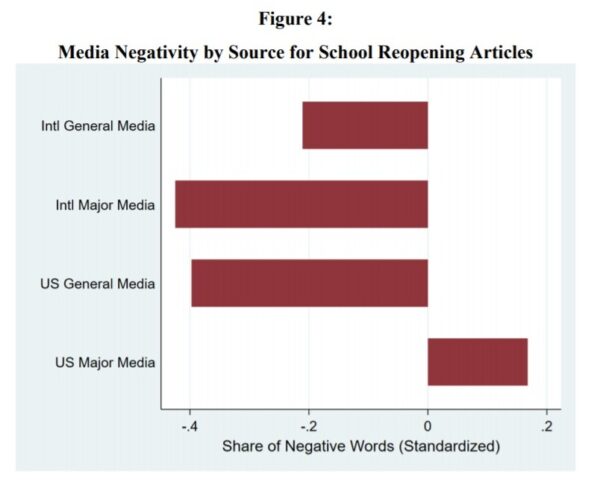
Above: In school reopening coverage, the largest U.S. media outlets (bottom bar) were much more likely to depict a critical storyline.
Why does it matter, and why has the coverage been so negative from the largest U.S. media outlets?
The coverage matters because it shapes public opinion and policy decisions officials make. In the case of schools reopening and COVID, more kids might have gotten in-person options if parents, teachers, and the public weren’t so terrified.
The underlying reasons aren’t so easily explained. One possibility given in the report is that U.S. readers “strongly prefer negative stories about COVID-19, and negative stories in general” more than their European counterparts, especially those who read the largest media outlets.
Other possible explanations include a political bias among journalists toward President-elect Joe Biden, who has until very recently emphasized school safety concerns, and the continued downsizing of the journalism industry that’s making outlets desperate for high-readership stories.
My own belief is that the intensity of fears being amplified on social media and the relative invisibility of vulnerable children in most journalists’ daily lives may have also played a role, especially at the national level. Social media streams filled with caskets and references to dead kids and a lack of regular exposure to vulnerable students’ experiences was a toxic combination.
ABOUT THE AUTHOR

Alexander Russo
Alexander Russo is founder and editor of The Grade, an award-winning effort to help improve media coverage of education issues. He’s also a Spencer Education Journalism Fellowship winner and a book author. You can reach him at @alexanderrusso.
Visit their website at: https://the-grade.org/