The selection of a new section editor creates an opportunity for the paper — and everyone else — to rethink conventional education coverage.
By Alexander Russo
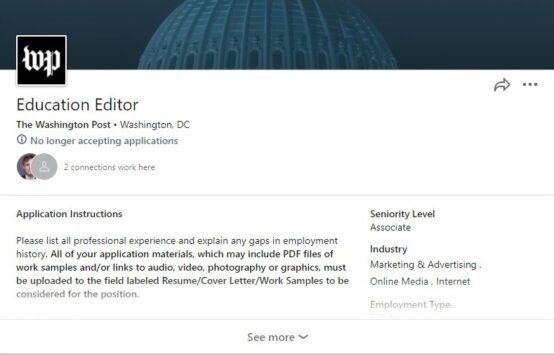
The Washington Post announced earlier this month that it was looking for a new education editor — one of the biggest jobs in education journalism.
“The Washington Post seeks an experienced editor to run our education team – a crucial subject at a critical time,” states the job announcement. In the midst of the coronavirus, the paper is “looking for an editor who can guide an extraordinary group of reporters in capturing the disparate dimensions of this evolving crisis.”
It’s a critical time for the nation and its education system. But it’s also a key moment for the Post’s education section — and for education journalism writ large. With some notable exceptions, education journalism has experienced a decline in staffing and resources along with the rest of the journalism business — and has been struggling to address some of the questions and concerns about how journalism has traditionally been practiced.
Under the leadership of owner Jeff Bezos and editor in chief Marty Baron, the Post’s education team is one of the largest groups at the outlet — and may be one of the biggest in the nation in a legacy newsroom. It produces serious education coverage, some of it very good. (Perry Stein’s new piece about the impact of violence on student learning is just the latest example.)
However, a national paper with a team this size should be doing outstanding coverage — investigative, groundbreaking, noteworthy work — at a level that hasn’t so far been achieved with any great regularity. A new editor is a chance to take that important step. And it creates a clear opportunity to sketch out some ideas for what the Post could do with its education coverage in 2020-2021 and beyond — some of which are relevant to the education beat anywhere.
It’s a critical time for the nation and its education system. But it’s also a key moment for the Post’s education section — and for education journalism writ large.
Brought on two years ago, national education reporter Laura Meckler has done strong work. I admired her reconsideration of the dominant segregation narrative last year, and her willingness to partner up with reporters on other beats to cover COVID. Her partner on the K-12 national beat, Moriah Balingit, is a rising star whose talents I have noted several times in the recent past. Local K-12 reporters Hannah Natanson, Perry Stein, Donna St. George, and Lauren Lumpkin are all doing good work, too.
However, the Post has experienced turnover in the leadership of the education section. Three years ago, Stephen Smith came from the Boston Globe to run the section. Before that, Nick Anderson and Josh White edited the section, among others.
And the Post’s K-12 education coverage has not improved as much as one might expect from the dark days before Bezos bought the paper and Baron took over, when the staff and its ambitions were much smaller.
Even now, too little of the Post’s education coverage is written in a way to show national significance. Meanwhile, the competition has been intensifying. The New York Times hired Erica Green from the Baltimore Sun and just announced a new foundation-funded endeavor that could add to its already formidable education content. USA Today has launched an expanded national education team and is in the process of expanding its staff, at least partly with foundation support. The Wall Street Journal recently tapped Chastity Pratt to be its new education editor, a new position heading a national team of education reporters.
“If you want to know about the fight over redrawing school zones in Montgomery County, MD, the Post is (just) fine,” quipped one close observer. “But if you want to learn how Montgomery County’s fight compares with similar integration efforts across the country, you should read the New York Times.”
But there’s no reason that the Post and its new section editor can’t do as well as or better than anyone else in the nation. In fact, there’s no excuse if it doesn’t.
A national paper with a team this size should be doing outstanding coverage — investigative, groundbreaking, noteworthy work — at a level that hasn’t so far been achieved with any great regularity.
Here are some of the critical decisions and strategies that the Post needs to consider, including some suggestions that might be relevant to other education teams and publications. Reining in Valerie Strauss’ outsized role is just a starting point.
COVERAGE
RIGHT-SIZE STRAUSS’S ROLE: As I’ve noted several times in the past, including earlier this year, the education section is currently dominated by the prolific bloggery of columnist Valerie Strauss, whose one-note pro-teacher posts and guest columns eclipse and skew the reported education news being provided by her colleagues. The over-reliance on Strauss is a problem that isn’t going away. It’s hard to imagine a much-improved education section that doesn’t include a serious reconsideration of an arrangement that I find confusing to readers and embarrassing to the Post.
LEVEL UP THE COVERAGE: By and large, the Post’s national education coverage seems predictably hostile to the Trump administration and sympathetic to classroom teachers. For a national outlet with top-level ambitions, the coverage is too often basic — simplistic stuff, red meat for core liberal readers and educators. But the coverage has not generally been smart about what’s going on behind the scenes or innovative in how it goes about producing stories. And when topics get hot – think last summer’s focus on Joe Biden and busing – the coverage seems to dumb things down in the rush to win the story rather than to smarten things up. To gain readers and keep them informed, the coverage will have to address nuances and tensions below the surface.
NATIONALIZE LOCAL STORIES: “I wish the Post covered the local schools as the national stories they are,” said one expert source who didn’t want to be named. “Large and small, each of the districts in the DC metropolitan area holds national importance.” Indeed, local reporters at the Post cover the much-gentrified city and increasingly diverse suburbs but their stories are rarely featured nationally or put in a national context. Too often, Post stories feature what’s going on in one local district but don’t shed light on how its neighbors are doing or how they fit into a national narrative. That’s a shame and could be easily rectified. One model for this approach is the USA Today education team, which makes abundant use of local and regional education reporters in weaving together national stories.
CREATE A WEEKLY COLUMN: Especially in this fast-moving, highly polarized news environment, readers need someplace they can go to understand the big story of the week or get an overview of what’s going on. Margaret Sullivan performs this invaluable function for the Post on the media beat. However, the section’s two current education columnists, Valerie Strauss and Jay Mathews, do not, each advocating their particular interests and positions rather than providing any real overview of the current debate. Some possible contenders for the spot would be Sara Mosle or Amanda Ripley, two veteran writers with great experience and understanding of education issues, as well as Laura Slover, who was Slate’s education columnist for a couple of years. I’m sure there are others.
STAFFING
FIND A VISIONARY TEAM LEADER: The Post nearly always finds talented, competent journalists to fill open jobs. But it doesn’t always find visionary, inspired people who can take the coverage in new directions. It’s a good sign that the job posting notes that experience covering or editing education is “desirable but not necessary.” The best person may not come from inside the ranks of education journalism, or even from traditional newsroom journalism.
DIVERSIFY THE TEAM: The Post does not participate in The Grade’s annual newsroom diversity update, but it seems clear that, with a couple of notable exceptions, the Post’s education team is overwhelmingly white. The effects of having white middle-aged editors on coverage has been widely documented of late, including this recent American Prospect piece. In an ideal world, the new editor will be a journalist of color and so should some of her next hires. There’s lots of talent out there! A small but growing number of education teams are now headed by journalists of color, and the impact is clear on the stories that are being assigned and how they’re being written.
REDUCE TURNOVER: One of the biggest problems at the paper has been the practice of bringing young talent in to cover education and then moving them to other beats. Turnover is one of the big reasons that the Post missed the DC schools grad rate scandal happening under its nose a few years ago. Some may want to move on to other beats — it’s their choice, for sure — but the pressure to take the offer can be strong. In June, former education reporter Alejandra Matos described her bittersweet experience being offered a permanent job at the paper but not covering education.
POACH A STAR OR TWO: While the current education team is strong, it doesn’t have any breakout/name-brand stars. If budget allowed an additional hire or two, one obvious talent to poach would be the Times’ Erica Green, who is now on book leave but who has recently been underutilized in her post on the Washington Bureau, rather than the national desk. Another would be Bethany Barnes, who produced some amazing work at The Oregonian before heading down to the Tampa Bay Times. They may be happy where they are, but it can’t hurt to try to win them over.
“If you want to know about the fight over redrawing school zones in Montgomery County, MD, the Post is (just) fine,” quipped one close observer. “But if you want to learn how Montgomery County’s fight compares with similar integration efforts across the country, you should read the New York Times.”
There are lots of other things the Post could do on education, including starting a weekly newsletter, tightening up its fact-checking of opinion pieces, and hiring an engagement person. But any or all of the above would represent major improvements.
The job announcement has been taken down, though you can see an old version on LinkedIn. There’s no word yet on who’s going to get the spot. However, an announcement — and ideally some improvements — could come shortly.
ABOUT THE AUTHOR

Alexander Russo
Alexander Russo is founder and editor of The Grade, an award-winning effort to help improve media coverage of education issues. He’s also a Spencer Education Journalism Fellowship winner and a book author. You can reach him at @alexanderrusso.
Visit their website at: https://the-grade.org/