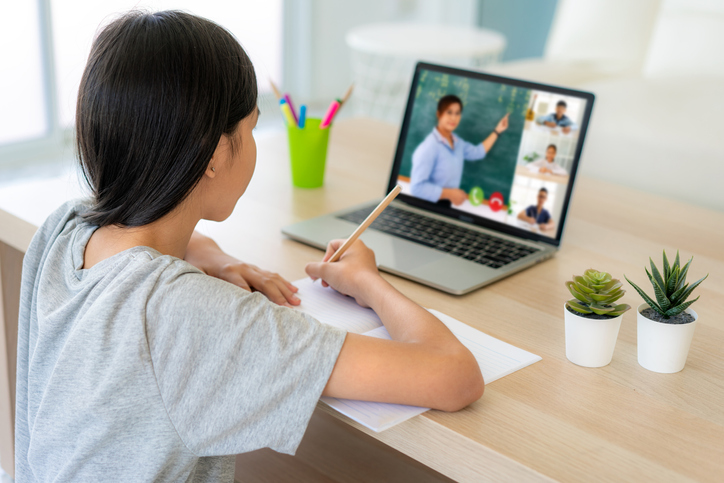
Q: I just finished my teacher training, got my dream job in an elementary school in Virginia, YAY, and am about to meet my students for the first time and start teaching. I’m so excited! And freaked out! And having second thoughts! Because IT’S ALL GOING TO BE ONLINE. I’m sorry for the screaming all-caps, but it’s stressful enough to be a new teacher without feeling like students’ parents will be judging my every move as they walk past their kids at the kitchen table, and I won’t have the ability to really see those “aha” and “I’m confused” moments and know when I should adjust what I’m doing, and I can’t physically interact with them, and I know a lot of them won’t be in the best place emotionally, and — please don’t tell anyone — I really don’t know what I’m doing. And oh, I’m not in the best place emotionally. Like I said, I’m freaking out.
Add to all of that many of my students may not come to my class much at all, based on what the district knows from the spring. I’m just worried about everything. Bonding with them. Looking stupid in front of my principal who will be “dropping in” to check on me. He told me it won’t be evaluative and that he just wants to support me, but I’m not sure I believe him. I’ll be a wreck when he shows up because I’ll be a wreck ALL the time! Despite my second thoughts, though, there’s no turning back, so please get me in the right headspace and tell me what I should do so I don’t bomb. Thank you!
A: For what it’s worth, you did a fantastic job communicating why you’re distressed, and that’s half the battle. When you can tap into the sources of your discomfort, you can deal with your emotions, start working on solutions, and stop wasting time on stuff you can’t fix. But let’s start with the big picture. It’s stressful to start a new job under any circumstances, let along remotely in the middle of a pandemic. Many experienced teachers feel like a first-year teacher right now, so you’re not alone. And some of the anticipatory dread you’re describing will resolve once you can actively engage with students, see that most parents are juggling too much to be analyzing your every move, and realize that most kids simply want to connect with caring adults, see their friends and have some normalcy. You’ll also have less time to marinate in your own extreme thoughts.
For now, take a “both/and” approach. Tell yourself, “I’m excited about landing my dream job and I’m worried I won’t have what it takes.” Or, “I’m great at making kids laugh, and I’m sad that I won’t be able to bond with them in person.” You’re entering the teaching profession for the long haul, and this will be a blip along the way. On the upside, that blip has the potential to help you throughout your career. You’ll be able to approach future challenges with the confidence and equanimity of someone who taught in 2020. In the meantime, focus on the things you know you do well, whether that’s thinking quickly on your feet, coming up with creative brain breaks, reassuring a frustrated kid, persevering when you’re stuck, or relating to kids’ esoteric interests. If you only focus on what could go wrong, you’ll magnify your worries.
Let’s shift to more practical considerations, such as training and support. Your principal has told you that he’ll be dropping in to check on you, so take him at his word. He’ll have to earn your trust over time, but you can start by assuming positive intent. Will the school be assigning you a mentor? If not, consider asking for one. Look for other sources of support, too, such as a Mastermind Group for new teachers or closed educator support groups on social media. Follow other educators and read relevant publications online and start creating a virtual professional learning community. Stay in touch with former classmates and exchange ideas and experiences. Attend available training sessions, including ones on trauma-informed practices. If you have a mentor, ask them to help you set reasonable, attainable goals. The more people you talk to, the more you’ll discover that everyone is feeling insecure and uneasy about the upcoming school year.
Before school starts, set up a workable, well-equipped “classroom” for yourself. If you’re worried about connectivity or technology, practice with a friend or relative. Get organized and come up with a consistent routine that will work with your schedule, making sure you incorporate movement breaks and establish some boundaries around the start and end of your workday. Don’t expect to love your job or create perfect lessons every day (this will be true after the pandemic ends, too). Take time to grieve the things you’re missing, such as the loss of student connection or the inability to meet with new colleagues in person. At the same time, don’t make far-reaching conclusions about the profession based on this year. This won’t last forever, and you may have a better experience than you expect.
For more Career Confidential: http://bit.ly/2C1WQmw
Have a question that you’d like Career Confidential to answer? Email contactphyllisfagell@gmail.com. All names and schools will remain confidential. No identifying information will be included in the published questions and answers.
ABOUT THE AUTHOR

Phyllis L. Fagell
Phyllis L. Fagell is the school counselor at Landon School in Washington, D.C., a therapist at the Chrysalis Group in Bethesda, Md., and the author of the Career Confidential blog. She is also the author of Middle School Matters and Middle School Superpowers, available at https://amzn.to/3Pw0pcu.