Coverage of the recent protest against Sen. Elizabeth Warren’s education plan raises important questions about how to cover education activism.
By Alexander Russo
*Corrected Tuesday, December 10.
No, you’re not imagining things. The education world has been roiled by more than the usual amount of turmoil and rancor over the past couple of weeks.
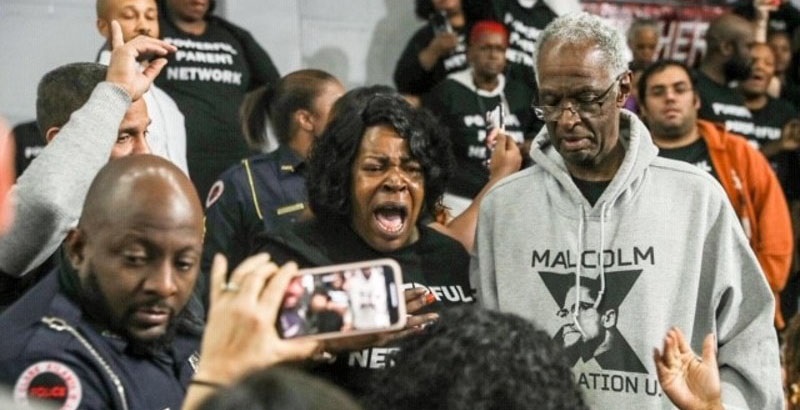
The week before Thanksgiving, an Atlanta speech designed to be a big appeal to the African-American community by Democratic candidate Sen. Elizabeth Warren was interrupted by parents and grandparents opposed to the charter school provisions in her education plan.
“Our children, our choice,” chanted the group, estimated at more than 100 parents and grandparents, forcing Warren and U.S. Rep. Ayanna Pressley to figure out how to respond to the interruption without violating the spirit of the event.
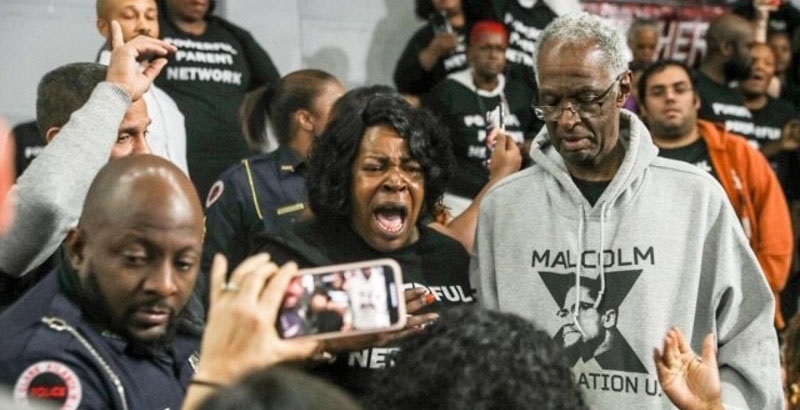
Parent protesters who disrupted Elizabeth Warren’s speech in Atlanta. Image credit: John Little.
The situation intensified the next day, when a livestreamed video of Warren talking with a small group of protesters after her speech came to light.
During that fascinating sixteen-minute conversation, Warren committed to reconsider her education plan, which includes eliminating funding for charter growth, and — inaccurately — denied sending her kids to private school. Initially overlooked, Warren’s misstatement was seized on by Warren opponents and right-leaning media outlets.
Then, two days before Thanksgiving, a front-page New York Times story featured the parents and activists who were behind the Atlanta protest and described a stark racial divide over charter schools that has been looming over the Democratic primary.
Hailed by charter supporters and rejected by charter opponents, the polarized response to that story is still with us a week later.
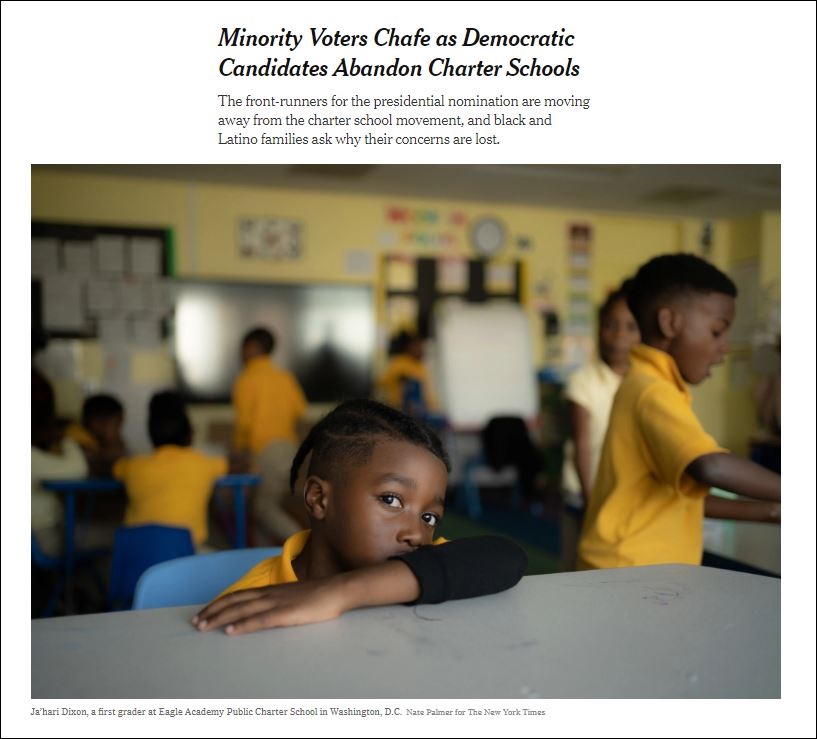
The New York Times version of the story focused on the concerns of the protesters and the racial division over charter schools.
These events raise several journalism-related issues, but most important for me is the question of how journalists described the Atlanta protesters — and how such depictions might be better handled going forward.
In particular, the Atlanta protest highlighted the question of how much focus journalists should give to the financial and organizational relationships supporting a protest effort.
Several of the stories about the Atlanta protest focused substantial attention on the funders behind these activists — a response that they and their supporters saw as demeaning.
The New York Times story went in the opposite direction — and was criticized for having downplayed the role of funders supporting the effort.
“Covering protests and activism can be tricky,” tweeted freelance journalist Rachel Cohen, who commented on the protest but has not written a piece about it.
Left-wing advocacy groups “rarely get scrutiny” that they warrant, noted Cohen, whose social media timeline became something of a lightning rod for debate over the coverage.
However, legitimate scrutiny shouldn’t automatically be “cast as racist or disrespectful.”
Protesters discussed charter schools with Senator Warren after her Atlanta event.
Whether it’s a teachers strike, a student walkout, or a demonstration against a school closing, protests have become a common assignment for education reporters.
The task might seem simple, given the powerful drama, abundance of visuals, and strong narrative. A protest story almost writes itself.
At the same time, protests tend to generate heated emotions and responses, both online and in real life. They’re like school board meetings on steroids.
For these reasons, covering protests is enormously difficult to do well — and critically important work.
One way some reporters try to add depth to their coverage is to ferret out the funding and organizational relationships behind the protesters.
It’s an understandable urge — one that I have succumbed to many times. But as you’ll see, it’s not necessarily the best way to go.
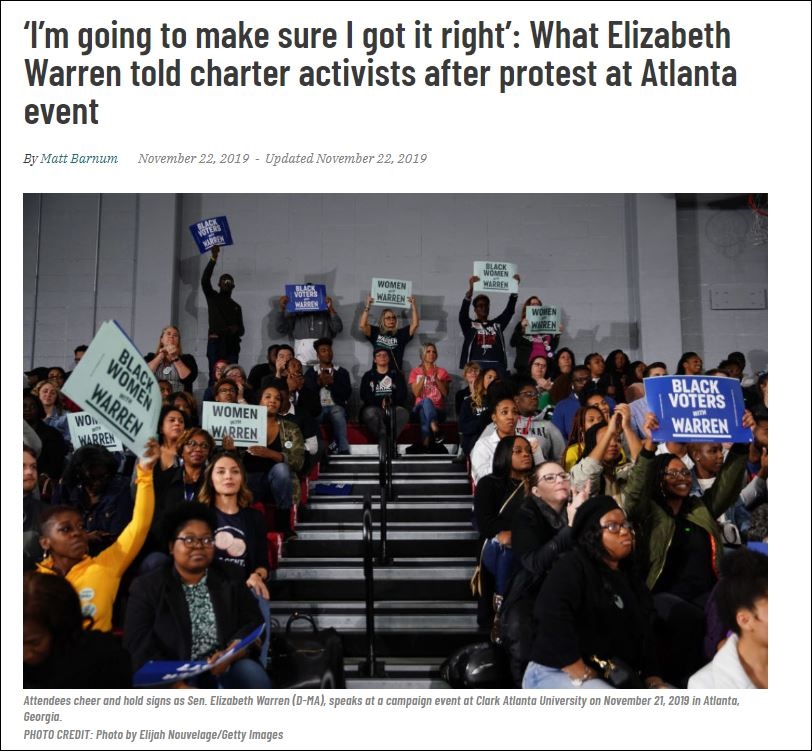
The Chalkbeat writeup of the protest contained a lengthy section detailing the funding sources and organizational affiliations of the protesting parents.
The good news is that protest coverage has been scrutinized by academics and researchers. There’s no need to come up with best practices on your own. For some thoughtful guidance, try here, here, and here.
However, the initial responses from reporters and media outlets to the Atlanta protest were all over the place.
Freelance journalist Cohen posted a series of comments questioning the protesters’ arguments, describing one of their concerns as an “incoherent talking point that really should not be taken seriously.”*
Several other journalists focused on the protesters’ backers, who included a handful of anonymous donors, and the pro-choice foundations that have funded some of the activists’ other work.
Much of the subsequent news coverage followed suit.
For example, a much-shared stream of tweets from the Intercept’s Ryan Grim focused almost entirely on the affiliations and funding sources of the protesters.
A follow-up article with his byline depicts the parent group as having “a handful of billionaire patrons.” The Guardian’s Hamilton Nolan took much the same approach.
Other outlets like the Boston Globe and HuffPost cited The Intercept’s depictions of the protesters, often without verifying the facts, giving the protesters a chance to respond, or providing any context.
From some readers’ points of view, this kind of coverage deepens understanding.
“It is rare for coverage to properly identify the funders of so-called activist groups,” tweeted University of Massachusetts political science professor Maurice Cunningham in reference to a Boston Globe story. “Readers deserve to know.”
However, there is a long history of attempts to discredit legitimate protests by those who oppose their point of view. All too often, media depictions have fallen prey to these tropes.
Arizona State University professor Sherman Dorn tweeted that, “as an historian, I’m pretty skeptical of the dismissal of protesters as ‘outside agitators.’” The term has history of being used as an attack on civil rights activists, he writes. Another, somewhat more modern term, is to describe protesters as an “astroturf” (i.e., fake) organization.
No stories that I saw used those exact terms in describing the Atlanta protest. But some of the coverage may have unintentionally conveyed that perception.
For example, the otherwise strong Chalkbeat write-up includes an extremely detailed section describing the Atlanta protesters’ organizations and funding sources, direct and otherwise.
According to Chalkbeat, roughly 200 people crowdfunded $16,000 to attend the event. The contributions included several anonymous $1,000 contributions, and the groups involved have been backed by pro-charter groups such as the Walton Family Foundation (which also helps support The Grade).
The write-up relegated the funding information to the second half of the story. However, the description was allowed a disproportionate amount of space — more than 300 words in a 1,200-word story.
The story also fails to remind readers that outside funding of protests is not unusual or to provide any explanation or context as to why the funding issue deserved so much detail.
So much detail, provided without the necessary context, can easily be misinterpreted to mean more than it does.
The Education Week write-up cited The Intercept’s information that one of the protest organizers was affiliated with an organization that receives Walton money but did not delve nearly as deeply into the outside funding issue.
The New York Times story focused on the protesters’ motivations and individual voices. The funding source is mentioned for the leader of one of the groups, but is not made into an entire issue.
Elizabeth Warren interrupted by protesters during speech. Via ABC News
To some charter advocates, the comments and the coverage were offensive.
“It is a safe bet that the members of Moms Demand Action have never been made to feel like prostitutes for their advocacy,” wrote choice advocate and parent Erika Sanzi in a blog post about how the protest was being discussed. That organization, led predominantly by white women concerned about gun safety, is funded by Bloomberg Philanthopies.
“This piece does the same thing all of you childless young white reporters do: reduce their activism to philanthropies,” tweeted Education Post firebrand Chris Stewart in reference to the Chalkbeat story. “Steal their agency. Assign their work to others. Give readers reason to ignore their point and the reason they protest.”
The journalists who were being criticized defended their work.
In an email, Chalkbeat’s Matt Barnum defended the detailed description of funding sources as necessary “in light of social media discussion — and in some cases misinformation — on the matter, both to ensure the facts are known and to give those criticized the opportunity to respond.”
He also cited the Howard Fuller quote placed near the end of his piece, in which the school choice activist noted that opponents focusing on funding sources is “a long-standing tactic to discredit black activists.”
Cohen declined to be interviewed for this piece. But her social media timeline provides comments on both sides of the issue.
“Activists shouldn’t be reduced to ‘paid protestors,’” tweeted Cohen. “The ‘outside agitator’ narrative is one progressive people should not be taking up themselves.”
She took down her post calling one of the protesters’ arguments “incoherent.” However, she told me via email that she stands by whatever she originally posted. “I sometimes delete tweets if think I can make my points clearer, or just generally to clean up my feed every few days.”
She rejected the notion that being childless is in any way disqualifying.
She also published a thread arguing that “what activists say is not inherently unimpeachable — and raising thoughts or objections is not silencing them.”
The Times’ education reporter Eliza Shapiro, who cowrote the feature with Erica Green, responded to criticism that the piece did not focus sufficiently on the protesters’ funders, saying that “a narrative that accuses parents of color of being pawns is…really, really problematic. It’s also not true.”
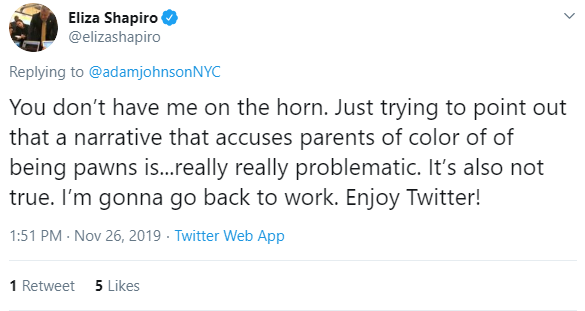
New York Times education reporter responded to criticism of her piece (with Erica Green) that “a narrative that accuses parents of color of being pawns is… really problematic. It’s also not true.”
Covering protests isn’t easy in today’s highly polarized political environment.
Just ask the Northwestern student journalists who were castigated for covering a student protest earlier this year, or read about problems in the coverage of the 2019 Chicago teachers strike.
The challenges aren’t anything new, either, as you can see from this critique of the coverage of the 1968 New York City teachers strike.
What happened in Atlanta isn’t just a onetime issue. It’s a chronic challenge for reporters covering contentious political moments — especially in situations like this one where a group of predominantly white journalists are writing about black and Latino activists in politically charged situations.
To my mind, there’s no problem with reporters mentioning the supporting organizations and funders who make activism possible – be they Bloomberg, Ford, Soros, or Walton. Transparency is important. Funding sources are fair game.
However, it’s important not to oversimplify the funding conversation. As ASU’s Dorn puts it, “there’s a large gap between ‘here’s some of the funding’ and ‘oh this is AstroTurf ignore everything they say.’”
Just as important, the scrutiny needs to be applied evenly. That means generally taking protesters at face value, assuming their concerns are authentic and their frustrations are real — and giving roughly equal scrutiny to progressive- or liberal-identified protests, such as teachers strikes or pro-integration campaigns, as you would to moderate- or conservative-identified endeavors such as charter school expansion.
Activists need to be covered fairly, regardless of ideology, race, or social status. That’s not what seems to have happened here, or in several recent episodes that come to mind, but it should have been. That’s what we should be aiming for.
*The original version of this column contained an inaccurate summary of one of journalist Rachel Cohen’s tweets:
The original version stated that Cohen posted a series of comments questioning the protesters’ arguments, “at one point describing the concern about losing charter school options as an ‘incoherent talking point that really should not be taken seriously.'”
The full text of Cohen’s actual tweet states: “Frankly suggesting that stronger transparency standards would ‘limit parental choice’ is an incoherent talking point that really should not be taken seriously.”
Cohen deleted that tweet for reasons she explains in the column above. The column has been corrected.
ABOUT THE AUTHOR

Alexander Russo
Alexander Russo is founder and editor of The Grade, an award-winning effort to help improve media coverage of education issues. He’s also a Spencer Education Journalism Fellowship winner and a book author. You can reach him at @alexanderrusso.
Visit their website at: https://the-grade.org/