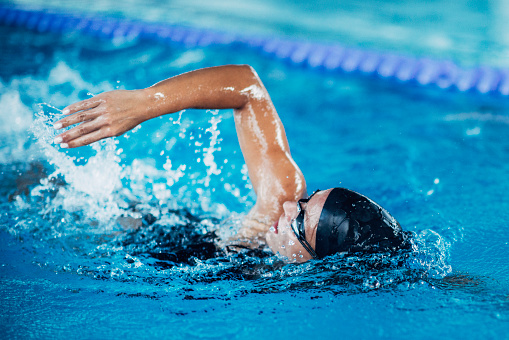
Individual and team sports help student-athletes develop personal attributes in ways that may not be available during the school day.
Waking up in the chilly dark of a Michigan morning, stoking themselves with chocolate milk and a granola bar, snuggling into the thickest hoodie they could find, and then driving to school in time for a 5:30 a.m. swim practice — that was a significant part of the high school lives of my three children.
And they say being on the swim team was one of the best parts of high school.
Mostly, I think, they remember the fun of being on the swim team — the friendships, the pizza, the chlorinated hair, the shaving parties. But I know the lessons they learned on the pool deck have sustained them through some personally difficult times and laid the groundwork for the professional relationships they are building today. With the increasing attention to so-called soft skills, I’m surprised we don’t hear more about high school athletics and how they build character. The reason to include sports in a student’s high school career is precisely because the experience adds to a student’s social-emotional portfolio. How well the football team does on Friday night is irrelevant to the quality of a child’s education — and certainly provides no reason for taxpayer support. But if you want kids to develop a growth mindset, help them make the link between what they do in practice and what happens in competition. Want them to learn to set goals and develop plans for achieving them? Get them into an individual sport like swimming, running, or tennis. Want them to develop grit and resilience? Let them experience the thrill of their own victories and the agony of their own defeats.
Do you want them to learn how to work with others? Any sport will teach that. “The sport is irrelevant. Whether you’re on a big team sport like basketball or an individual sport like swimming or tennis, you are still part of a team. You still ride the bus together. You still have to get along on the pool deck and in the locker room. You are still negotiating with people all the time,” said my youngest daughter.
“There’s an accountability that’s built into being on an athletic team. You have to show up, and you have to deliver. If you don’t, you let everyone down,” she said.
Her sister concurs. “You can’t swim a relay by yourself. You can’t win a meet by yourself. You need everybody to be there,” she said.
My oldest daughter swam in and coached both club and high school teams. On the question of club vs. high school teams, she is quite clear: The culture of high school teams differs markedly from that of club teams and offers far greater educational value for teenagers.
“Kids might be very isolated in school, but when they become part of a high school team, they suddenly have peers they can connect to. They’re not so isolated at school anymore,” she said.
“High school teams let kids develop loyalty to each other and to their school. On the high school team, I have kids who could never, ever afford to pay club fees. They’d never have the opportunity to be part of a sport,” she said.
Teenagers and teachers also can develop different relationships after the final school bell. “After school, you get to see students doing what they’re good at, doing what they enjoy. Teachers who are around after school get to see students as a real person, not just some kid who’s mouthing off in class,” she said. That can make a difference in how teachers and students relate to each other in academic classes.
“Adolescents need to be seen as whole people. They’re marginalized so much. When adults can see them and recognize them as being whole people, that really builds their self-confidence, and it creates better relationships between them and school,” she said.
My kids experienced a lot of sweet moments during their swimming careers. They had a lot of fun and stood atop many podiums. But, from a mother’s perspective, the greatest value from competition was learning that they could sometimes do their very best and still lose. Winning was never guaranteed. Whether they were winning or losing, they still had to go back and try again the next day and the day after that. Just like in life.
Citation: Richardson, J. (2016). The editor’s note: Swimming through life. Phi Delta Kappan, 97 (8), 4.
ABOUT THE AUTHOR

Joan Richardson
Joan Richardson is the former director of the PDK Poll of the Public’s Attitudes Toward the Public Schools and the former editor-in-chief of Phi Delta Kappan magazine.