In this week’s newsletter: White House theatrics. How to tell a math story. And: Baby steps towards re-examining COVID measures.
RIP, US EDUCATION DEPARTMENT
The big education story of the week
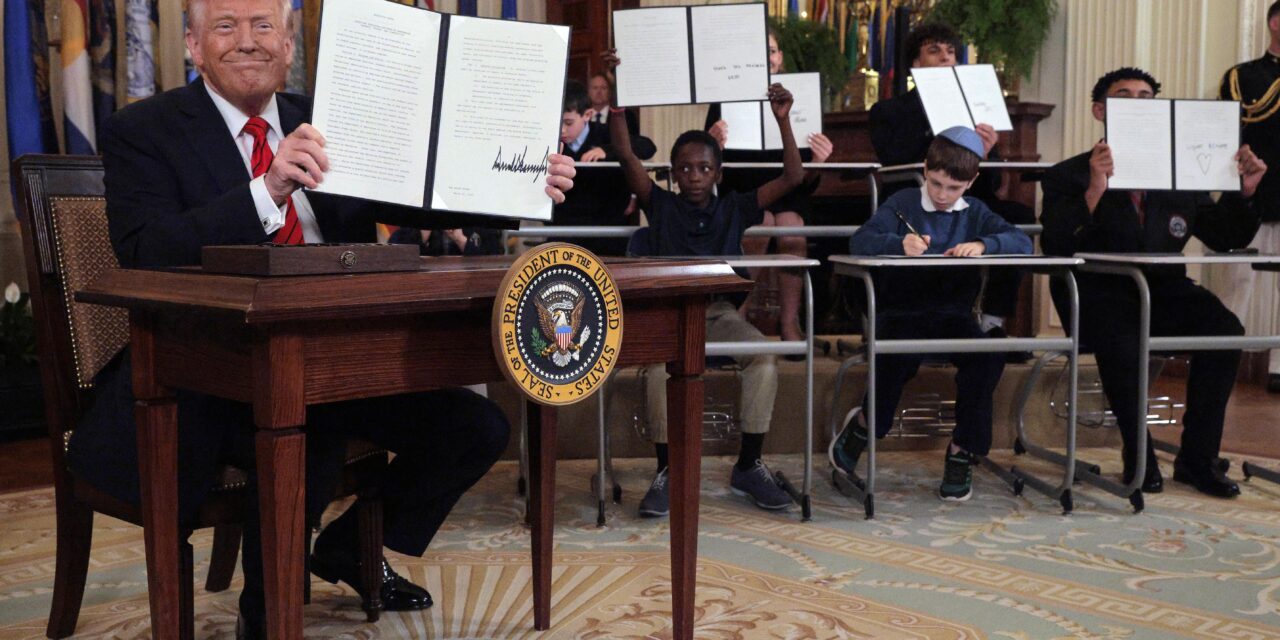
The big education news of the week is the Trump White House’s pseudo-abolishment of the US Department of Education. (USA Today, New York Times, AP, Boston Globe, Washington Post, Wall Street Journal, Chalkbeat).
The much-anticipated Executive Order doesn’t really rise to the level of news. Petrilli called it a “nothing burger.” Rotherham called it “theatrics.” Kamenetz might call it a pseudo-event. The 15-minute East Room event featured schoolchildren and desks. But it happened, and it got a lot of media attention.
A few outlets and journalists attempted to find useful angles like Republican governors’ interest in gaining control of federal funding, potential downstream effects on vulnerable kids, the White House’s effort to distract from other, more pressing education issues — and the President’s seeming ambivalence about the whole thing (The 74, NPR, New York Times).
But two months into the new administration, my opinion remains the same: Every minute spent covering staged events, fearful speculation, and empty statements is time spent not covering what’s really going on in schools.
Find the real story. Ignore the circus.
DEPTH, COLOR, & CLASSROOM DETAILS
The best education journalism of the week
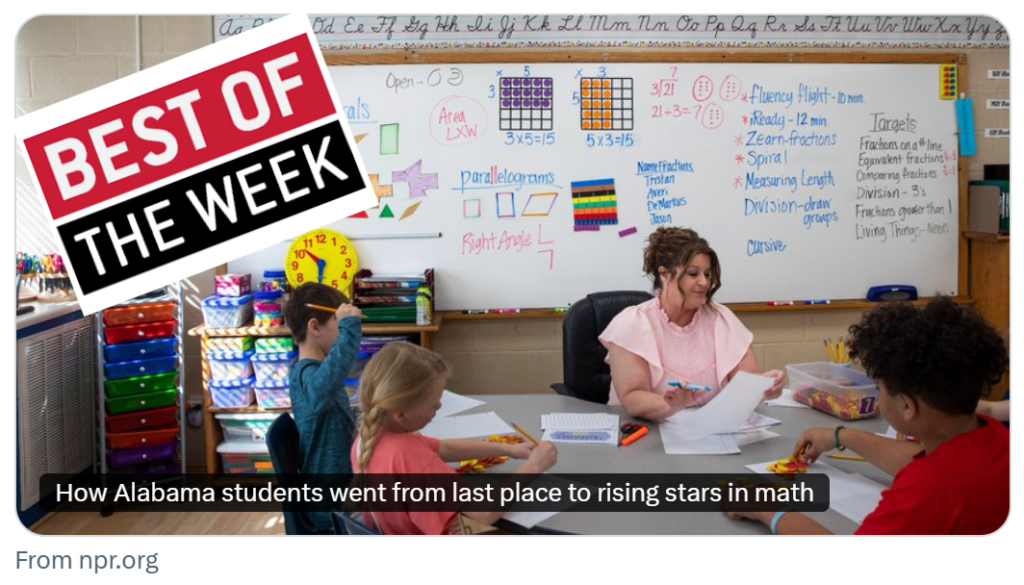
Speaking of covering the real story: The best education journalism of the week is How Alabama students went from last place to rising stars in math by NPR’s Cory Turner, part of a series about successful schools in the south. Here’s another about reading in Louisiana.
When Alabama students last month turned in the biggest gains in the nation on NAEP fourth-grade tests, longtime education reporter Turner saw a story. Traveling to rural DeKalb County, he found a district in the state’s northeast corner where student scores have soared since the pandemic. In a six-minute feature that’s somehow both deep and colorful, Turner tells exactly how they did it.
Students in DeKalb returned to in-person learning sooner than most, and the district used COVID relief funds to hire math coaches and zero in more closely on metrics. “Data or it didn’t happen,” says the district’s math coordinator. The district also redid its math curriculum, making it more hands-on and focused on problem solving.
Turner leavens his reporting with classroom scenes and inviting sounds: As he sifts through a classroom’s math supplies — wooden cubes, foam blocks and number tiles — the rattle of stiff plastic bags mixes with the chatter of children. As with most of Turner’s features, it’s a small but satisfying explanatory window without a wasted word.
Other education stories we liked include cell phone bans and disabled students (LAist), how a few South Carolina districts recovered from Covid shutdowns (Post and Courier), and night kindergarten in Newark (The 74).
COVID COLLAPSE
The Grade’s latest columns and commentary
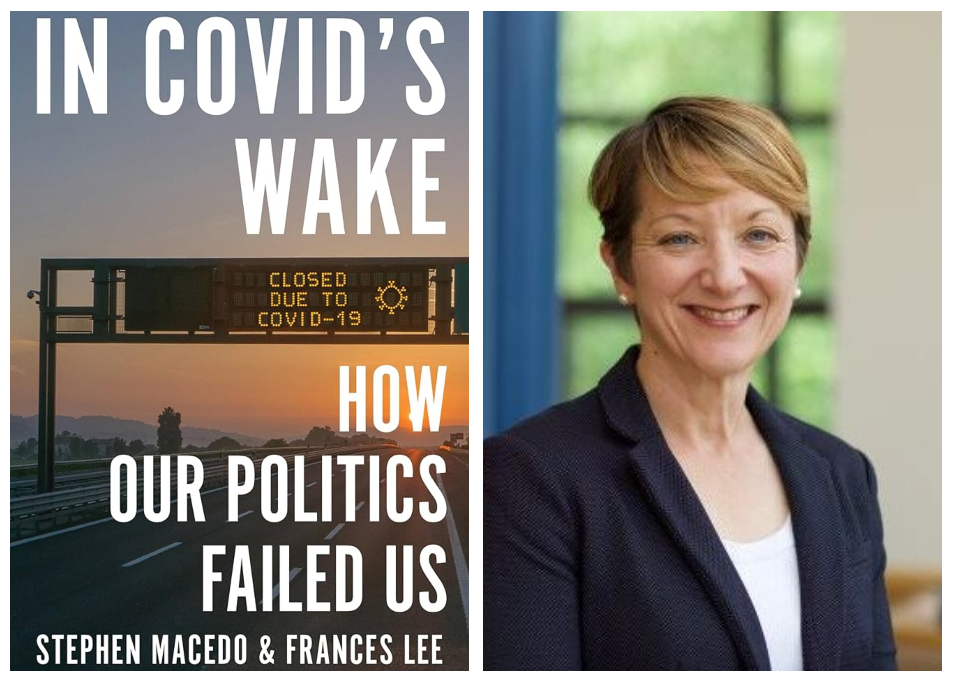
In our latest COVID anniversary piece, Princeton professor and co-author Frances Lee describes how journalism (and other “truth-seeking” institutions) too often failed to assess tradeoffs, investigate regional and international variations, and address broader societal concerns.
“The lack of interest in the policy variation that existed around the country during 2020 really stands out,” says Lee in the interview, Covid Collapse. “It’s as if many journalists didn’t notice that large shares of public school students were back in school.”
Though the answers have so far mostly been predictable non-apologies, a handful of news outlets have asked education leaders and public officials what they’d do differently — if anything (San Jose Mercury News, New York Times).
At some point soon, I’m hoping news outlets will also start reflecting on their coverage, too.

Above: The New York Times’ The Daily podcast also had Lee (and co-author Stephen Macedo) on their show, asking the core question: Were the COVID Lockdowns Worth It? Host Michael Barbaro described the book as “an invitation to have a reckoning.”
PEOPLE, JOBS, & EVENTS
Who’s going where and what’s happening
📰 Notables: Freelancer Megan Greenwell has a big Bloomberg magazine feature about “Darth” David Coleman and the College Board and their new efforts to dominate CTE. Other pieces and segments of note include an unsigned piece The pandemic hit pupils hardest in America’s Democrat-leaning states in the Economist, Rose Horowitch’s The DEI Catch-22 in the Atlantic, and Aubri Juhasz’s Louisiana has a long history with French. This immersion school aims to keep it alive (NPR).📰 Quotables:
“The fact that reporters are being forced to rely on laid-off workers and their union for basic information about the types/breakdown of employees who were let go from the Education Department last week is utterly ridiculous.”
“Letting math-y claims from math-y people go without fact checks does your audience a disservice.”
“Congrats to all the mainstream media folks who bought the Trump spin about not being associated with Project 2025.”
“I find it so telling that Dems don’t have a Project 2025 of their own.”
“Education used to be the Democrats’ strongest issue.”
📰 Upcoming: EdSource is hosting a roundtable March 27 titled Five years after Covid: Innovations that are driving results.
THE KICKER
We saved the best for last.

Good to see this image of longtime Chicago education journalist Kate Grossman, who like many others is trying to “break through the noise to bring you news that helps you make sense of the world.”
That’s all, folks. Thanks for reading!
Reply to this email to send us questions, comments or tips. Know someone else who should be reading Best of the Week? Send them this link to sign up.
Using Feedly or FlipBoard or any other kind of news reader? You can subscribe to The Grade’s “feed” by plugging in this web address: http://www.kappanonline.org/category/the-grade/feed/.
Read more about The Grade here. You can read all the back issues of The Grade’s newsletter, Best of the Week, here.
By Alexander Russo