An education reporter reflects on the war in Gaza and journalistic notions of objectivity.
By Nour Habib
I have a “strong Twitter feed,” as a fellow journalist called it back in December.
He was referring to my posts relating to Gaza, which have been frequent and leave no one wondering where I stand. He was wondering whether my public “stance,” so to speak, would prevent me from writing about anything relating to Israel/Palestine.
It was a legitimate question, particularly in light of how some news organizations have treated staffers who make public comments about the conflict or have signed a letter calling for the protection of journalists and for fair coverage that is not biased toward Israel.
At one national newspaper, reporters who signed the letter were reportedly banned from writing about the war for three months. There are also reports of outlets that forced their staffers to withdraw their names from the letter.
I don’t regret sharing my beliefs about the war in Gaza, and I don’t believe that expressing these beliefs interferes with my ability to be an effective journalist. To date, I have experienced no negative reactions from my readers or colleagues.
I want more journalists to express themselves — and more newsrooms to make clear that they value their reporters’ humanity.
I want more journalists to express themselves — and more newsrooms to make clear that they value their reporters’ humanity.
As journalists, we’re all aware of the importance that newsrooms have given to “objectivity.” We are not to take a side on controversial or political issues, whether in our stories or personally on public platforms.
But the notion of “objectivity” has also been criticized in recent years, as discussion has revolved around whether “both sides-ism” serves anyone or simply creates a false equivalency. A young colleague of mine told me that she took a class in college on the idea of objectivity and who it actually benefits.
In 2021, Emily Wilder, a young journalist just out of college, was fired from the Associated Press weeks after starting there, reportedly for violating the outlet’s social media policy relating to objectivity.
What she said at the time has stuck with me: “‘Objectivity’ feels fickle when the basic terms we use to report news implicitly stake a claim. Using ‘Israel’ but never ‘Palestine,” or ‘war’ but not ‘siege and occupation’ are political choices — yet media make those exact choices all the time without being flagged as biased.”
We can also argue that bias comes out in the choices we make about what stories to cover, the placement of stories on our websites and in print, and the descriptors we use. I have yet to see a news outlet use the word “barbaric” to describe any actions committed by Israel.
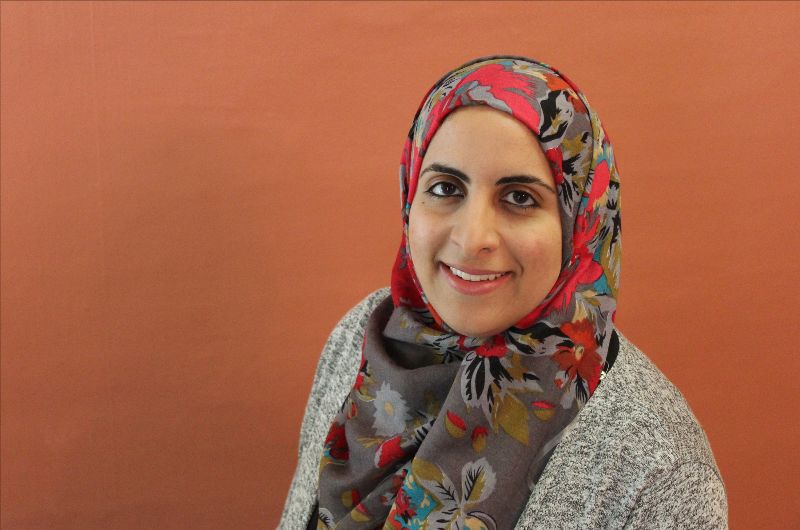
“Children in Gaza are now dying of malnutrition,” notes education journalist Nour Habib (above) on Twitter. “Because they are being DENIED humanitarian aid. By Israel. Just spelling it out, as an FYI, for anyone who’s checked out and isn’t following the horror anymore.”
My posts on X — formerly Twitter — clearly spell out my position:
I am against the killing of civilians, against the starvation of children. I stand against killing other journalists. I want our government to stop providing weapons to Israel. And I want American news organizations to recognize their bias, provide crucial historical context, acknowledge the asymmetrical nature of this “conflict,” and do better journalism.
A handful of my colleagues are also publicly vocal about the conflict, and I asked them why.
“I think being against genocide, being against needless civilian deaths and being against our own fellow reporters being slaughtered are not controversial opinions to have,” one of them said.
Another noted that our very identity as journalists — as people out to seek the truth, defend democracy, hold the power to account — dictates that we hold our own government responsible when it is actively aiding a country that is flouting international humanitarian law and the rules of war.
She also noted that if we were taking these public stances in any other context – that was not about Israel – no one would even question it. “It’s like there’s a different set of rules,” she said.
“KPBS trusts our journalists to put aside their personal beliefs when it comes to covering the news for our community.”
Interestingly, journalists seem to be the only ones having this conversation.
I’ve not heard from any readers concerned about me taking a public stance. A few have liked or reposted my posts. In person, I’ve had one source reference my social media posts on Gaza, but only to ask me how I am doing. No one, as far as I know, has complained to my editors.
I had no trouble getting my story pitch about a local university official who appeared to call for the ethnic cleansing of Palestinians from Gaza approved at my organization. Two extra sets of eyeballs did review it before publication, however, which I had no problem with. You can read it here.
Granted, I’m an obscure local education journalist with just over 1,000 followers. Most of my posts get around 100 views. I think the only person who really cares about what I say is…me.
The best public statement on this issue that I have seen so far is from KPBS San Diego public media, when newsroom leaders were asked about their journalists who had signed the letter mentioned above.
“KPBS trusts our journalists to put aside their personal beliefs when it comes to covering the news for our community. At the same time, a newsroom with diverse lived experiences and perspectives helps us hold ourselves accountable to considering the full context of stories.”
I think more news organizations should follow their lead.
Journalists are human.
They should be able to express their humanity.
Nour Habib is an education reporter for The Virginian-Pilot and Daily Press. Previously, she worked as a journalist in New Hampshire and Oklahoma. You can read her work here and follow her at @nourhb.
Previously from The Grade
Why education reporters need antibias training (Issac J. Bailey 2019)
Why white journalists need to stop focusing on ‘learning loss’ (Ray Salazar 2021)
Making education journalism more accessible and inclusive (Amber Walker interview with Nikki Usher 2022)
Candor, urgency, & action: how to transform the education beat (Alexander Russo 2023)
Former education reporter rethinks coverage for a new era (Alexander Russo interview with Rebecca Klein)