School and district leaders can save education by working together to offer students accomplishment and relevance.
There is no clearer, more authentic assessment than a learner saying, “I can do this” or “I know this,” and proving it through actions. This original human system of engaging in and evaluating learning can transform today’s schools. Yet despite the simplicity of such mastery-based learning, adopting it remains a challenge to the time-bound competitive models embedded in our schools.
In an era with 24/7 access to the learning kids want, in the form they choose, and at the moment they need it, schools face an existential crisis that requires us to transform practices and structures we have lived with for more than a century. Those phones adults find so distracting help students learn almost anything: play the guitar, cook a meal, repair a car, or understand ancient history. “It’s no wonder kids are resisting our current educational system. In many ways, it is irrelevant,” says San Pedro, California, teacher Rachel Bruhnke (2021). A survey by the nonprofit YouthTruth found that “About half of students do not feel that what they learn in school will help them outside the classroom . . . Just 54 percent of middle schoolers and 46 percent of high schoolers think their studies are relevant” (Stringer, 2017).
Moving to mastery or competency-based learning is public education’s primary answer to today’s challenges. We communicated with multiple educators across several states, over Zoom and by email, about how their schools have made the transition to mastery learning and how they’ve learned from others to refine their practice.
Why mastery learning?
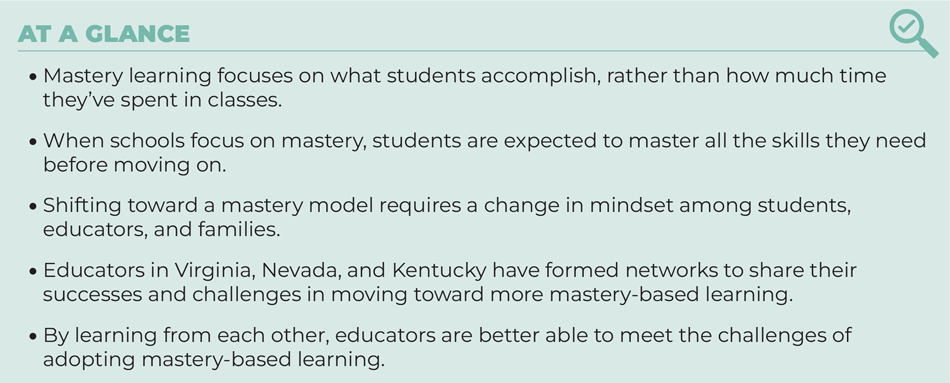
Many educators are engaging young people with mastery-based learning that includes learner-centered project work and assessments that enable students to demonstrate the skills and knowledge they’ve gained. Students who’ve shown mastery of certain material are given the opportunity to then move on to new material. “A competency-based education model focuses on skills and knowledge students can apply — rather than how much time they spend in a class. Students in these learning environments have access to content that matches their needs and can advance as soon as they master the material,” says Lu Young, former chair and current vice-chair of the Kentucky Board of Education, a leader of her state’s NextGen Leadership network.
An absolute focus on learning, rather than on seat time, begins to close the distance between the schools that kids attend and the way they want to learn. Since 1910, the Carnegie seat-time clock-hour, as applied in secondary schools, has prevented our students from learning in a way that makes sense to them. Even the Carnegie Foundation’s current president, Tim Knowles (2024), announced at a recent summit, “The Carnegie Unit should have had an expiration date put on it.”
In traditional schools, time, space, culture, curriculum, and pedagogy are fixed. In the mastery model, learning is constant, and everything else responds to each student’s needs.
Based on student interest and curiosity, mastery learning fosters self-determination, helps students make sense of their learning, and pushes all to be their best by assessing their work through an accomplishment lens. “I cooked dinner for my younger brothers,” “I fixed my mom’s vacuum,” “I discovered that author.” In traditional schools, time, space, culture, curriculum, and pedagogy are fixed. In the mastery model, learning is constant, and everything else responds to each student’s needs. The ambiguity created by “uncalibrated” grades and varying expectations of teachers vanishes as students pursue and attain real, relevant goals (Finkelstein, 1913).
Making these significant changes in the everyday culture and practices of schools requires support. Networks of professional peers who share research, concepts, experiences, and the continuous learning needed for true transformation can provide this support. Whether based in a school, in a district, or across a state, they can sustain educators’ efforts in ways purchased programs and corporate workshops cannot.
A transformative approach
“The biggest obstacle [to mastery] is the shift in adult learning,” says J.J. Black, a Shelby County, Kentucky, principal and member of Kentucky’s Next Generation Leadership Network. “The second obstacle is having adults get out of the way of their students.”
Moving away from seat time to focus on mastery requires a mindset shift among educators, students, and families. “A lot of parents just don’t understand that mastery means you get to do all the work, that the kid can’t get moved forward, or take an F, or skip Unit 3,” says Ryan Cordia, principal of a new mastery learning career tech high school in North Las Vegas and part of the Nevada Future of Learning Network. “But that level of work ethic caught on towards the end of quarter three. We’ve helped students unlearn the ‘just get through’ attitude and focus on the purpose of each course.”
When learning is the expected constant, our connections with learners grow. Teachers use these connections to engage in flexible, continuous planning built around students’ needs. Mae Craddock, the librarian in a middle/high school in Virginia, says, “If the student hasn’t mastered the concept, you know immediately that you have to figure out what happened and fix it. You have to rewind and do it differently. If you’ve paced everything out with rigid planning, you can’t do that. You have to move on. With mastery, you say, ‘That didn’t work. We have to go back and try again.’”
Cordia found that teachers and learners needed time to adapt to this new model. For many, the reality of what a focus on learning meant became clear as the year ended. “We had over 200 kids this year who needed to finish units [because they hadn’t demonstrated mastery]. We stayed open an extra nine days, and they all came and finished their work within that time. No one needs to retake a 16-week course, no one has a grade that says nothing — except that the student sat there.”
Adapting to students’ needs
Principal Black says about the shift in Shelby County, Kentucky, that “teachers had to shift from students learning something simply to regurgitate information for a test to students being able to transfer their knowledge in various situations.” The change was worth it because of what it has done for students. “The most important outcome has been allowing all students to succeed,” continues Black. “Students shine in different ways. Every student can be successful given the opportunity to evidence their learning.” The opportunity for all to succeed in their own way and in their own time allows learners to connect with and commit to their learning.
David Glover, a teacher in a Virginia project-based/mastery learning high school where learners define the context and time, says, “The questions I try to avoid are, ‘How many points is this worth? Is this graded?’ Anything that exposes the gamification of courses where motivation is tethered to letters and numbers. I’ve found success untethering that dynamic by relying on two fundamental pillars: positive relationships and student interest.”
Educators can build formal and informal networks, virtually and in-person, to share questions and answers, problems and progress, research and support.
In Fairfax County, Virginia, James Madison High School has been developing and implementing a mastery learning model for eight years, communicating constantly with district administration, parents, and community. Liz Calvert, principal and participant in the Virginia Leads Innovation Network, was assistant principal when the initiative began with questions about the fact that a student might have seven different teachers, each of whom calculated grades in a different way. What does that say about the meaning of grades? “We found that the deeper we went in our conversations, the more it led to critical questions. What is right for kids? What is learning? If you can find it on Google, why is it a question?” Calvert adds, “Kids are good at going through the motions and being compliant in our classes, but are they really learning? We had to work on lesson design, identifying critical skills relevant to different content areas, and focus on what assessment should really look like. As we aligned practice and homework to what was being assessed, alignment took on new meaning.”
The conversion of both teaching and administrative practice can seem daunting, and it requires committed leadership backed from above and below. “We had a hard first year,” Cordia reflects. “It was a lot of brain power, a lot of energy. Opening any school, traditional or not, is hard. But in hindsight, teachers took to it quicker than expected. We were doing it OK after the first three months and pretty well within seven months. That big a shift in months, not years, means we had support from every corner.”
Accomplishment over achievement
“I think back to the PE report cards from years ago,” says Jeff Prillaman, leader of Glover’s school. “You weren’t assessed as 1, 2, or 3. Instead, progress reports said, Student can skip. . . can jump on one foot . . . can toss underhand . . . can throw overhand.”’
“Achievement is the completion of the task imposed from outside,” Adam Gopnik (2023) notes in The New York Times. “Accomplishment is the end point of an engulfing activity we’ve chosen, whose reward is the sudden rush of fulfillment, the sense of happiness that rises uniquely from absorption in a thing outside ourselves.” Understanding this difference between achievement and accomplishment is our first step forward. “Nobody leaves my class knowing 95% of what makes a building stand up,” a Pratt Institute engineering professor once said, describing why he only had two grades, pass or fail. A grade of 95, an A, is an achievement, but it fails to explain or hold students accountable for that missing 5%. In the case of building a skyscraper, that missing 5% could be crucial.
The existing school design is based on the bell curve, in which a small percentage of our children do well, the vast majority “get through,” and the most vulnerable fail — a cruel and ineffective answer for our community, national, and global futures. Mastery education expects every learner to master skills they need. However, children bring a vast range of knowledge, individual strengths, interests, and experiences to school. If we want them to be able to learn what they will need to make responsible and effective choices in their adult lives, then our use of time, space, assessment, discipline, and pedagogies must be flexible.
Lessons from the past
Educators have known forever they must close the gap separating learners from their schools. But closing that gap doesn’t mean we must reinvent our wheel. We go into this work standing on the shoulders of giants.
In 1969, Neil Postman worked with Alan Shapiro, a teacher in New Rochelle, New York, to develop a new high school plan, known as the Program for Inquiry, Involvement, and Independent Study (Postman & Shapiro, 1970). Their plan built on the beliefs underlying mastery learning: Learning requires relevance and real-world application. Students must learn to organize their own learning. Learning must be interdisciplinary and driven by contemporary issues and learner interests. The resulting school adopted a pure mastery assessment model — learners either accomplished the task and received high school credit, or they tried again, likely in another way.
Jake Burks, retired Virginia principal and superintendent, collaborated with others, including educators in Johnson City, New York, on mastery learning in the 1970s (Desmond, 1991). He describes his assessment system: “Grades should reflect our mission that all students will learn successfully. We didn’t post grades below C. We didn’t give zeros. Doing so creates an expectation that some students would get those grades. If a student didn’t reach mastery on an assessment or a test, the grade would be ‘incomplete.’ Together, you’d keep working until it was mastered.”
These efforts achieved long-term success, ending because of politics at the national and state levels, not the failure of students. Today, we can learn from that history as we think about how to move forward again.
The network way forward
When Postman, Shapiro, and Burks worked to transform education in the 20th century, they were isolated from educators on similar journeys. Links came only through books, once-a-year conferences, or the arrival of a monthly journal. Just-in-time advice, cross-pollination of experiences, or simple encouragement required discovering others and connecting through the mail or on long-distance phone calls.
Today, educators can build formal and informal networks, virtually and in-person, to share questions and answers, problems and progress, research and support. Whether the change agent is a single teacher, part of a team in a school or school system, or a state innovation project, network participants build peer-to-peer relationships as they test and crowdsource innovative work.
Kentucky, Nevada, and Virginia have created formal networks focused on reimagining school and helping young people learn and demonstrate mastery of the competencies necessary to thrive across their lifespans — which may extend beyond the year 2100. “It’s so important to not feel like you’re the only one pushing the boundaries,” says Cordia as he discusses his part in Nevada’s Future of Learning Network. “Are we crazy? Should we even be doing this? Why am I losing so much sleep and cashing in so many political chips? Then we come to network events and realize there are so many different people pushing the boundaries and trying new things in classrooms, schools, districts, and across the state. When middle school leaders talk, I get reenergized and excited about who’s coming to us. We’ll be letting those kids down if we go back to a traditional lecture and test focus. So, I feel inspiration and pressure.”
Kentucky’ s Next Generation Leadership Academy
The University of Kentucky’s Next Generation Leadership Academy (https://nextgen.uky.edu/nxgla) is a 13-year-old network that has developed, sustained, and spread learner-centered educational innovation across the state, from tiny districts in Appalachia to huge county districts in Louisville and Lexington. In virtual and in-person meetings, school teams build transformation skills through protocols (including surveying at least 100 students each year about their needs and wants), then meet to share evidence of their school’s journey to deep learning mastery. The network has influenced state initiatives supporting the transformation
of all Kentucky K-12 public schools to a mastery-focused, competency-driven, learner-centered system responding to the needs of learners facing uncertain futures.
“We were in the academy early on, second or third year, and we’ve stayed connected,” says former Shelby County Chief Academic Officer Susan Dugle. “When we needed help, we would reach out, or they would need us and reach out.” The network supported Shelby County’s adoption of a mastery model and prototyping student demonstrations of their accomplishments.
Virginia Leads Innovation Network
Originally a partnership between the Virginia Department of Education and the Virginia School Consortium for Learning, the Virginia Leads Innovation Network (VaLIN; https://valin.common wealthlearningpartnership.org) was developed in 2018 along with the state’s Profile of a Graduate, which delineates the qualities a student needs for success in college or the workforce. The first VaLIN cohort began with division innovation teams committing to deeper learning, active engagement, and equity. Supported with ongoing coaching, teams now organize into communities of practice.
“VaLIN allowed educators to share ideas, challenge current practices, and bolster their courage to step into innovative change,” says Gena Keller, executive director of the Commonwealth Learning Partnership, the network’s current lead partner. “VaLIN has opened doors to competency-based learning experiences for all students and ways for those students to demonstrate durable skills.”
Nevada’s Future of Learning Network
Nevada’s Portrait of a Learner was built through statewide conversations connecting educators and parents, community and business leaders, and young people. The portrait asks students to build their own answers to these questions: How will I thrive? How do I build and sustain relationships and community? How will I contribute to make an impact? How will I grow in my learning? The Future of Learning Network (www.nvfutureoflearning.org), supported by the Nevada Department of Education and led by Superintendent Jhone Ebert, began in 2022 to answer a question posed to educators as a result of the portrait: How might we put these shared values into practice?
Facilitated by ed.Xtraordinary with nationally recognized coaching support, the Nevada network brings together diverse school design teams, including schools on Native American reservations, in mining and ranching counties, and in Clark County (Las Vegas). “We’ve built pathways for educators to explore the relationships, experiences, and environments essential to realizing our Portrait of a Learner,” says Jeanine Collins, the chief innovation officer of ed.Xtraordinary. “Educators have researched and tested competencies, and participants are poised to explore learner expression and assessment while reflecting on accountability with our state’s department of education. Most importantly, young people and the community are involved as builders and critical friends. Co-design is how we create a more responsive system and embody the portrait attributes.”
Accomplishing adoption
Few teachers or administrators have seen a learner-centered, mastery-driven school in action. Few have experienced the process. “There aren’t many models out there,” says Calvert. “So, we’re learning from each other.” These networks enable educators to learn from others on the same journey.
The embrace of mastery learning is a national project with a long history, yet it begins with educators coming together at the most basic level. “We meet every morning,” says Craddock, “but Wednesday is a meeting where we ask about every learner: Who’s doing OK, who’s struggling, and what do we need to change?”
“The biggest mindset for teachers who support mastery is to understand that it is about the journey and not the timeline. They understand that students learn at different paces and require different support,” says Prillaman. Teachers come together to understand what feedback and learning opportunities their students need in the moment.
“We started with a mission, not a mission statement,” says Burks. “A mission statement doesn’t mean anything, but even our kids knew what the mission was. Then, we made sure what we were doing led us to the mission. What you know, what you want, what you believe, what you do — all are important.”
These impactful conversations about what students know and can do, occurring among networks large and small, within schools and across them, are the driving force behind transformative change. As young people master essential competencies, learning ceases to be the variable but instead becomes a powerful constant in their growth and life success.
Note: Thank you to the educators who shared their experiences with us for this article: Lu Young, Kentucky Board of Education, Frankfort; J.J. Black, Shelby County Public Schools, KY; Susan Dugle, University of Kentucky NextGen Leadership Academy, Lexington; Ryan Cordia, Clarke County Schools, NV; Jeanine Collins, ed.Xtraordinary, Las Vegas, NV; Elizabeth Calvert, Fairfax County Public Schools, VA; Mae Craddock, Jeff Prillaman, and David Glover, Albemarle County Public Schools, Charlottesville, VA; Gena Keller, Commonwealth Learning Partnership/VaLIN, Fluvanna County, VA; Jake Burks, retired superintendent, Orange County, VA.
References
Bruhnke, R. (2021, July 28). Kids aren’t “Zoombies.” Today’s education is just irrelevant. Los Angeles Times.
Desmond, C.T. (1991). Mastery learning: Teacher belief, language, practices. Paper presented at the annual meeting of the American Educational Research Association.
Finkelstein, I.E. (1913). The Marking System in Theory and Practice. Warwick & York, Incorporated.
Gopnik, A. (2023, May 15). What we lose when we push out kids to “achieve.” The New York Times.
Knowles, T. (2024, March 24). Opening keynote. Improvement in Education: Carnegie Summit 2024, San Diego, CA.
Postman, N. & Shapiro, A. (1970). 3I Program Proposal. www.joshkarpf.com/3i/proposal1970.html
Stringer, K. (2017, December 11). Only half of students think what they’re learning in school is relevant to the real world, survey says. The 74 Million.
This article appears in the October 2024 issue of Kappan, Vol. 106, No. 2, p. 8-13.

ABOUT THE AUTHORS

Ira David Socol
IRA DAVID SOCOL is a principal adviser with Socol Moran Partners who consults with schools, districts, and state networks to implement student-centered learning practices. He is a co-author of Timeless Learning (Wiley, 2018) and Education Reimagined: A Space for Risk (Rowman-Littlefield, 2019).
Pamela Moran
PAMELA MORAN is the executive director of the Virginia School Consortium for Learning, co-chair of VaLIN, and adviser with Socol Moran Partners. She is a co-author of Timeless Learning (Wiley, 2018) and blogs at https://medium.com/@pammoran.