
Is a balance of different types of mathematics instruction actually possible? And does the debate ignore more important questions about the purposes of school mathematics?
Mathematics education has long valued “balance.” The balance of greatest interest has been between conceptual understanding and procedural fluency — or between meaning and computation (Brownell, 1956, p. 129). Debates over which kind of knowledge deserves more emphasis in school have gone on since the late 19th century (Hiebert & Lefevre, 1986). These debates informed the recent efforts to develop national standards (Kilpatrick, Swafford, & Findell, 2001; National Council of Teachers of Mathematics, 2000; National Governors Association Center for Best Practices & Council of Chief State School Officers, 2010). In recent years, the consensus has been that both conceptual understanding and procedural fluency are important and that students should develop them both at the same time (Hiebert & Lefevre, 1986; National Mathematics Advisory Panel, 2008).
These appeals for “balance” have not been limited to conversations about types of knowledge or proficiency to include in students’ mathematics learning. They have also shown up in conversations about teaching, where the field has reached less consensus. One impulse has been to look for a “balance” between competing instructional approaches. But what does that really mean for the day-to-day work of classroom teaching? Is such an instructional balance possible? And are there more important questions we should be considering?
Is balance possible?
During the “math wars” that raged in California in the 1990s and then spread elsewhere in the U.S. in the following decade, educators disagreed about not just what mathematics children should learn, but also how to teach it. These debates often get collapsed. An emphasis on procedural fluency is associated with more “teacher-centered” instruction, and an emphasis on conceptual understanding with more “student-centered” instruction. This collapse is an oversimplification. Many who agree on the goals for school mathematics have very different perspectives on how it should be taught (Munter, Stein, & Smith, 2015a). And ideas about teaching mathematics abound.
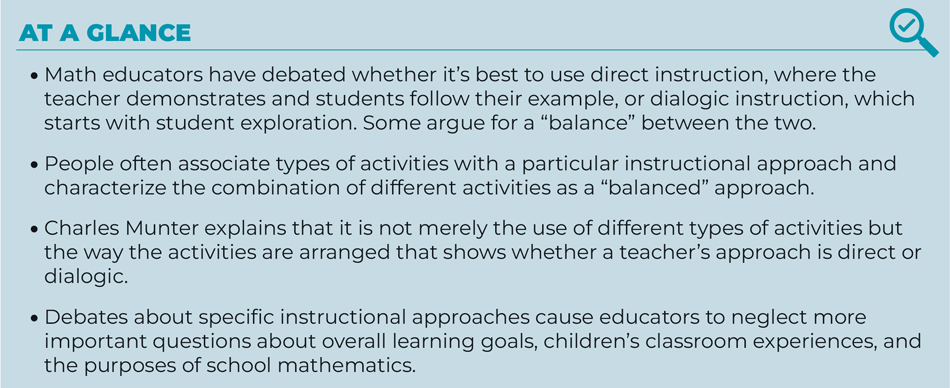
Many of those ideas can be sorted into two categories: dialogic approaches and direct approaches. Each approach is varied and multifaceted, but one feature that distinguishes them is how the instruction “positions” students in relation to the teacher, the mathematics, and each other (Gresalfi et al., 2009). Direct approaches position students as apprentices (Collins, Brown, & Holum, 1991) who first watch the expert teacher complete a task and then practice the task themselves with increasing independence (Rosenshine, 2012). Dialogic approaches position students as authors of their own learning (Carpenter & Lehrer, 1999) and as valuable learning partners for their peers and even the teacher (Freire, 1970).
It is tempting to appeal to balance as a solution in this case. For example, one might imagine a mathematics teacher saying, “In my teaching, I employ a balance of direct and dialogic instruction.” Such a statement sounds good. But what might it mean?
Configurations of instruction
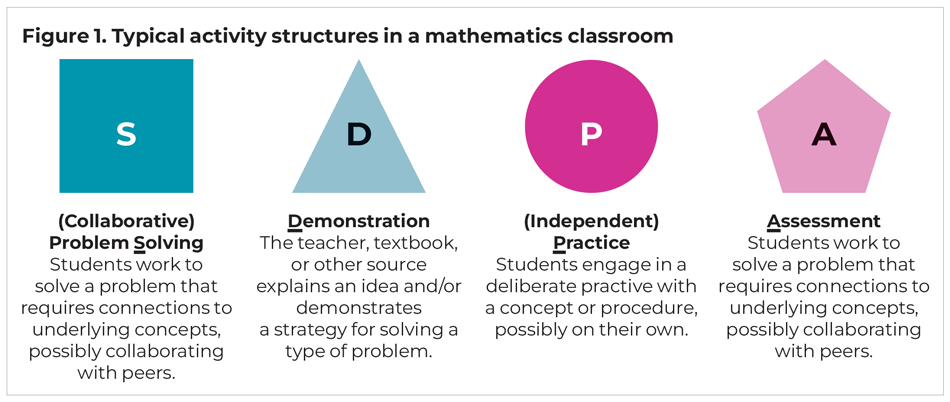
To help consider what balanced instruction might look like, let us assume that we can sort all instruction into a few activity structures: (collaborative) problem solving, demonstration, (independent) practice, and assessment (see Figure 1).
Using these basic activity structures, we can characterize a week of math lessons. Figure 2 shows what instruction might look like in two classrooms — one employing a direct approach, the other a dialogic approach.
In the direct-instruction classroom, the teacher lectured on a new topic on Monday, then students filled in a prepared notes packet, followed by some guided practice. They repeated this on Tuesday, but before independent practice, students worked in small groups to try to solve a problem using the strategies the teacher had just demonstrated. Before Wednesday’s lecture, the teacher engaged students in a brief formative assessment of their understanding so far. On Thursday, to help solidify their understanding and provide additional practice before Friday’s assessment, students worked in small groups to apply what they had been learning to solve a real-world problem.

In the dialogic classroom, the teacher introduced the same topic by asking students to work in small groups to generate strategies for solving a problem, which they then discussed as a whole class. They engaged in a similar inquiry-based task on Tuesday, concluding with a formative assessment activity. On Wednesday, the teacher lectured on some ideas or procedures related to the previous days’ work and asked students to do some practice. On Thursday, students worked together to figure out one more idea and, after the teacher demonstrated a few things, engaged in more practice. Their week similarly concluded with an assessment event.
Figure 2 shows that the teachers in these hypothetical classrooms used all four activity structures multiple times across a week of lessons. Based on that information, one might suggest that each teacher took a “balanced” instructional approach. What distinguishes these two classrooms, however, is not the presence of the activity structures, but the way those structures are sequenced and for what purposes. These different configurations of instruction position students as classroom participants in different ways and afford different kinds of learning opportunities.
How sequencing of instruction positions learners
In practical terms, a key distinction between direct and dialogic instruction is whether a new topic begins with the teacher or textbook through demonstration (direct) or with the students through inquiry and problem solving (dialogic). Popular characterizations would suggest that is also where each approach ends, reducing them to “pure demonstration” or “pure discovery” (e.g., Alfieri et al., 2011).
But regardless of instructional approach, teachers need not choose only one of these activity types. Within a dialogic approach, teachers will do some demonstration. After all, why would the person who is most knowledgeable about the school mathematics curriculum withhold information from students if/when it becomes relevant? Similarly, within a direct approach, students will likely do some problem solving and application to help solidify and expand their understanding of the ideas. So, with respect to teacher demonstration or student problem solving, the question is not “Which one?” but rather “In what sequence?”
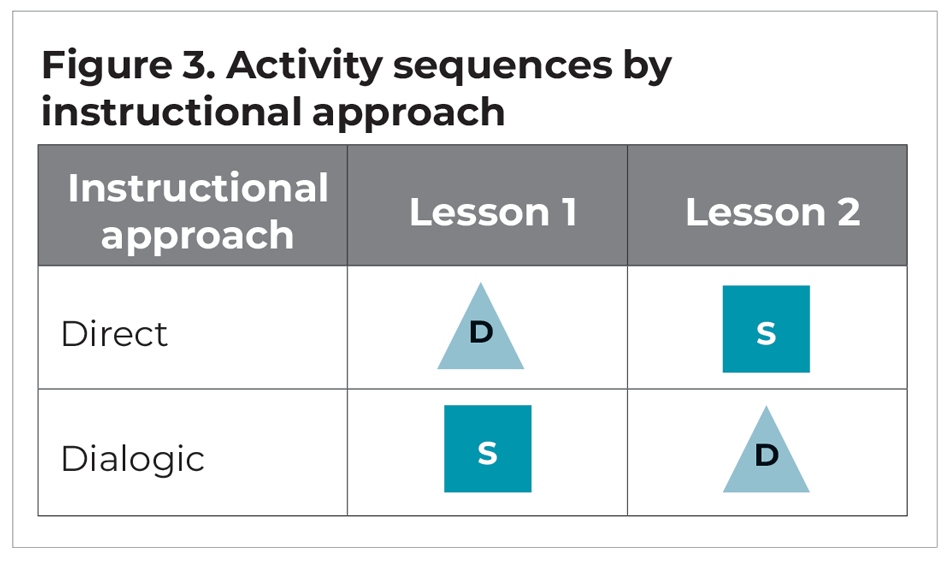
To help consider this, let’s examine how teachers might sequence a single pair of activity structures (see Figure 3). In the direct instruction classroom, the teacher shows students something in Lesson 1 and then asks them to apply it in Lesson 2. In the dialogic classroom, students engage in inquiry in Lesson 1. Then, in Lesson 2, the teacher shares information that supplements their work in Lesson 1 (Schwartz & Bransford, 1998).
When we focus on these two activities, differences with respect to sequence and purpose are even clearer than when we examine a week of instruction. Activities for exposition and application in the direct instruction classroom are re-
sequenced and repurposed for inquiry and “judicious telling” (Freeburn & Arbaugh, 2017; Lobato, Clarke, & Ellis, 2005) in the dialogic classroom.
A little of both?
For decades, the dominant form of mathematics teaching in schools has been fairly consistent (Hiebert, 2013). Teachers continue to adhere to the school mathematics tradition of demonstrating procedures for students to replicate (Cobb et al., 1992). In response to that tradition, as an instructor in university teacher education programs, I have likely been guilty of “over-correcting” (Brownell, 1956) — emphasizing inquiry-based mathematics instruction and neglecting demonstration and practice. So it’s perhaps not surprising that my student teachers, after encountering seemingly conflicting messages across their program’s different settings (Nguyen & Munter, 2024), conclude that they want to do “a little of both” in their teaching.
But these examples I’ve presented — though oversimplified — illustrate that it may be misguided to think that classrooms can be equal parts direct and dialogic instruction. One teacher’s approach can be consistently direct, another’s consistently dialogic, but both could employ the same activity structures, for different purposes and in different configurations. So neither of these imagined teachers is doing “a little of both” instructional approaches; they are both using “a little of several” activity structures, but all within a single instructional approach.
What teachers think of as balance in pedagogy may not be between different instructional approaches (e.g., direct or dialogic), but within those approaches. Dialogic instruction will include some telling; direct instruction will include some problem solving. An instructional approach is not simply about which types of activities the teacher is engaging students in, but about how those activities are configured to position students in particular ways and offer coherent learning opportunities across a school year.
So is it even possible to employ a balance of direct and dialogic instruction? Might attempting such a thing create incoherence in students’ experiences? Might this attempt at balance be a reason students choose not to engage in an inquiry activity and instead “[wait] for the teacher to hand over the required knowledge” (Goos, 2004, p. 283)?
When it comes to determining one’s instructional approach, rather than focusing on which kinds of activities to use, it would be more revealing to consider the rationales for those choices (Munter, Stein, & Smith, 2015b) and how they position students as learners.
What’s left unanswered
Even if one finds the argument in this article persuasive, it does not help us decide which instructional approach is “best.” Answering that kind of question — assuming we even should (more on that below) — requires consideration of other factors, including one’s perspectives on learning, students’ classroom experiences, and even the purposes of school mathematics.
Learning
What kind of teaching is “best” depends, in part, on what the goals are. Educators may agree on the goals of school mathematics (e.g., conceptual understanding and procedural fluency), but still promote different instructional approaches for achieving those goals. This is often due to different perspectives on learning.
For example, dialogic learning may involve a greater degree of cognitive struggle, which some scholars (e.g., Hiebert and Grouws, 2007) identified as a key feature of teaching for conceptual understanding. Advocates of dialogic approaches are likely to view that struggle as necessary for deep learning. Advocates of direct approaches are less likely to view such struggle as productive (e.g., Powell, Hughes, & Peltier, 2022).
Similarly, the dialogic classroom will afford more opportunities for students to pose their own problems (Silver, 1997) and engage in mathematical discourse (Smith & Stein, 2011). These opportunities are not as valued within direct approaches, which emphasize a more prescribed curriculum and timely, corrective feedback.
Students’ classroom experiences
Basing a decision about instructional approach only on whether or how students learn to do and use mathematics, however, overlooks a host of other dimensions of students’ experiences that might inform one’s decision about what is “best” (Myers, 2022). Teachers might consider which approach can most effectively accomplish any of the following:
- Affirming students’ social identities (Aguirre et al., 2013).
- Promoting student agency (Boaler & Greeno, 2000).
- Fostering a sense of belonging (Darragh, 2013).
- Ensuring cultural relevance (Ladson-Billings, 1994).
- Supporting emerging multilingual students (Celedon-Pattichis & Ramirez, 2012).
- Building positive teacher-student relationships (Battey et al., 2016; Gutiérrez, 1999).
Through the years, mathematics educators have probably touted how their reform efforts can accomplish all these goals. But questions remain about the inherent effectiveness of more dialogic approaches at enhancing the experiences of students from historically marginalized groups (Martin, 2015).
Purposes of school mathematics
The choice of instructional approach might also be influenced by broader considerations of purpose: What is school mathematics supposed to accomplish, for both the lives of children (and families) and society? With respect to the former, the National Council of Teachers of Mathematics (NCTM, 2018) suggested school mathematics should help students “expand professional opportunities, understand and critique the world, and experience the joy, wonder, and beauty of mathematics” (p. 7). Determining which instructional approach is better suited to accomplish such goals is outside the scope of this article, but the NCTM’s call to “catalyze change” does suggest our current system is falling short.
At a societal level, school mathematics has, arguably, played a significant role in ranking, sorting, and slotting people into an economic system (Ernest, 2018), largely maintaining historical disadvantages for Black and Indigenous communities (Ladson-Billings, 2006). We may instead want it to help fight oppression, reduce inequality, nurture our democracy, and improve our stewardship of the planet (D’Ambrosio, 1990). Again, is one instructional approach more likely to help accomplish these goals than another? And is one a worse “culprit” when it comes to the problems?
The more important questions
When we step back and look at these larger problems, the choice of instructional approach in math classrooms seems less consequential. No matter how we configure our classrooms, the broader social structures remain.
There has been considerable debate over the years about how mathematics should be taught. I’ve explained how the concept of balanced instruction may be a myth. Perhaps a second “myth” is that pedagogy is where we should spend so much time looking for ways to equalize the benefits of school mathematics. Instead of debating how we teach mathematics, perhaps we should devote more time to considering:
- Why we teach mathematics. For example, should our curriculum be “balanced” across the different purposes that mathematics can serve, including expanding professional opportunity; understanding and critiquing the world; and experiencing joy, wonder, and beauty? (NCTM 2018)
- Who benefits. How can we redress the historical imbalance in which communities have benefitted most from school mathematics? (Martin, 2015)
- How to teach more ethically. Should we “balance” the mathematical content we teach with teaching about the social responsibility of using mathematics? (Ernest, 2018)
- How much math instruction students need. Should we “balance” time, attention, and resources across all subject areas in schooling? (Shah, 2019).
Answering such questions might help to reveal ways that our current priorities are out of “balance.”
If one associates demonstration with direct instruction and problem solving with dialogic instruction, it seems reasonable to call for a “balanced approach.” But different instructional approaches already employ both of those activity structures (among others), just in different configurations and for different purposes. Thus, the more important questions for us to ask about our instruction and activity structures might be:
- How are my students being positioned?
- What kinds of learning opportunities am I providing?
- How am I enhancing the ways that students — especially minoritized students — experience the classroom?
Merely balancing our instruction across different activity structures does not determine the answers to these questions. “A little of both” does not guarantee that students are being positioned as competent, with a voice in which mathematical ideas the class pursues and how (Gresalfi et al., 2009). Nor does it guarantee that students have the opportunity to develop procedural fluency, conceptual understanding, and other strands of proficiency. As teachers, we must consider the kinds of experiences we hope to foster for our students and be intentional about configuring our instruction to meet those goals.
But working through debates about instructional approach, while important, is unlikely to address broader questions about why, how, and whether we should do school mathematics in the first place, what we want it to accomplish, and for whom. Reaching consensus on those matters within the next century may require working through another myth or two.
Note: The author would like to thank some of the artists who provided the soundtrack for his work on this manuscript: Beth Orton (“Weather Alive”), Makaya McCraven (“In These Times”), Sam Prekop & John McEntire (“Sons Of”), and Alvvays (“Blue Rev”).
References
Aguirre, J., Mayfield-Ingram, K., & Martin, D. (2013). The impact of identity in K-8 mathematics: Rethinking equity-based practices. National Council of Teachers of Mathematics.
Alfieri, L., Brooks, P.J., Aldrich, N.J., & Tenenbaum, H.R. (2011). Does discovery-based instruction enhance learning? Journal of Educational Psychology, 103 (1), 1-18.
Battey, D., Neal, R.A., Leyva, L., & Adams-Wiggins, K. (2016). The interconnectedness of relational and content dimensions of quality instruction: Supportive teacher-student relationships in urban elementary mathematics classrooms. The Journal of Mathematical Behavior, 42, 1-19.
Boaler, J. & Greeno, J.G. (2000). Identity, agency, and knowing in mathematics worlds. In J. Boaler (Ed.), Multiple perspectives on mathematics teaching and learning (pp. 171-200). Ablex.
Brownell, W.A. (1956). Meaning and skill — Maintaining the balance. The Arithmetic Teacher, 3 (4), 129-142.
Carpenter, T. & Lehrer, R. (1999). Teaching and learning mathematics with understanding. In E. Fennema & T. Romberg (Eds.), Mathematics classrooms that promote understanding (pp. 19-32). Erlbaum.
Celedon-Pattichis, S. & Ramirez, N.G. (Eds.). (2012). Beyond good teaching: Advancing Mathematics Education for ELLs. National Council of Teachers of Mathematics.
Cobb, P., Wood, T., Yackel, E., & McNeal, B. (1992). Characteristics of classroom mathematics traditions: An interactional analysis. American Educational Research Journal, 29 (3), 573-604.
Collins, A., Brown, J.S., & Holum, A. (1991). Cognitive apprenticeship: Making thinking visible. American Educator, 15 (3), 6-11, 38-46.
D’Ambrosio, U. (1990). The role of mathematics education in building a democratic and just society. For the Learning of Mathematics, 10 (3), 20-23.
Darragh, L. (2013). Constructing confidence and identities of belonging in mathematics at the transition to secondary school. Research in Mathematics Education, 15 (3), 215-229.
Ernest, P. (2018). The ethics of mathematics: Is mathematics harmful? In P. Ernest (Ed.), The philosophy of mathematics education today (pp. 187-216). Springer.
Freeburn, B. & Arbaugh, F. (2017). Supporting productive struggle with communication moves. The Mathematics Teacher, 111 (3), 176-181.
Freire, P. (1970). Pedagogy of the oppressed (30th anniv. ed.). Bloomsbury.
Goos, M. (2004). Learning mathematics in a classroom community of inquiry. Journal for Research in Mathematics Education, 35 (4), 258-291.
Gresalfi, M., Martin, T., Hand, V., & Greeno, J. (2009). Constructing competence: An analysis of student participation in the activity systems of mathematics classrooms. Educational Studies in Mathematics, 70, 49-70.
Gutiérrez, R. (1999). Advancing urban Latina/o youth in mathematics: Lessons from an effective high school mathematics department. The Urban Review, 31 (3), 263-281.
Hiebert, J. (2013). The constantly underestimated challenge of improving mathematics instruction. In K.R. Leatham (Ed.), Vital directions for mathematics education research (pp. 45-56). Springer.
Hiebert, J. & Grouws, D.A. (2007). The effects of classroom mathematics teaching on students’ learning. In F.K. Lester (Ed.), Second handbook of research on mathematics teaching and learning (pp. 371–404). Information Age.
Hiebert, J. & Lefevre, P. (1986). Conceptual and procedural knowledge in mathematics: An introductory analysis. In J. Hiebert (Ed.), Conceptual and procedural knowledge: The case of mathematics (pp. 1-27). Erlbaum.
Kilpatrick, J., Swafford, J., & Findell, B. (Eds.). (2001). Adding it up: Helping children learn mathematics. National Academy Press.
Ladson-Billings, G. (1994). The dreamkeepers: Successful teaching for African-American students. Jossey-Bass.
Ladson-Billings, G. (2006). From the achievement gap to the education debt: Understanding achievement in US schools. Educational Researcher, 35 (7), 3-12.
Lobato, J., Clarke, D., & Ellis, A.B. (2005). Initiating and eliciting in teaching: A reformulation of telling. Journal for Research in Mathematics Education, 36 (2), 101-136.
Martin, D.B. (2015). The collective Black and “principles to actions.” Journal of Urban Mathematics Education, 8 (1), 17-23.
Munter, C., Stein, M.K., & Smith, M.S. (2015a). Dialogic and direct instruction: Two distinct models of mathematics instruction and the debate(s) surrounding them. Teachers College Record, 117 (11), 1-32.
Munter, C., Stein, M.K., & Smith, M.S. (2015b). Is there a common pedagogical core? Examining instructional practices of competing models of mathematics teaching. NCSM Journal of Mathematics Education Leadership, 16 (2), 3-13.
Myers, M. (2022). Learning trajectories research needs a hard re-set: Using PCTM to center cognition, context, and culture. In A.E. Lischka, E.B. Dyer, R.S. Jones, J.N. Lovett, J. Strayer, & S. Drown, (Eds.), Proceedings of the Forty-Fourth Annual Meeting of the North American Chapter of the International Group for the Psychology of Mathematics Education (pp. 62-78). Middle Tennessee State University.
National Council of Teachers of Mathematics. (2018). Catalyzing change in high school mathematics: Initiating critical conversations.
National Council of Teachers of Mathematics. (2000). Principles and standards for school mathematics.
National Governors Association Center for Best Practices & Council of Chief State School Officers. (2010). Common Core state standards for mathematics. www.corestandards.org
National Mathematics Advisory Panel. (2008). Foundations for success: The final report of the National Mathematics Advisory Panel. U.S. Department of Education.
Nguyen, P. & Munter, C. (2024). Secondary mathematics preservice teachers’ perceptions of program (in)coherence. Journal of Mathematics Teacher Education, 27, 441-477.
Powell, S.R., Hughes, E.M., & Peltier, C. (2022). Myths that undermine maths teaching [White paper]. Centre for Independent Studies.
Rosenshine, B. (2012). Principles of instruction: Research-based strategies that all teachers should know. American Educator, 36 (1), 12-19, 39.
Schwartz, D.L. & Bransford, J.D. (1998). A time for telling. Cognition and Instruction, 16 (4), 475-522.
Shah, N. (2019). Should there be less mathematics education? In S. Otten, A.G. Candela, Z. de Araujo, C. Haines, & C. Munter (Eds.), Proceedings of the Forty-First Annual Meeting of the North American Chapter of the International Group for the Psychology of Mathematics Education (pp. 29-32). University of Missouri.
Silver, E.A. (1997). Fostering creativity through instruction rich in mathematical problem solving and problem posing. ZDM, 29 (3), 75-80.
Smith, M. & Stein, M.K. (2011). 5 Practices for orchestrating productive mathematics discussions. National Council of Teachers of Mathematics.
This article appears in the December 2024 issue of Kappan, Vol. 106, No. 4, p. 14-19.

ABOUT THE AUTHOR

Charles Munter
Charles Munter is an associate professor of mathematics education at a public research university in Missouri.