|
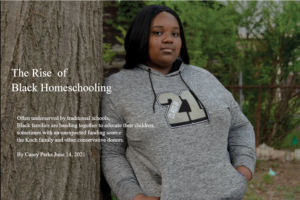
Above: Detroit student Victoria Bradley, featured in a recent New Yorker story, whose mother Bernita recently tweeted “This is Resistance Work, Not a Bribe!”
📰 COVERING BLACK PARENTS’ ADVOCACY: There hasn’t been the usual wave of journalistic praise for Casey Parks’ most recent New Yorker story, The Rise of Black Homeschooling, which highlights the inadequacy and toxicity of the education too many Black children are being offered and raises important questions about the long-held emphasis racial diversity in schools.
One reason may be that the piece includes prominent, repeated mentions of Black parents receiving support from conservative-leaning funders (including some who fund The Grade): “Often underserved by traditional schools,” notes the first of several references to funders, “Black families are banding together to educate their children, sometimes with an unexpected funding source: the Koch family and other conservative donors.”
For some readers, the effect of these mentions is to disqualify Black parents’ decisions and undercut their agency — a concern that’s come up in education journalism before. Just a few weeks ago, parent advocate Sarah Carpenter wrote an impassioned plea to education journalists to avoid overfocusing on funding sources, noting that “writing articles this way keeps dangerous stereotypes about Black and Brown people going.” It also came up a few years ago when coverage of parent protesters demanding attention from US Sen. Elizabeth Warren focused on the protesters’ funding sources. My column noted that the best approach, illustrated by New York Times reporter Erica Green, mentioned funding sources and moved on.
I’m glad Parks wrote this piece and the New Yorker published it. She’s an extremely talented feature writer, known for her detailed human portraits of subject who in the past have been deeply appreciative of her efforts to capture their stories. We need more journalism that pulls parent voices toward the center of education coverage. However, I do wish that she’d kept focus on the experiences of her subjects and the schools they are exiting. And I’m guessing that parents in this piece are not nearly as pleased with how they were depicted as previous subjects have been. For good reason.
📰 PROTEST COVERAGE REQUIRES CONTEXT: The understandable temptation when covering heated topics like CRT is to focus on the emotions (angry parents, teachers and students in tears) and the possible implications (if the proposal passes, or doesn’t). But don’t just present the show on stage; take your readers backstage and fill them in on what’s going on behind the scenes.
According to an NBC News’ investigation, Critical race theory battle invades school boards — with help from conservative groups, co-reported by former education reporter Tyler Kingkade, much of the current surge of debate over CRT has been coordinated by political advocacy groups. The controversy (and the glut of right-wing coverage) have “all the red flags of a dark money astroturf campaign,” according to the New Yorker’s Jane Mayer, who’s written about these kinds of things. What’s happening is “a well-planned Republican misinformation strategy,” according to Nikole Hannah-Jones, whose 1619 Project is the focus of some of the debate. That doesn’t disqualify anyone’s viewpoint if they happen to agree. Left-leaning organizations like teachers unions are also campaigning to have their viewpoint advanced in indirect ways, notes Chalkbeat’s Matt Barnum. And, of course, situations vary widely across 13,000 school districts. But the backstory is a crucial thing for readers to know. Please include it. Otherwise, you’re letting your coverage become part of the outrage machine.
Related: School privatization lobby places fake news on local stations (The Intercept) . Also: Researcher Uncovers ‘Critical Race Theory’ Astroturfing Campaign (Vice)
📰 COMPARE AND CONTRAST TWO WEST COAST OUTLETS: One of the most vivid contrasts when it comes to education coverage these days can be seen between the LA Times and the SF Chronicle, especially when it comes to school reopening. For example, the LAT’s recent education newsletter promotes what can easily be read as a sort of pro-closed schools (pro safety) stance: “The L.A. Unified School District has been slower than many to fully return to normal, but as my colleague Howard Blume writes, there’s an upside to that: So far, the number of known COVID-19 cases transmitted at L.A. schools has remained constant at zero.” At the same time, SF Chronicle’s education reporter Jill Tucker takes a much different approach, scrutinizing the possibility that local school districts will try to find loopholes to keep kids home rather than sending them back to school: Bay Area school reopenings still have cloud of uncertainty despite unity from health officials. In the Bay Area, writes Tucker, school reopening decisions “were not typically based on science, coronavirus case rates or expert advice, but rather political will, leadership, labor negotiations, etc.”
Did someone forward you this newsletter? You can sign up here.
|
PEOPLE, JOBS
Who’s going where & doing what?
|
|
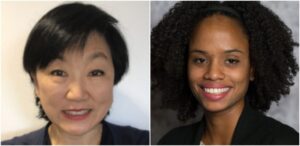
| ABOVE: Mary Suh, left, will be the New York Times’ next education editor. Tamara Gilkes Borr writes about education for The Economist.🔥 New hires: Mary Suh, “known for her creativity, intellectual curiosity and rigor,” has been named education editor at the New York Times, according to the official announcement. And former NYT metro reporter and sometimes-education reporter Juliana Kim has started her new gig as education reporter at WPLN in Nashville. The Houston Chronicle has replaced outgoing education reporters Shelby Webb and Jacob Carpenter with Hannah Dellinger, who will cover suburban education, and Alejandro Serrano, who will cover Houston ISD. Congrats to all!
🔥 In The Economist, Tamara Gilkes Borr (above, right) wrote this week about the many reasons why “most American children are taught to read in a way that study after study has found to be wrong.” The news outlet doesn’t byline many of its articles, but many of the outlet’s recent education stories have been written by Gilkes Borr, who joined the outlet in January. Follow her here.
🔥 Jobs: KPCC Los Angeles is still looking for an education editor, and they’re also hiring a higher education reporter for a nine-month contract. The Education Writers Association is hiring a program specialist. Colorado Public Radio is looking for a health, education, and justice editor. And The Chronicle of Higher Education is hiring for multiple positions, including staff reporter and engagement editor.
🔥 EWA announced its newest class of reporting fellows, who will receive $8,000 to work on projects ranging from a collaboration with Native American college students narrating their own journeys to a look at the impact of COVID on child care deserts in Wisconsin. Some of those named include APM Report’s Sasha Aslanian, USA Today’s Sami West, The Oregonian’s Eder Campuzano, and NYT Magazine contributor Samantha Shapiro. Congrats to all.
🔥 Departures: “It’s a blow to lose Jacqui,” CT Mirror executive editor Elizabeth Hamilton said of Jacqueline Rabe Thomas’ upcoming departure from the outlet. We profiled Rabe Thomas’ standout work just last fall. However, there’s some good news: Hamilton told us that Report for America education reporter Adria Watson will stay on the education beat.
🔥 Belated congrats to The New Haven Independent’s Emily Hays, who won a Connecticut Society of Professional Journalists’ award for her reporting on education! Hays also took home a third-place prize for COVID news reporting.
|
EVENTS
What just happened & what’s coming next?
|
|
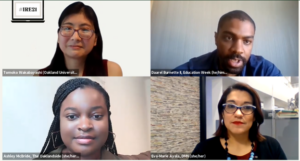
| ABOVE: Clockwise from top left, Oakland University’s Tomoko Wakabayashi, Education Week’s Daarel Burnette II, Dallas Morning News Ed Lab editor Eva-Marie Ayala, and Oaklandside’s Ashley McBride discussed investigating educational inequities at #IRE21 earlier this week. Members can watch a recording here. And former education reporter Bethany Barnes (not pictured) thanked those who attended her session with Lulu Ramadan on approaches to local investigations. ⏰ Media appearances: The San Francisco Chronicle’s Jill Tucker talked about what school will look like in the Bay Area next fall (and doubts that it will be fully open) on KCBS Radio. The Boston Globe’s Bianca Vázquez Toness was on EWA Radio to talk about the educational experiences of families whose lives were most disrupted by COVID-19.
⏰ Books: “Why didn’t we move mountains as a society to offer care and learning as safely as possible to our most vulnerable?” asked NPR’s Anya Kamenetz on Twitter in response to a teacher-written NYT op-ed describing remote learning as a disgrace. Kamenetz’s upcoming book on how schools and society responded to the pandemic will focus on exactly this question, she said.
⏰ New resources: Emily Oster announced the launching of a COVID-19 School Data Hub that “aims to provide a platform for educators, policymakers, and researchers to understand the impact of the COVID-19 pandemic on students and how they learn in schools.” Check it out here. Scalawag editor Cierra Brown Hinton and NC Local News Lab Fund’s Lizzy Hazeltine are going public with the “Anti-Racist Table Stakes,” a resource for those interested in combating inequity and racism. Lastly, do you need to talk to someone about critical race theory in schools and the influence of outside money? Teachers College professor Jeffrey Henig wrote the book on it, along with co-authors Rebecca Jacobsen and Sarah Reckhhow.
⏰ Upcoming: Don’t miss the culmination of GBH’s “COVID and the Classroom” series at a virtual event June 21. The series looked at how COVID shaped the lives of three Boston-area high school seniors.
|
|
|
|
THE KICKER
|