|
| TEACHERS & VACCINES
The big education story of the week |
|
| RECONSIDERING BUSING
The best education journalism of the week |
|
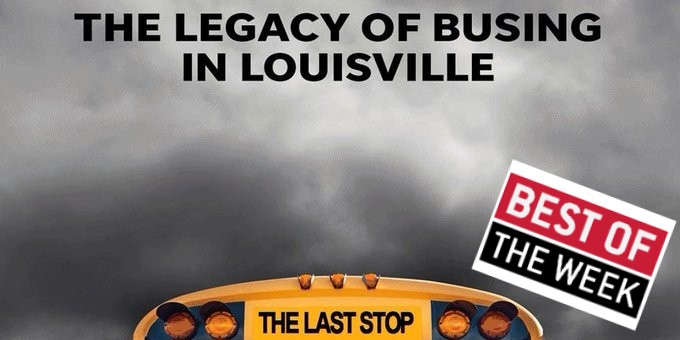
| 🏆 BEST: The best story this week is a four-part series from the Louisville Courier Journal called The Last Stop: Louisville’s flawed busing legacy may be near its end (above). The series looks at Louisville’s desegregation myth, examines busing in Jefferson County schools, and investigates why diversity is disappearing from public schools now. Louisville’s plan has been one of the most widely admired in the nation, but this series describes how the plan may have papered over some problems and even exacerbated others. Ed Week’s Andrew Ujifusa called it “a great read” and praised the visuals. “Do yourself a favor and start reading,” tweeted WFPL News education reporter Jess Clark. “These stories truly captured the depth, nuance, and heart of issues around JCPS’ student assignment plan.”
🏆 RUNNER-UP: This week’s runner-up is What Cindy Marten’s Rise Tells Us About the State of Education Politics by Will Huntsberry in Voice Of San Diego. This story is timely and authoritative, and it speaks to how hard it can be to report on schools without access to the people at the top. It also includes some telling stories about Marten, including the time she put on ruby slippers, clicked her heels, and asked an audience to envision the public school system they wanted. “Marten embodies a new guiding principle in national education politics,” writes Huntsberry. “The way to a better public school system does not lie in criticizing its faults, but relentless positivity about its promise.” For more on Marten, who’s been nominated to join the Biden administration, see Francine Maxwell’s op-ed NAACP San Diego Branch Opposes Nomination of Superintendent Cindy Marten to the Post of Deputy Secretary.
To get daily education headlines and education news events, follow @thegrade_ |
|
A LITTLE MORE HARD-NOSED REPORTING, PLEASE
New from The Grade |
|
| So far, at least, the Democratic-led school reopening effort has been a bit of a mess. But we still know much less about what’s going on behind the scenes than we should.
In this week’s column, I’m pushing reporters to be more aggressive, to dig deeper into convenient (and often self-serving) narratives about logistics, costs, and risks — and to tell us what’s going on behind the scenes rather than what’s taking place in public.
The reopening story keeps getting bigger, and political reporters from the Associated Press, NYT, Washington Post, CNN, Politico, and NBC are all getting involved, along with TV journalists who are already engaged.
But nobody can tell this story better than education journalists, and I’m hopeful they will squeeze their sources for deeper insights and amplify their skepticism for sharper coverage. |
|
| MEDIA TIDBITS
Thought-provoking commentary on the latest coverage. |
|
| Above: As reported in Politico CA, the California Teachers Association (CTA) has launched a campaign against reopening. It uses San Diego Union-Tribune and Sacramento Bee headlines to amplify its case. Union-Tribune education reporter Kristen Taketa notes that the “locations of those cases were not available, cases were reported countywide from a 2-month period, and no school outbreaks had been reported by that time.”
📰 PARENTS SUPPORT THIS? Parents fearful of COVID or concerned about sudden scheduling changes may like the remote and hybrid options that they’re being offered, but the reported outcomes from remote learning in particular remain awful — and awfully inequitable. Poor kids remain much less likely to have in-person options in Los Angeles, according to the LAT. Grades are down and depression is rising among Bay Area kids, according to the SF Chronicle. Frequent school shutdowns are driving NYC families crazy (according to the NYT) and taking a toll on teachers (according to the NY Daily News). Families are fleeing Sacramento-area public schools in search of in-person options, according to the Bee. Some parents are upset that Fairfax schools are going to open classrooms to kids and monitors while teachers instruct remotely, according to NBC Washington. Remote students are more stressed, according to NBC News.
📰 DEATH TO THE ‘INSPIRATIONAL’ NEWS STORY: “A teen gives up her college savings to pay her mother’s back rent. A student uses his lunch money to help pay down his classmate’s debt.” Inspirational news stories are a common feature in education, but now might be a good time to rethink their implications, according to Kiran Ambika Misra’s New Republic story, Death to the Inspirational News Story. “Let’s stop pretending these stories are heartwarming,” she writes. People want good news, it’s true, but not at the expense of stories that gloss over the underlying realities or make unusual outcomes appear to be commonplace. It’s a point that Amy Silverman made in her piece for The Grade about coverage of kids with disabilities, calling the trend “inspiration porn.”
📰 SELF-EXAMINATION AT THE PHILADELPHIA INQUIRER: “Pushing for an antiracist newsroom means putting policies in place of traditions, engagement in place of norms of distanced objectivity, and difficult conversations in place of colorblind politeness.” A new piece published in Poynter by a Temple University professor features a content audit and the results of nearly 50 interviews. “Reporter after reporter shared stories of feeling that they had to change how they pitched, framed, or made style choices within a story to make the story legible to an assumed white reader,” notes professor Andrea Wenzel. In 2016, an Inquirer education story created a minor controversy over its depiction of a white family that chose a neighborhood school over a popular charter option.
Correction: In last week’s newsletter, I got WBEZ education reporter Sarah Karp’s last name wrong in an item about what it was like covering former Chicago teachers union head Karen Lewis. So sorry about that! |
|
 |
JOB MOVES, REPORTER KUDOS, & CORRECTIONS
Who’s going where & doing what? |
|
| Above, left to right: Cayla Bamberger, Lily Altavena, and Nicole Gaudiano
🔥 Comings and goings: Tuesday was Cayla Bamberger’s first day covering education for the Connecticut Post, where she’s replacing Linda Lambeck. Arizona Republic K-12 reporter Lily Altavena is moving on, and her job is open. “It’s hard to know when it’s time to leave a job like this,” she tweeted. “As I contemplated a new opportunity, I realized I’ll never quite feel done with ed reporting here.” And former Politico education reporter Nicole Gaudiano started her new gig covering the White House for Business Insider. Talk about being in the middle of all the action. Maybe she can get us some inside details on the botched reopening rollout?
🔥 Storm duty: Kudos to all the Texas ed reporters who kept their followers informed about the snowstorm and school closures this week! Shout-outs to the Dallas Morning News Ed Lab team, which reported on schools canceling food distribution, and several others, including the Houston Chronicle’s Shelby Webb and Jacob Carpenter and Houston Public Media’s Laura Isensee. We hope you’re all safe and well.
🔥 Rescuing local news: “It is uncomfortable for journalists to stand up and say ‘enough,’ and talk with our readers and our community leaders about the slow death of our papers, but we have to do it,” said Baltimore Sun education reporter and NewsGuild leader Liz Bowie in an email. Bowie is fighting to save her paper, which received the good news that it may be acquired by a nonprofit. Bowie believes that the Baltimore Sun “could become a national model for replanting newspapers into local ownership.”
🔥 Learning the ropes: Former Spencer fellow S. Mitra Kalita says she’s letting interns silently join her phone or Zoom interviews so they can learn by observing, which is hard to do in a pandemic. “Everything I learned in journalism, I learned by eavesdropping on veteran reporters nearby,” she tweeted. If you’re a new education reporter, how have you learned the beat during this crazy time? Let us know at @thegrade_.
🔥 Corrections, please: In her CNN interview with Jake Tapper last weekend, CDC Director Rochelle Walensky said that only “around 60% of students are reliably masking,” according to a CDC study. But “that’s not what the study found…,” noted Chalkbeat’s Matt Barnum. He also corrected a recent Valerie Strauss column in the Washington Post, noting that the CDC guidance “extensively discusses asymptomatic screening.” As of Friday morning, the Post has not added a correction or clarification.
Did someone forward you this newsletter? You can sign up here. |
|
EVENTS & APPEARANCES
What just happened & what’s coming next? |
|
| ⏰ Media appearances: Chalkbeat’s Matt Barnum was on WBUR’s On Point to talk about what the science says about school reopenings. CalMatters’ Ricardo Cano was on the California State of Mind podcast to talk about school enrollment in the pandemic. And hear what KQED education reporter Vanessa Rancaño had to say last week on The Messy Path to Reopening Public Schools. National education reporters Erica Green, Andrew Ujifusa, and Laura Meckler appeared at a recent AASA event to help local school administrators “better connect” with national education reporters. And NBC News’ Erin Einhorn and WLRN’s Verónica Zaragovia were on WNYC’s The Takeaway, talking about attendance problems during the pandemic.
⏰ Upcoming: The NYT’s Nikole Hannah-Jones will participate in a 45-minute conversation on race, journalism, and education for Big Picture Learning on Friday, March 12. Register here. This year’s virtual NICAR21 will be March 3-5. Check out the education reporter networking event March 5 with the Texas Tribune’s Aliyya Swaby and the Fresno Bee’s Isabel Sophia Dieppa. Also of note on March 5: Using data in pursuit of solutions journalism with Matthew Kauffman and AL.com’s Trisha Powell Crain.
⏰ ICYMI: The Seattle Times hosted an Ed Lab Live event Wednesday with Highline Schools, which was featured in Joy Resmovits‘ story about accelerated learning. WBEZ’s Kate Grossman and Sarah Karp talked to teachers and education experts in a virtual event on Tuesday about what lies ahead for kids. You can watch it here. And Nikole Hannah-Jones and AFT President Randi Weingarten participated in an event Thursday about the 1619 Project. |
|

THE KICKER |
|
| By Alexander Russo with additional writing from Michele Jacques and Colleen Connolly. |
|
|
|
|
|
|