Educators can help students engage in critical discussions about technology use and its impact on their lives and society.
Digital technologies play a powerful role in today’s classrooms. Smartphones and laptop computers create learning opportunities that were hard to imagine when the iPhone was first introduced in 2007. But like all technologies, digital devices bring unintended, collateral, and disproportionate effects — ones that teachers and school leaders likely understand better than most. Smartphones and laptops provide students with access to communication and information, but they also contribute to distraction, social conflict, bullying, body image issues, and many other problems. How should educators respond when problems like these inevitably arise?
Consider the “Devious Licks” meme that emerged on TikTok in September 2021 and inspired a wave of school vandalisms. Many administrators and teachers reacted by increasing surveillance and meting out punishments. Devious Licks quickly faded from view, but the question of whether those reactions were appropriate and effective remains.
Or consider the ChatGPT chatbot created by OpenAI and released to the public in November 2022. ChatGPT can generate novel responses to all manner of questions using human-like language. It can even compose entire essays that mimic the writing style of a high school student. This has led to a torrent of concerns over students’ use of ChatGPT to cheat on assignments (Herman, 2022; Klein, 2023). Will teachers need to ramp up their methods of detection?
How long before the next trend demands a response? Instead of reacting to problems that technologies inevitably bring, how might schools and educators take a more proactive approach?
Despite its profound impacts on our lives, technology is rarely a topic for critical thinking and democratic discussion in schools. This is a missed opportunity. In our research, we have found that students, teachers, and administrators have much to say about how technologies affect their communities and the flow of their daily lives. What if, rather than focusing on setting and enforcing rules about technologies, educators used them as a starting point for critical inquiry and decision making with students? By nurturing discussions about technology, its effects, and our relationships to it, schools can take a proactive approach to solving challenges technologies pose.

Teaching about technology through subject areas
In his 1995 book The End of Education, Neil Postman argued for schools to include technology education as a new and distinct subject that doesn’t just teach students how to use technology but encourages critical thinking about “what technology helps us do and what it hinders us from doing” (p. 191). While we would love to see new classes and areas of study that center technology as an object for inquiry, we recognize those are unlikely. Nevertheless, Postman’s vision for a technology education that extends beyond the development of technical skills remains vital. Following in Postman’s spirit, we believe students need to develop a technoskeptical stance: one in which they critically reflect on what technologies do (and undo) and deliberate about how to live well with current and upcoming technology.
This kind of technology education does not require the development of a new class; it can occur within the larger school environment and the core subject areas. Schools already make many technological decisions every day, such as those about which instructional technologies to adopt or which ones to limit in schools. In addition, we have seen examples in our research of how science, social studies, and English language arts can each provide fertile ground for technoskeptical thinking and deliberation among students. That potential has not yet been realized. Some of the possibilities that exist within the subject areas are as follows.
Science
The Next Generation Science Standards (Achieve, 2013) and the movement for STEM education (Roehrig et al., 2021), have raised the prominence of engineering and technology in science classrooms. These changes ought to provide many opportunities to engage in critical thinking and debate about technology. However, the focus generally has been on developing students’ technical knowledge and skills.
For example, a common STEM activity is for students to design an effective water filter (e.g., Alsultan et al., 2021; Berge et al., 2014). This is typically treated as a purely technical problem of assembling the available materials into a device that best meets the design criteria. However, this misses many opportunities for technoskeptical thinking. A teacher might engage students in conversation about why we live in a world where filters are necessary. Students could explore how and why water becomes contaminated; the technological choices that our society makes about procuring potable water; and how to design systems that serve everyone, especially those who are most vulnerable.
Social studies
Technology has long been included in social studies curricula. Any history curriculum will point out influential technologies in different places and times. However, technological inventions such as railroads, cars, or computers often are treated as inevitable engines of progress and worthy of little further discussion or debate. An inquiry approach would encourage critical thinking and discussions.
The social studies themes first adopted by the National Council for the Social Studies in 1994 asked questions such as, “What can we learn from the past about how new technologies result in broader social change, some of which is unanticipated? Is new technology always better than that which it replaces?” More recently, C3Teachers and IEEE’s Raising Engineering Awareness through the Conduit of History (REACH) program offer numerous model lessons about technology that ask students to weigh evidence and discuss compelling questions such as, “Was the development of agriculture good for humans?” and “How would your life be different without electric lighting?” These lessons encourage students to evaluate the trade-offs of technological change and whether, and for whom, they constitute progress.
English language arts
Technology is central to the English language arts (ELA) curriculum, though it is not always recognized as such. Reading a novel or writing an essay, after all, is only possible thanks to the alphabet — perhaps the most influential communication technology of all time. In the history of ELA, educators occasionally have encouraged reflection about how the technologies we use to communicate, whether writing or film or social media, shape the messages we send and receive. The inclusion of media literacy in the ELA curriculum, for instance, has prompted discussions about how technologies withhold or disclose information in ways that can distort its interpretation (Hobbs & Jensen, 2009).
More often, however, ELA has focused on the technical skills involved in communicating in different media. The Common Core standards for ELA, for instance, acknowledge that new technologies have broadened the need for students to read and produce not just words, but “graphics, images, hyperlinks, and embedded video and audio” (Common Core State Standards Initiative, 2022). While such standards focus on technology skills, they also point to places where technoskeptical thinking could find a home in the ELA curriculum. For example, students could engage in discussions about how different media might change the ways we communicate or make it easier (or more difficult) for certain people to participate in public discourse.
The technology education iceberg
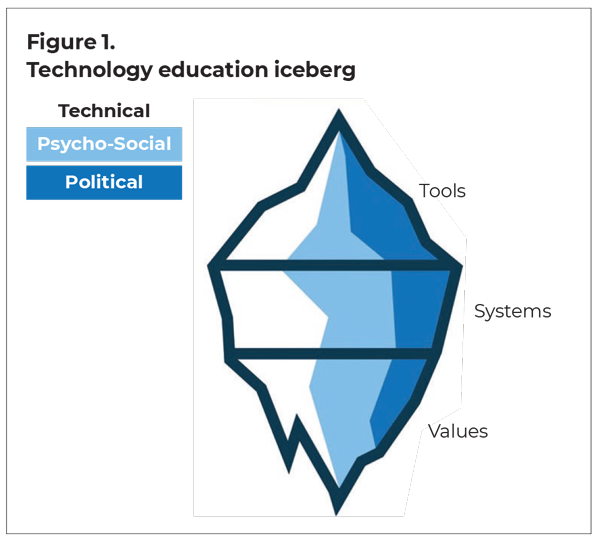
In our research, we’ve found that the kind of technology education that goes beyond technical “how to” questions is rare. We developed the technology education iceberg (see Figure 1) as a guiding framework that educators can use to plan, or reflect on, how they teach about technology and make sure that their curriculum is more well-rounded in its approach.
The iceberg framework consists of three dimensions of technology that can be explored at different levels of depth.
- The technical dimension includes how technologies are made and how they function, ideas often addressed in science/STEM classes as well as coding or robotics clubs. It also can include deeper examinations of how technologies fit into larger systems of production, use, and maintenance, as well as their effects on human health and the environment.
- The psycho-social dimension focuses on how technology affects how humans think and interact as individuals and communities. Students might investigate how constant access to social media affects their concentration, changes their social relationships, and influences cultures and institutions.
- The political dimension concerns who makes (and ought to make) decisions about technologies, from individuals to companies to lawmakers.
For each dimension, educators might ask students to think about technologies as tools that produce direct and predictable outcomes. But to promote deeper thinking that goes beyond the surface, educators should encourage students to think of technologies as parts of systems with complex and collateral effects, and as reflecting and reinforcing values such as efficiency, freedom, power, democracy, and justice.
The iceberg in action
These technological dimensions and levels are not just abstract concepts for school curricula. They often are embedded in the daily lives of school communities. For example, transportation technologies and systems affect how everyone is able to arrive at school each day. The iceberg encourages us to move beyond superficial questions about how to make traffic flow more efficiently to consider how our transportation system was made by certain people, for certain people, and with particular values in mind. Had different people, with different values and concerns, been in charge, the U.S. might have more walkable and bikeable cities with neighborhood schools, healthier communities, stronger local economies, and more sustainable environments (Marx, 2022; Speck, 2013).
Critical inquiries into technology need not address every part of the iceberg in every lesson. The framework exists to help educators identify aspects of a technology that they might not have otherwise explored and consider how incorporating that dimension could lead to deeper and richer discussions. Teachers should look for ways to explore the deeper parts of the iceberg, but the surface-level components have an important role to play as well. In fact, they are often fine places for inquiries to begin.
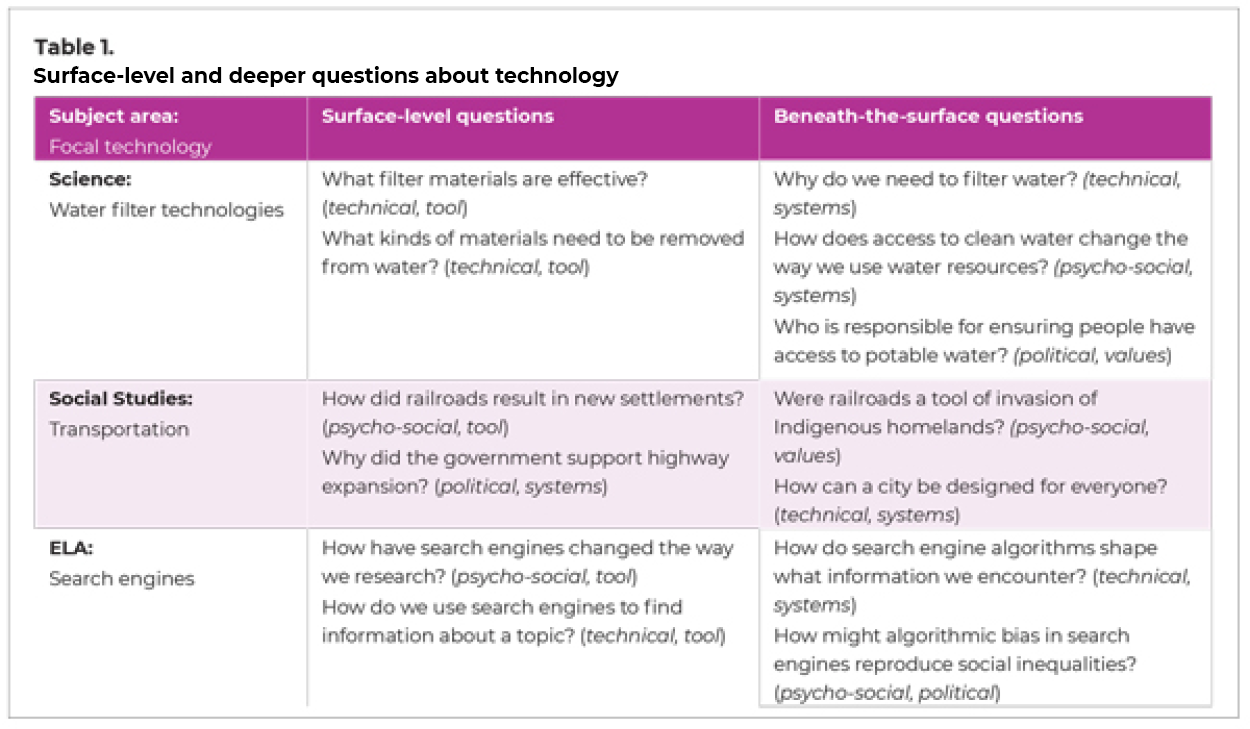
Table 1 illustrates how the framework can be applied to topics that are addressed in core subject areas. For each technology, we identify surface-level questions as well as questions that go deeper, and we link each of those questions with the dimensions of the iceberg. The surface-level questions tend to be the ones most commonly used. While those questions can help start a conversation, the beneath-the-surface questions are far more likely to stimulate critical thinking and rich discussion.
Putting the iceberg to work in schools
Using the technology education iceberg in schools doesn’t require an overhaul of our existing practices. The following are specific strategies that can be used to start putting the iceberg to work to encourage technoskeptical discourse.
Find curricular connections
When technology appears in core subject areas, regard it as an invitation for technoskeptical inquiry and discussion. Importantly, inviting students to consider how technological tools, systems, and values shape the ways we develop scientific knowledge, practice democracy, or create and interpret meaning is not an add-on to the curriculum. It’s a way to engage with content-area learning more meaningfully.
Ask thoughtful questions
Once they’ve found a curricular connection, teachers can use the iceberg to consider what types of questions they want to ask (see Table 1). The Civics of Technology project poses five critical questions that educators might ask about any technology:
- What does society give up for the benefits of the technology?
- Who is harmed and who benefits from the technology?
- What does the technology need?
- What are the unintended or unexpected changes caused by the technology?
- Why is it difficult to imagine our world without the technology?
Drawing from Neil Postman (1998), these questions can help students consider the trade-offs of technology, but they primarily focus on the psycho-social dimension. The iceberg can remind educators to reflect on how more technical and political questions might allow for different types of connections. For example, educators might ask how the design of a technology excludes or harms some people or whether decision makers consider those who are most harmed by the technology.
Encourage critical thinking about school technology
The iceberg can stimulate conversations about the technologies that are ubiquitous in schools. Educators can appear hypocritical by asking students to be careful consumers and users of technology, while at the same time imposing video surveillance or adopting data-collecting instructional technologies without their input.
Teachers might collaborate with students to conduct ed tech audits to help determine which technologies the school or district should adopt. Including students in consequential discussions can offer students real-life lessons in the difficulties of making decisions in a community.
We consistently have found that students want to engage in deep and reflective conversations about the complex relationships they have with ever-present technologies.
Booting up conversations about technology
We live in a time of rapid technological change (ChatGPT is just the latest illustration of this), and students deserve opportunities to think about and discuss the role of technology in their lives. Fortunately, this does not require new classes or wholesale change. It can take place through the everyday topics and issues that arise in schools.
While adults often stereotype students as singularly obsessed with their smartphones and social media, we consistently have found that students want to engage in deep and reflective conversations about the complex relationships they have with ever-present technologies. These discussions aren’t simply about technology, but about the type of world we want to live in. We should provide students tools to think about their tools. We might start by posing a central question to technology education: What relationships do we want with technology?
References
Achieve, Inc. (2013). Next generation science standards.
Alsultan, J., Rice, M., Feldman, A., Nkrumah, T., Ergas, S., & Ghebremichael, K. (2021). Biosand filters for water purification. The Science Teacher, 88 (4), 41-46.
Berge, N., Thompson, D.D., Ingram, C., & Pierce, C. (2014). Engineering design and EFFECTs: A water filtration example. Science Scope, 38 (3), 16-27.
Common Core State Standards Initiative. (2022). Common core state standards for English language arts and literacy in history/social studies, science, and technical subjects. Council of Chief State School Officers.
Herman, D. (2022, December 9). The end of high-school English. The Atlantic.
Hobbs, R. & Jensen, A. (2009). The past, present, and future of media literacy education. Journal of Media Literacy Education, 1 (1), 1-11.
Klein, A. (2023, February 21). ChatGPT cheating: What to do when it happens. Education Week.
Marx, P. (2022). Road to nowhere: What Silicon Valley gets wrong about the future of transportation. Verso Books.
National Council for the Social Studies. (1994/2010). National curriculum standards for social studies: A framework for teaching, learning, and assessment.
Postman, N. (1995). The end of education: Redefining the value of school. Vintage Books.
Postman, N. (1998, March 28). Five things we need to know about technological change [Address]. New Tech ‘98, Denver, Colorado.
Roehrig, G.H., Dare, E.A., Ellis, J.A., & Ring-Whalen, E. (2021). Beyond the basics: A detailed conceptual framework of integrated STEM. Disciplinary and Interdisciplinary Science Education Research, 3 (1), 1-18.
Speck, J. (2013). Walkable city: How downtown can save America, one step at a time. Macmillan.
This article appears in the April 2023 issue of Kappan, Vol. 104, No. 7, pp. 42-46.

ABOUT THE AUTHORS

Daniel G. Krutka
DANIEL G. KRUTKA is an associate professor of social studies education at the University of North Texas in Denton and is the co-founder of the Civics of Technology project.
Jacob Pleasants
JACOB PLEASANTS is a former high school science teacher and a science teacher educator at the University of Oklahoma, Norman.
T. Philip NIchols
T. Philip Nichols is an associate professor in the Department of Curriculum & Instruction at Baylor University, Waco, Texas.