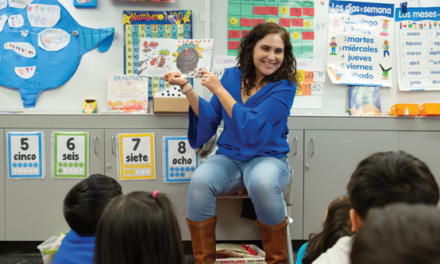
A comprehensive high school embraces problem-based learning as its strategy to improve student achievement.
In the freshman Advanced Placement Human Geography course, a district administrator listens as students describe how they would redraw the district’s attendance lines to relieve some schools of overcrowding and help other schools that struggle to attract students. These students have been working in teams to explore the district’s enrollment imbalances and now are presenting their proposals to district administrators, the school board, and the community.
This group of students has proposed redrawing attendance boundaries laterally, effectively blending socioeconomic and racial groups into each school. This would reduce the overcrowding in schools that serve primarily middle- to upper-class white and Asian students and add enrollment to schools that have empty seats. “So what would you tell parents who are concerned about how far they’d have to drive their child to school each morning?” asked the district administrator. “Why should their child be forced to attend a school not in their neighborhood, just because they’re wealthy, when a poor kid gets to attend the elementary school right across the street? How is that fair?”
The students huddle together for a few seconds. “You’re right. Those parents might think our system is unfair,” responds the spokesperson for the students. “But we would tell them that there are more important benefits for their kids to learn with and from students who are different from them than the benefits they might get by spending less time in their car.”
The administrator smiles, pauses a second, and then says, “That’s a good answer. I could have used you in a meeting last week.”
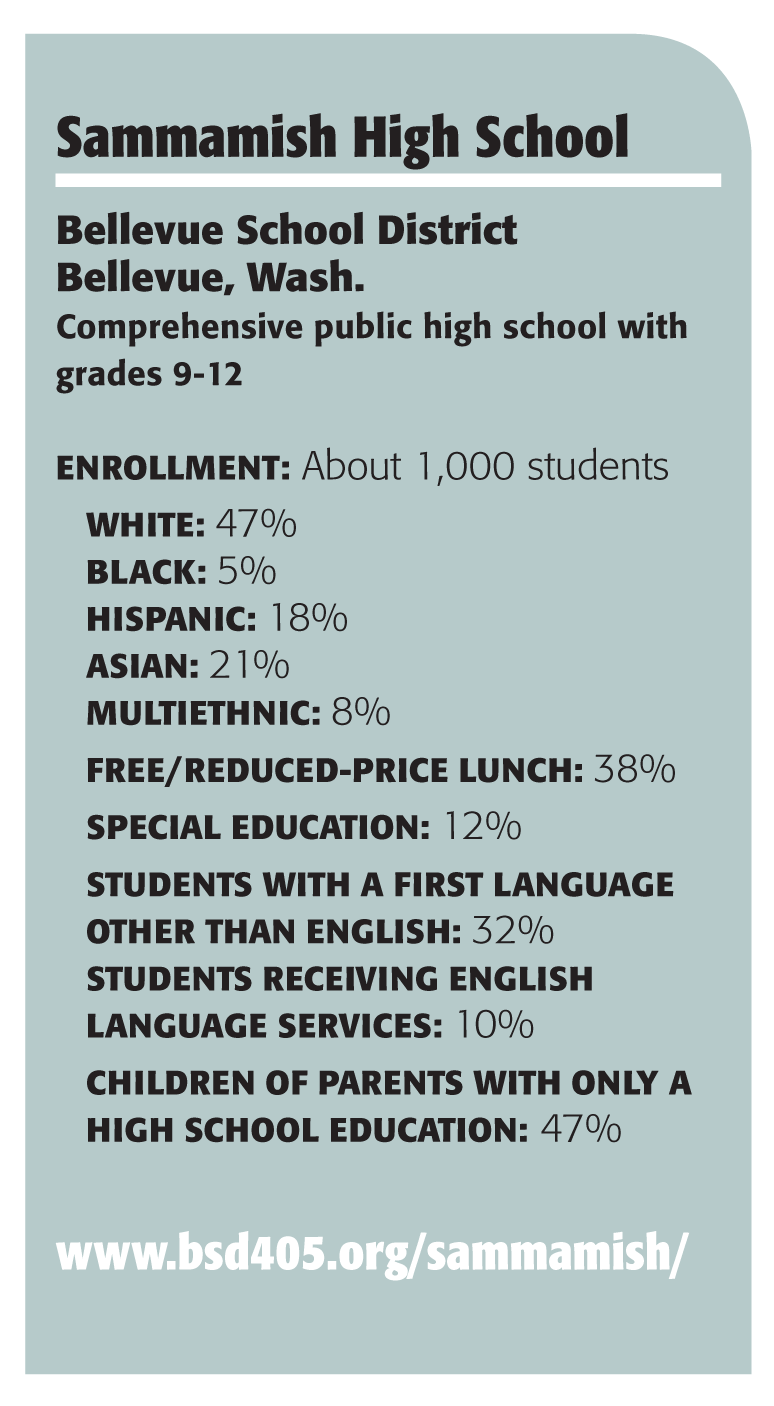
Interactions like this don’t develop overnight. This grew out of years of curricular experimentation and iteration at Sammamish High School in Bellevue, Wash., where teachers embraced problem-based learning (PBL) and developed locally relevant, authentic, real-world challenge cycles through which students learned core content knowledge. The school made this switch after receiving an Investing in Innovation (i3) Development grant from the U.S. Department of Education in 2010 to design and implement PBL coursework across all content areas in the school. Teachers sought the grant as a result of formal discussions to address chronic problems of decreasing enrollment and low student engagement and motivation. With the grant in hand, teachers and teacher leaders then spent five years redesigning all the professional learning experiences and a majority of required courses, integrating PBL pedagogy and principles throughout. While the plan was ambitious, teachers and school leaders believed that PBL offered a novel approach to school improvement that challenged them to fundamentally rethink teaching and learning and do so within a proven pedagogical model.
What is problem-based learning?
Problem-based learning has experienced a resurgence with school leaders who are eager to increase student engagement and motivation and encourage more explicit instruction of the kind of conceptual understanding and disciplinary practices promoted by the Common Core State Standards and the Next Generation Science Standards. The concept of PBL actually grew out of the constructivist pedagogy popularized by Dewey (1916) and later was successfully implemented in professional training programs such as medical, engineering, and law schools (Mergendoller et al., 2006).
In problem- and project-based learning, students learn key content knowledge and cognitive, social-emotional, and democratic skills by solving authentic problems or completing projects that reflect a perceived need in the community. But while similar in many regards, problem– and project-based learning differ in a few details. In problem-based learning, students learn essential content while solving a highly complex and ill-defined problem, but the content they learn depends on how they conceptualize the problem and potential solutions. Project-based learning, in contrast, tends to emphasize product more than process, and teachers tend to emphasize predetermined content while also giving students space and time to creatively apply that content to complete a relevant and authentic project.
Since the 1990s, research has demonstrated that inquiry-, project-, and problem-based learning coursework can increase student engagement and motivation (Barron et al., 1998; Barron & Darling-Hammond, 2008; Belland, Glazewski, & Ertmer, 2009; Blumenfeld, Soloway, & Marx, 1991; Boaler & Staples, 2008). Various studies have also shown that providing students with purposeful, interactive, and complex work more fully engages them in learning activities than what they experience in more traditional environments (Blumenfeld, Soloway, & Marx, 1991; National Research Council, 2000; Ravitz, 2009). More recent research has demonstrated that students exhibited deeper conceptual knowledge while also performing as well as or better than their peers on standardized measures when immersed in problem-based learning (Halvorsen et al., 2014; Parker et al., 2013).

Constructing a PBL framework
Sammamish teachers, teacher leaders, school leaders, and educational researchers working out of the Institute for Science and Math Education at the University of Washington, spent five years developing Key Elements of Problem-Based Learning, a document that guided all course redesign and almost all of the district’s professional learning activities from 2010 to 2015. It describes seven design principles that teachers and school leaders should use when creating and implementing problem-based activities. Those include:
- Authentic problems: Students learn essential content knowledge through collaborative and creative problem solving of challenging, ill-defined, real-world problems.
- Authentic assessment: Teachers and content-specific professionals assess students formatively (throughout a unit) andsummatively (at the end of the unit) as students develop and present solutions to their challenge cycle problem.
- Culturally relevant and responsive pedagogy: Teachers use their knowledge of students’ racial, social, cultural, historical, and familial backgrounds to design problems that students perceive as relevant to their lives and authentic to particular fields. In addition, teachers use student feedback to inform course and lesson design and adopt more equitable and just teaching practices.
- Expertise: Teachers and students collaborate with industry experts to design units and assessments focused around authentic problems and design.
- Collaboration: Teachers provide students with problems that are inherently “group-worthy” (Lotan, 2003), which means that the problems and tasks presented to students are complex and complicated enough to demand sustained collaboration. In addition, teachers explicitly teach students collaboration skills they apply to their problem-solving process.
- Academic discourse: Teachers provide students with the academic, discipline-specific language and interaction skills needed to engage with industry experts.
- Student voice and leadership: Teachers position students as emerging pedagogical and content-area experts by routinely eliciting their feedback and input into unit and lesson design and then using that feedback to adjust their classroom practice.
Perhaps most important, the Key Elements provide a common language to discuss teaching and learning. While not every teacher fully adopted PBL, our data demonstrate that most teachers use the Key Elements terminology to explain their instructional choices and describe how students are learning in their classroom.
PBL implementation, student improvement, and teacher readiness
We compared Advanced Placement mean scores between matched groups of students who took AP courses and the associated AP test before the PBL intervention (comparison group) and during it (treatment group). We used student performance on AP exams for our study for two reasons. First, because of the design of our study, we collected student achievement data spanning back to 2007 and, in some cases, 2005. Between 2005 and 2015, the state of Washington implemented three different end-of-year, high-stakes tests making true comparisons between groups of students from 2007 and 2013, for example, difficult if not impossible. Second, educational research has demonstrated relationships between student participation and success in AP coursework and college success (Long, Iatarola, & Conger, 2009; Reid & Moore, 2008) and has yet to demonstrate similar relationships between performance on high-stakes testing and college success. As college- and career-readiness was a strong focus of the school’s guiding philosophy, a comparison of AP scores provided us a more reliable measure of students’ increased college readiness. The criteria for inclusion into the sample included students who attended the school for three or more years and students who had taken at least one AP exam in an English, math, social studies, or science AP course. While there remained some issues with matching a similar number of students who qualified for free and reduced-price lunch and who received special education services, for example, our sample sizes across courses were robust enough to provide us with valid and reliable comparisons. Table 1 shows our sample sizes for each comparison group in each AP course.
We found that students in the treatment group outperformed the comparison group on multiple AP tests, showing statistically significant gains on AP scores across in Biology, Calculus (combined BC and BC/AB), Chemistry, Physics, Psychology, Statistics, U.S. Government, and U.S. History. Table 2 shows the statistically significant mean AP score differences by course, between students in the comparison and treatment groups. (When statistically significant, the effect size was typically 0.25 to 0.5 standard deviations with gains typically of greater than 0.25 to 0.5 AP test score points depending on the course.)
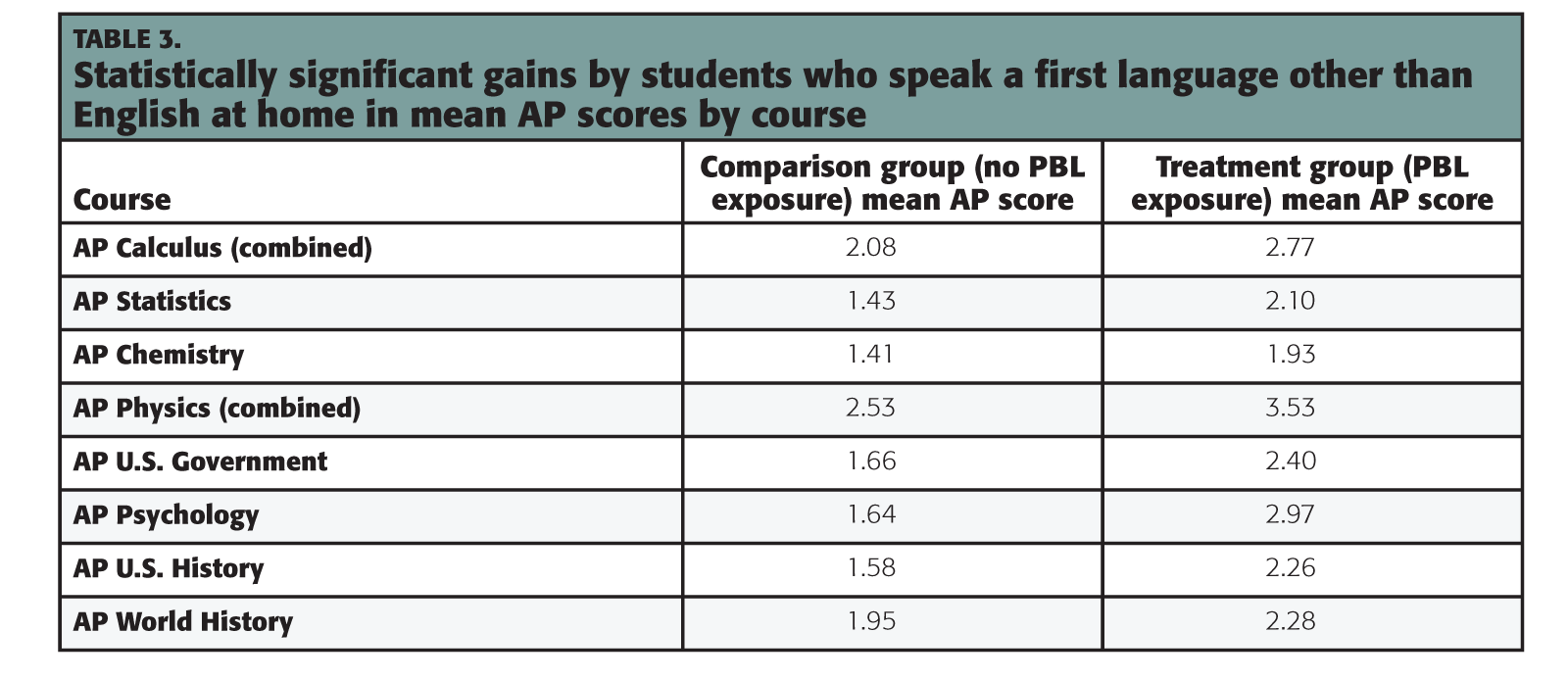
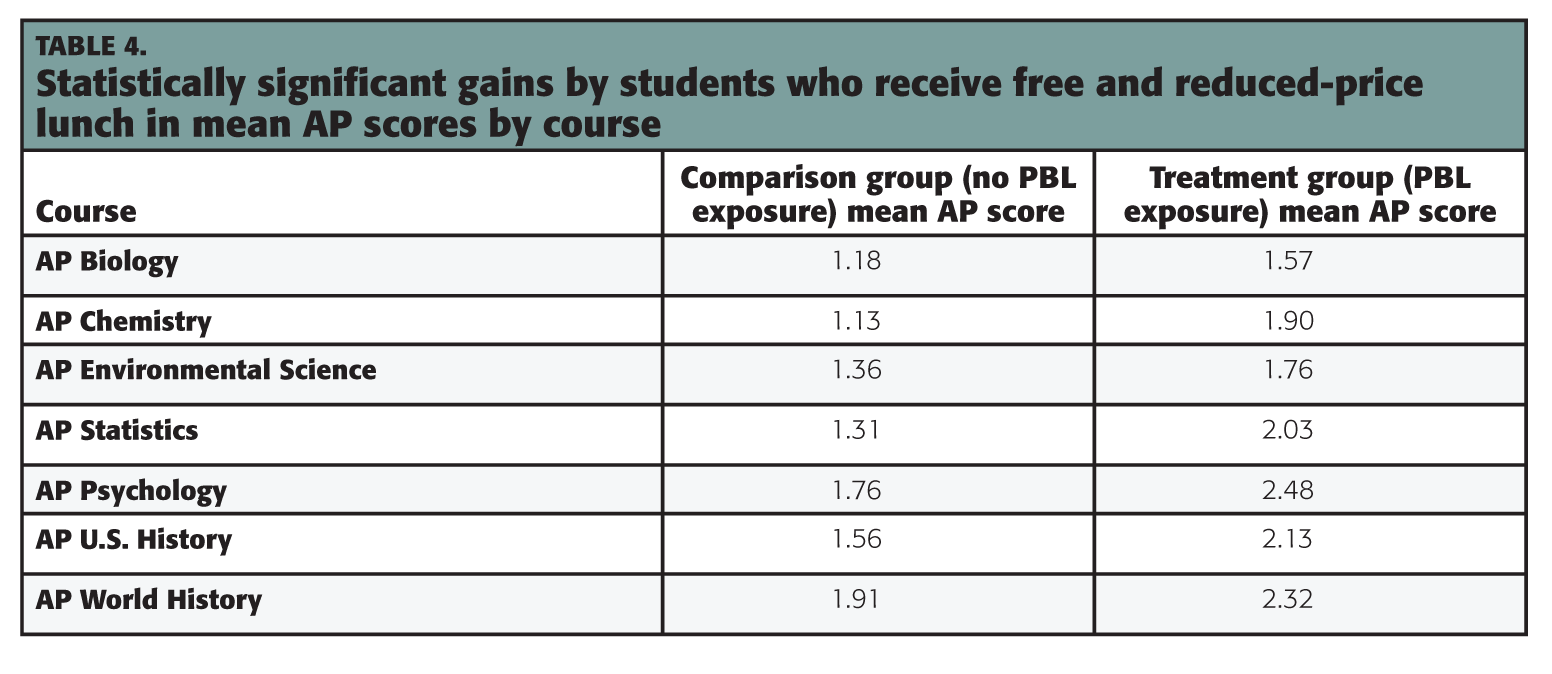
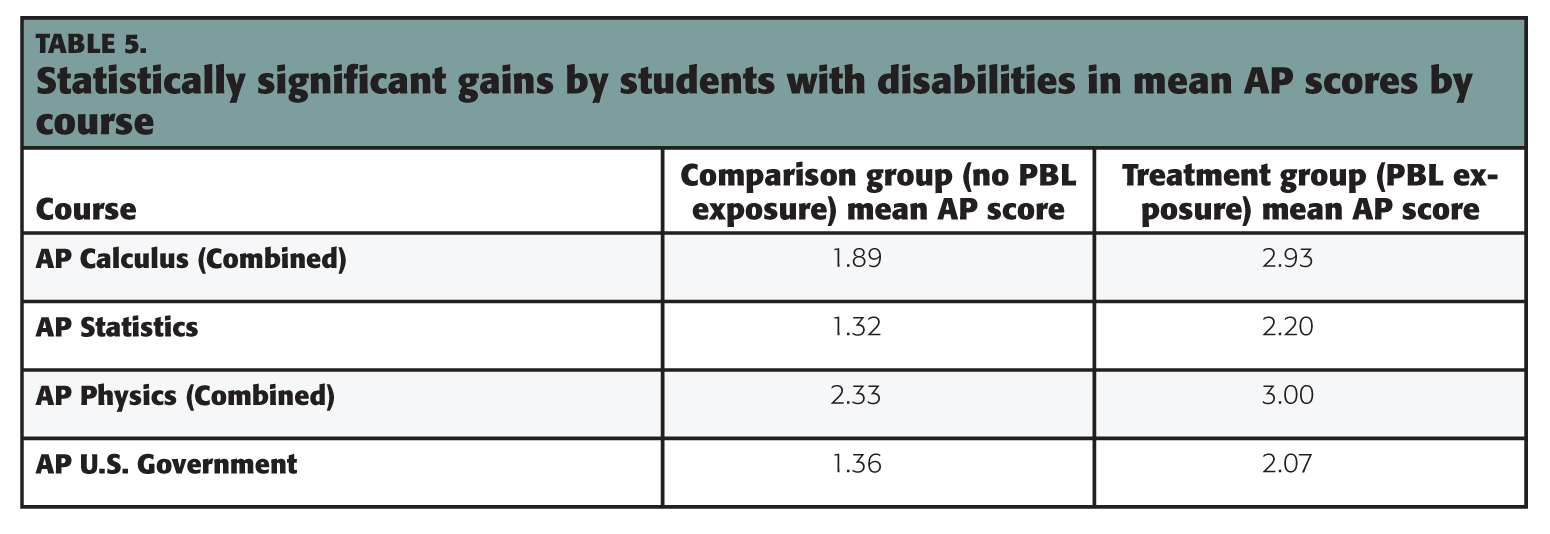
Overall, students in the treatment group passed a higher percentage of their AP tests despite a dramatic increase in student enrollment in AP courses. Further, on several of the AP exams, student gains were statistically significant even when disaggregating the data by students who receive free and reduced-price lunch, students with disabilities, and students who speak a first language other than English at home. (See Tables 3 and 4.)
However, while these gains are impressive, we resist the urge to make causal claims about the benefits of PBL in and of itself. Rather, we have found that there are several, corresponding factors that, along with the implementation of PBL coursework, affected student gains on AP tests. Specifically, we argue that teacher adoption of PBL gave the school an opportunity to establish a common and shared language around teaching and learning, and this helped them improve their design and implementation of PBL curricula over time.
In Year 4 of our study, we did about 100 classroom observations to understand how teachers were implementing problem-based learning. To increase our chances to see PBL in action, we focused on 30 or so teachers who had experience designing and implementing it, and we observed them teaching courses they had already redesigned. Because the Key Elements document guided how they had designed their curriculum, we used it to design our observation protocols.
Our observations showed significant variability in how teachers were implementing PBL across the school. We describe this as the difference between PBL and PBL Readiness — teachers who were implementing PBL with fidelity designed units and lessons centered on authentic problems, authentic assessment, and culturally responsive instruction, and they considered these to be non-negotiable components to their unit design; on the other hand, some teachers were approaching such implementation — i.e. they were “ready” for full implementation — but their units or lessons did not show as much fidelity to the principles of PBL (though their classrooms did feature high levels of student collaboration, expertise, academic discourse, and student voice and leadership).
Our data suggest teachers’ adoption and implementation of PBL had to do with several variables including what department they taught in and the extent to which teachers in each department perceived PBL as a good fit for their discipline. We found no evidence that PBL adoption was affected by teachers’ years of experience or whether they taught AP courses, as most teachers at Sammamish High School teach both AP and non-AP courses. Data from teacher interviews and classroom observations show the highest levels of implementation were in the social studies and science departments with varied implementation in the math department and little implementation in the English department.
Conclusion
Our data suggest several important takeaways from Sammamish High School’s implementation of problem-based learning. First, our data reinforce current research (Halvorsen et al., 2014; Parker et al., 2013) that show students perform the same or better on standardized measures when provided with sustained, rich PBL learning experiences. Second, those benefits extend to all students, regardless of socioeconomic or linguistic status, or special learning needs. Third, schools can deepen and increase student learning when the entire school community develops, owns, and embraces a common framework and language to discuss and understand teaching and learning.
Finally, while our findings focus on academic achievement, we argue that PBL also can have positive effects on students’ social, emotional, and civic development. We routinely observed students negotiating differences of opinion around math problems, social and scientific policy, and authorial intent. In PBL, these negotiations become not just purposeful but necessary. While it is easy for us as researchers to focus our attention on the possibility of improved academic outcomes, it is equally important to focus our attention on all the ways PBL can help schools and teachers produce better people.
References
Barron, B., Schwartz, D.L., Vye, N.J., Moore, A., Petrosino, A., Zech, L., Bransford, J.D., & The Cognition and Technology Group at Vanderbilt. (1998). Doing with understanding: Lessons from research on problem- and project-based learning. The Journal of Learning Sciences, 7 (3 & 4), 271-311.
Barron, B. & Darling-Hammond, L. (2008). Teaching for meaningful learning: A review of research on inquiry-based and cooperative learning. In L. Darling-Hammond, B. Barron, D. Pearson, A.H. Schoenfeld, E.K. Stage, T.D. Zimmerman, G.N. Cervetti, & J.L. Tilson (Eds.), Powerful learning: What we know about teaching for understanding. San Francisco, CA: Jossey-Bass.
Belland, B.R., Glazewski, K.D., & Ertmer, P.A. (2009). Inclusion and problem-based learning: Roles of students in a mixed-ability group. RMLE Online: Research in Middle-Level Education, 32 (9), 1-19.
Blumenfeld, P.C., Soloway, E., & Marx, R.W. (1991). Motivating project-based learning: Sustaining the doing, supporting the learning. Educational Psychologist, 26, 369-398.
Boaler, J.O. & Staples, M. (2008). Creating mathematical futures through an equitable teaching approach: The case of Railside School. Teachers College Record, 110 (3).
Dewey, J. (1916). Democracy and education. New York, NY: Macmillan Press.
Halvorsen, A., Duke, N., Brugar, K., Block, M., Strachan, S., Berka, M., & Brown, J. (2014). Narrowing the achievement gap in 2nd-grade social studies and content-area literacy: The promise of a problem-based learning approach. East Lansing, MI: Michigan State University, Education Policy Center.
Long, M.C., Iatarola, P., & Conger, D. (2009). Explaining gaps in readiness for college-level math: The role of high school courses. Education Finance and Policy, 4 (1), 1-33.
Lotan, R.A. (2003). Group-worthy tasks. Educational Leadership, 60 (6), 72-75.
Mergendoller, J.R., Markham, T., Ravitz, J., & Larmer, J. (2006). Pervasive management of project-based learning: Teachers as guides and facilitators. In C. Evertson, C.M. Weinstein, & C.S. Weinsten (Eds.), Handbook of classroom management: Research, practice, and contemporary issues (pp. 583-615). Mahwah, NJ: Erlbaum.
National Research Council. (2000). How people learn: Brain, mind, experience, and school (expanded ed.). Washington, DC: National Academy Press.
Parker, W.C., Lo, J., Yeo, A.J., Valencia, S.W., Nguyen, D., Abbott, R.D., Nolen, S.B., Bransford, J.D., & Vye, N.J. (2013). Beyond breadth-speed-test: Toward deeper knowing and engagement in an advanced placement course. American Educational Research Journal, 50 (6), 1424-1459.
Ravitz, J. (2009). Introduction: Summarizing findings and looking ahead to a new generation of PBL research. Interdisciplinary Journal of Problem-Based Learning, 3 (1), 4-11.
Reid, M.J. & Moore III, J.L. (2008). College readiness and academic preparation for postsecondary education: Oral histories of first-generation urban college students. Urban Education, 43, 240-261.
Citation: Sutton, P.S. & Knuth, R. (2017). A schoolwide investment in problem-based learning. Phi Delta Kappan 99 (2), 65-71.
ABOUT THE AUTHORS

Paul S. Sutton
PAUL S. SUTTON is an assistant professor of education at Pacific Lutheran University in Tacoma, WA.
Randy Knuth
RANDY KNUTH is president of Knuth Research, Spokane, Wash.