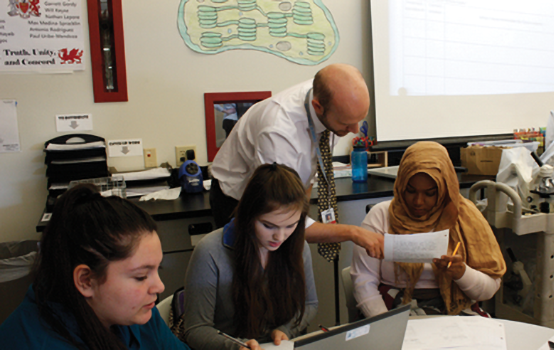
A distributed leadership model propels innovative STEM high schools to produce graduates ready for college and prepared to successfully major in STEM disciplines.
Inclusive STEM high schools are relatively new in the U.S., yet they have policy implications for school reform, STEM initiatives, and improving opportunity for all students. Texas, North Carolina, Ohio, and Tennessee each have launched statewide initiatives to boost the number of inclusive STEM high schools — known as ISHSs. These schools accept students primarily on the basis of their interest in STEM rather than aptitude or prior achievement. The goal of this type of STEM school is to prepare students to be successful in a STEM college major by providing a program of studies with greater depth and breadth than their states require for high school graduation (Lynch, 2015; Means et al., 2008).
ISHSs intentionally recruit and enroll higher proportions of students from groups often underrepresented in STEM — African-Americans, Hispanics, women, students from low-income families, and first-generation college goers. With admission by lottery, ISHSs are schools of choice; students are interested in STEM and are willing to work hard in a college preparatory environment.
Our research study, Opportunity Structures for Preparation and Inspiration, focused on eight carefully selected ISHSs that are building opportunities in STEM for underrepresented students (Lynch, 2015; Peters-Burton et al., 2014b). Table 1 shows demographics of the eight schools, which are highly diverse and scattered across the country. They have no formal affiliations with one another.
Experts in the field nominated a pool of schools for the study, eventually winnowed to the eight schools in Table 1. The schools required students to take broader and deeper STEM coursework than mandated by their respective states and school districts and had outcome indicators that demonstrated substantial academic achievement and other measures of school success. For instance, they have higher attendance, graduation and college admissions rates than schools with similar demographics, and often score higher on state assessments. The study set out to identify the schools’ critical components and to build a logic model to explain how they create opportunity structures and guide students toward success in STEM (Lynch et al., 2011).
We found that one of the unique features of the schools was how their administrative structures were organized and how leadership was distributed among school administration, teachers, and sometimes students. Each school had a clear sense of its mission-driven purpose: to graduate students prepared for STEM college majors including students from underrepresented groups. These schools blurred boundaries between formal and informal education, reconfiguring relationships among teachers, students, and knowledge (Coburn, 2003; Elmore, 1996).

Support for the school mission
The schools had flexible and responsive administrative and organizational structures. Often they were held to fewer school district rules and regulations than more traditional schools, giving them more freedom to explore new options to achieve their STEM mission and goals. These ISHSs focused on innovative instruction, and they accessed STEM resources in their community to enrich student learning, creating schools that were outwardly-focused. Leadership was distributed formally and informally — formally by school leaders’ delegation to others and informally through collaborations that arose among teachers and members of the STEM community. Together, administrators and teachers managed complex school environments aiming for continuous improvement. For example, the Wayne School of Engineering in Goldsboro, N.C., synchronized its class schedule and calendar with that of a local community college so that students could take classes on both campuses, enriching the rural school’s offerings (Peters-Burton et al., 2013).
The schools also took the latitude, sometimes hard won, to hire teachers who fit their teaching and learning philosophy (Spillane, 2015). They sought teachers with strong content knowledge in STEM disciplines, and the flexibility, open-mindedness, and willingness to work in a collaborative learning community. The Urban Science Academy in Boston formed its school goals in 2005 while it was still a small school. A teacher described an early dichotomy between teachers who bought into the mission and those who did not, saying, “The genesis [of the strength of the school] was a very small school with maybe 35 instructors . . . everyone wanted to play on that tightly knit team. People who are not here any longer, for some reason, may not have wanted to make the investment” (Peters-Burton et al., 2014a, p. 55).
Intentional communities of support
These kinds of schools could succeed only by making sure that they intentionally created supportive communities of practice. Administrators provided vision and guidance in shaping a school environment that empowered teachers and students to effectively participate. At High Tech High School in San Diego, an administrator explained that finding good teachers could be challenging, “given the way we do things here” (Behrend et al, 2014). Administrators needed teachers who had the skills and inclination to engage in project-based learning, teacher-led curriculum design, and collaborative practice. At Dozier-Libbey Medical High School in Antioch, Calif., teachers worked together to employ a thoughtful and deliberate integration of its medical theme into nearly all aspects of the school’s curriculum. Each grade level was assigned a different health theme and the school used large, integrated projects to drive instruction around these themes. Teachers and students worked in interdisciplinary groups to refine, implement, and reflect on projects throughout the school year. The teachers met for in-house professional development two hours each week, explaining that these elaborate projects were possible due to the small size of the school; all students shared the same teachers for English, science, social studies, and health (Ford et al., 2014).
Supporting innovation and change
Collaboration also has been a key ingredient in the growth and success at these schools for students and teachers. For example, the ISHSs supported innovation and change by providing pathways for teachers to become leaders in their school and beyond. High Tech High developed teacher leadership through an on-campus graduate school of education, an accredited program run by the charter network that offered two master’s degrees in teacher leadership and school leadership. Said a High Tech High administrator, “We knew that when we started HTH it needed to be a rich learning place for the adults who worked here if we were going to succeed; we knew we needed to figure out how to engage the adults.” Similarly, the Denver School of Science and Technology charter network developed an emerging leaders program to train new administrators from among the ranks of its 10-school network, providing pathways for teachers to move into roles as deans or directors of curriculum and instruction.
The Wayne School of Engineering provided regular professional development opportunities designed to foster staff collaboration through grade-level planning sessions and subject-specific efforts. One morning each week was designated for using a “tuning process” at staff meetings where teachers engaged in reflections about their teaching practices and choices for assessment. As described by an administrator, the staff did “a tuning piece every week, we did a reflection piece every week, we did a piece on assessment, and then we’re out on staff development on Thursdays where they’re sharing what they’re doing in their classrooms.”
Teachers often took responsibility for shaping and implementing professional development based on their needs. At the Urban Science Academy, a pair of instructional teacher leaders explained that they worked with administrators to create a vision for their professional development and then had the autonomy to design the 18 hours of mandatory professional development required by the school district so that it was tailored to the needs of the school. These experiences included teacher-developed minicourses that were often inspired by instructional rounds conducted by groups of teachers observing each other (Spillane, 2015).
Distributed leadership
The walls of these STEM schools were porous to the outside world, changing the relationship between student, teacher, and knowledge by changing the schools’ connections with their surrounding communities.
Projects and professional development were shaped to foster interactions with the nearby STEM communities, businesses, industries, or institutes of higher education. Students could access STEM experts in remote locations online. Schools welcomed in-school interactions with STEM experts as project mentors, panelists, and judges. Outside-of-school experiences offered real-world STEM and career connections through community-based projects, field trips, mentorships, internships, and job shadows. Students presented their completed projects with teachers and other students, and often before panels of community members through formal presentations. Such connections to outside STEM experts and resources gave students increased freedom and accessibility to learn in settings beyond the traditional classroom. Through these experiences, they could learn things that their teachers could not know, reshaping the distribution of STEM knowledge in the school.
An example of this changing relationship between students and knowledge was manifested in projects at Urban Science Academy. Students learned about housing conditions for immigrants by assuming the role of architect to design housing for eight migrant workers and got feedback from local architects. In another project, a 10th-grade team gathered and analyzed data on teenage dating violence to create a public service announcement from their research. An 11th-grade Urban Science Academy student explained how the Computer Club operated and shared developing student expertise:
Currently, we have a technology support class which is like an in-school internship. Part of the class, you learn how to learn code for computers and web sites. The other part, if it’s needed, then you and another student will go around the school fixing things and bringing things to teachers. It really helps a lot and especially since the majority of people here want to go into some type of technology or engineering-based career (Peters-Burton et al., 2014a, p. 33).
Students at Wayne School of Engineering planned and executed their own community service projects through a community-based tutoring outreach program called Project Heart. A community liaison called the program “a game changer for students” because it provided them “the opportunity to pause and see that there’s a world out there, and an impact that they can make.” The implementation of these community service projects required students to exercise real leadership skills. The director pointed out that students would need these skills “when they step outside the door [and into the world of work]” (Peters-Burton et al., 2013).
Some schools articulated their changed relationships between student, teacher, and knowledge through their school culture. At Stapleton High School in Denver, Colo., an administrator described student success as grounded in values with the goal of building character:
I think that culture — you guys are part of something much larger than yourself. You are part of a community that you have expectations for and expectations from that you have to meet. You are part of something that you have a responsibility to. I think those notions of culture are very powerful and collectively challenge kids to be their best, to help each other succeed. I think that’s a foundation of everything (Spillane et al., 2013, p. 45).
Part of something bigger
This culture of “being a part of something much larger than yourself” was very important and afforded many opportunities for students who might not otherwise have had access to them in a traditional public school education. Dozier-Libby, in Antioch, Calif., provided students a health-focused STEM education. A workforce coordinator at John Muir Health, a hospital community partner of the school, said:
Most of the students do not have parents or family members in the medical arena so they are coming to this school really looking for opportunity. What they are getting exposed to at this school . . . all the guest speakers, all the job shadowing, learning about (medical) jobs during interviews. There are so many different things to do in the medical arena, but most kids think it’s doctors and nurses. They don’t have family members influencing them. These (medical) people are influencing them and exposing them to opportunity for a better life. And it is really pretty exciting. I would say most of their parents have not gone to college in this community, so I just think it is very cool (Ford et al., 2014, p. 48).
Summary and implications
The eight schools in the study engaged in practices that affect what Elmore (1996) refers to as the “instructional core of education” — characteristics that focus on “changing fundamental conditions affecting the relationship of student, teacher, and knowledge” (p. 6). The principals at these schools hired teachers whose philosophies aligned with the schools’ missions and then worked collaboratively with teachers to reach their school goals. This collaboration reflected the schools’ distributed leadership and flattened hierarchy (Ford & Behrend, 2014). Administrators at these schools worked to develop, support, and maintain strong teaching and learning by further forging connections within the schools and more broadly into the surrounding communities.
Intentionally created school structures supported teacher collaboration and fostered relationships that allowed teachers to learn from one another. Working toward common goals created an environment of trust that encouraged teachers to take risks, try new ideas, and connect with the community beyond their classrooms. Shared decision making and opportunities to assume leadership roles within the schools gave teachers a sense of ownership for the school outcomes, reinforcing the schoolwide collaborative culture. An administrator at Stapleton High School expressed a sentiment common across the schools: “It’s a hard school, but you’re in an incredible learning community where everyone is learning. The teachers help each other; the teachers are part of a community that is so strong.” These STEM schools supported learning environments that changed the relationships among teachers, students, and knowledge, strengthening community connections. The flattened hierarchies of these inclusive STEM high schools deepened student understanding of STEM, bolstered their confidence, and allowed them to see new opportunities for college and career.
References
Behrend, T.S., Ford, M.R., Ross, K.M., Han, E.M., Peters-Burton, E., & Spillane, N.K. (2014). Gary and Jerri-Ann Jacobs High Tech High: A case study of an inclusive STEM-focused high school in San Diego, California. Washington, DC: George Washington University. http://bit.ly/1Uix9n9
Coburn, C. (2003). Rethinking scale: Moving beyond numbers to deep and lasting change. Educational Researcher, 32 (6), 3-12.
Elmore, R. (1996, Spring). Getting to scale with good educational practice. Harvard Educational Review, 66 (1), 1-26.
Ford, M.R. & Behrend, T.S. (2014, April). A cross-case analysis of four exemplar STEM-focused high schools: Administrative structure. In E. Peters-Burton (Chair), Critical components of inclusive STEM-focused high schools: A cross-case analysis. Symposium conducted at the annual meeting of the American Education Research Association, Philadelphia, PA.
Ford, M.R., Kaminsky, S.E., Lynch, S.J., House, A., & Han, E.M. (2014). Dozier-Libbey Medical High School: A case study of an inclusive STEM-focused high school in Antioch, Calif. Washington, DC: George Washington University. http://bit.ly/1pzLOPo
Lynch, S.J. (2015, July 14). Science for all: A new breed of schools is closing achievement gaps among students and may hold the key to a revitalized 21st-century workforce. Scientific American, 313 (1).
Lynch, S.J., Behrend, T., Means, B.M., & Peters-Burton, E. (2011). Multiple instrumental case studies of inclusive STEM-focused high schools: Opportunity structures for preparation and inspiration (OSPrI). Proposal to the National Science Foundation.
Means, B., Confrey, J., House, A., & Bhanot, R. (2008). STEM high schools: Specialized science technology engineering and mathematics secondary schools in the U.S. Menlo Park, CA: SRI International. http://bit.ly/1R9CeyP
Peters-Burton, E., Ford, M.R., Ross, K.M., Behrend, T.S., Spillane, N.K., & Han, E.M. (2014a). Urban Science Academy: A case study of an inclusive STEM-focused high school in Boston, Mass. Washington, DC: George Washington University. http://bit.ly/1ROuXPA
Peters-Burton, E., Kaminsky, S.E., Lynch, S.J., Behrend, T., Ross, K., House, A., & Han, E. M. (2013). Wayne School of Engineering: A case study of an inclusive STEM-focused high school in Goldsboro, N.C. Washington, DC: George Washington University. http://bit.ly/1S4rD5s
Peters-Burton, E., Lynch, S.J., Behrend, T.S., & Means, B.B. (2014b). Inclusive STEM high school design: 10 critical components. Theory Into Practice, 53 (1), 64-71.
Spillane, N.K. (2015). Teacher characteristics and school-based professional development in inclusive STEM-focused high schools: A cross-case analysis(Doctoral dissertation). George Washington University, Washington, D.C.
Spillane, N.K., Kaminsky, S.E., Lynch, S.J., Ross, K.M., Means, B.M., & Han, E.M. (2013). Denver School of Science and Technology, Stapleton High School: A case study of an inclusive STEM-focused high school in Denver, Colo. Washington, DC: George Washington University. http://bit.ly/1LeOz2C
Citation: Spillane, N.K., Lynch, S.J. & Ford, M.R. (2016). Inclusive STEM high schools increase opportunities for underrepresented students. Phi Delta Kappan, 97 (8), 54-59.
R&D appears in each issue of Kappan with the assistance of the Deans Alliance, which is composed of the deans of the education schools/colleges at the following universities: George Washington University, Harvard University, Michigan State University, Northwestern University, Stanford University, Teachers College Columbia University, University of California, Berkeley, University of California, Los Angeles, University of Colorado, University of Michigan, University of Pennsylvania, and University of Wisconsin.
ABOUT THE AUTHORS

Michael R. Ford
MICHAEL R. FORD is a doctoral candidate at George Washington University, Washington, D.C.

Nancy K. Spillane
NANCY K. SPILLANE . is a clinical associate professor at the Center for Excellence in STEM Education, West Virginia University, Morgantown, W. Va.

Sharon J. Lynch
SHARON J. LYNCH is a professor of curriculum and pedagogy at George Washington University, Washington, D.C.