Students of all backgrounds and abilities need to feel they belong at school.
Think for a moment about where you feel you belong. Do you have any specific spaces in mind? Or a person or group of people with whom you feel you belong? Take a moment to conjure up how you feel when you are in that space or among those people. How is your body? Your heart rate? Your emotions? Are you able to relax? To focus? To learn?
Now, think about spaces where you feel like you do not belong or where you may even feel a level of hostility directed toward you. Take another moment to identify how your body, emotions, and brain feel in that space. Are you able to relax? Could you learn at your best?
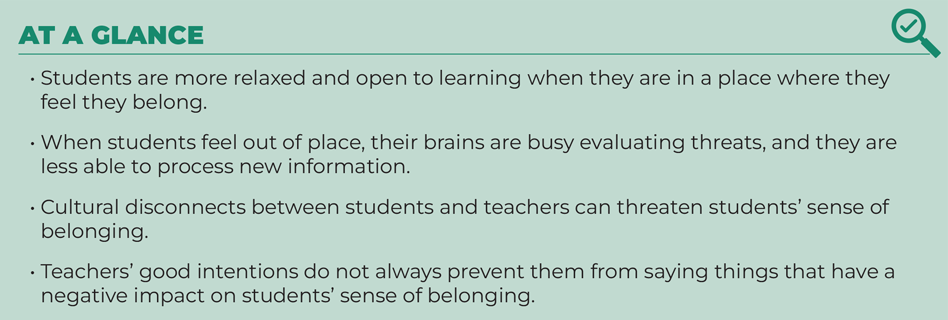
Chances are, you feel most relaxed and open to learning in the spaces where you feel you belong. Unfortunately, for too many students, that space is not school. For example, in the first episode of the podcast Belonging, educator and host Erica Young (2022) asks her nephew, a high school freshman and young Black man, “Do you feel like you belong [at your school]?” His immediate reply: “Most definitely not.” He’s not alone in feeling this way. Data from the last 20-plus years consistently reveal that students who are not white, who speak English as a second language, who have disabilities, who identify as LGBTQIA+, or who are impacted by poverty feel a deep sense of not belonging. They feel excluded and marginalized in the space where they spend a significant proportion of their daily lives (Coles, 2019; Jenkins, 2022).
This feeling has a long history of negative educational impacts. These include an inability to attend and focus; mental and physical distress; lower grades (Vasquez-Salgado, Greenfield, & Guan Shu-Sha, 2021); and barriers to learning (Hammond, 2014). Unfortunately, a long-standing cultural mismatch continues to persist between teachers, 81% of whom are white, and the 51.1% of K-12 students who are not (Taie & Goldring, 2020). With recent attempts by many states and school districts to ban the teaching of anything deemed “woke,” the disconnect between students who feel they don’t belong and their schools is likely to increase. Even the most well-intentioned teachers must therefore engage and be supported in the difficult work of exploring how they do and do not contribute to building a sense of belonging for all learners.
Why belonging matters
Belonging is the feeling you get when you can be your true self, when it is clear that your ideas matter, your opinions and thoughts are valued, your background is honored, and all that you bring to the space is respected. Belonging honors a student’s humanity and inherent value as a human. Being in a space or among people where you feel like you belong is comforting and affirming.
Underlying these feelings are biological and physiological responses that help shape learning. That is, feeling that you belong opens your brain for learning and has a significant positive impact on achievement (Hattie, 2008), continued engagement, and mental health. Having a sense of belonging is a well-documented biological need (Eberhardt, 2019); and being in a space where one feels seen, valued, safe, and human, is essential for learning.
Specifically, for a student to learn, information must reach the “top” of their brain, the cortex, which is the region responsible for higher-level processes, such as language, memory, reasoning, thought, learning, decision-making, emotion, and creativity (Think PBS, 2020). Before information can get there, however, it must make it past the brain’s threat detection system, housed in the “reptilian” brain or brain stem. Here things like heartbeat, blood flow, digestion, body temperature, balance, breathing, and threat detection are regulated in an attempt to keep us alive (Hammond, 2014; Think PBS, 2020). Our brain stem, and specifically the reticular activating system (RAS) within it, continuously scans our surroundings, at all times of day and night, for any novel stimulus or event that signals a change in our environment. These might include unfamiliar activities as well as potential threats to our safety related to our social status or cultural mismatches between ourselves and our environment. When confronted with a novel or unfamiliar situation, our threat detection system is activated and does not allow information to efficiently pass upward to the cortex until it is sure we are safe.
Teachers must have spaces where their brains are open for learning, where they belong, so they can do the work of ensuring they have built spaces of belonging for all.
Complicating the passage of information to the higher regions of the brain is the fact that the cultures to which we belong form one of the lenses through which we filter information to determine what is safe or unsafe, novel or familiar. Information passes through the RAS more easily in familiar spaces that reflect our cultural backgrounds (Hammond, 2014; Think PBS, 2020). If we encounter unfamiliar information or people or someone who looks or sounds like a person who has done us harm, or whose tone and body language reads as unsafe to us, information will be less efficient in its journey to the cortex. As a result, the part of our brains largely responsible for learning may not get a chance to see that information — that is, to learn.
Because the teaching force remains largely white and female, and the student population continuously diversifies by nearly every measure, and because schools are overwhelmingly still reflective of white, middle-class norms and mores, the average student is learning in an environment that is inherently novel. Our students (and perhaps we as educators) are continuously scanning for danger and attempting to minimize social threats. Without a sense of belonging, information will be largely stalled at the base of the brain. If we are to rewrite long-standing inequities, teachers must engage in the difficult work of learning, unlearning, and relearning, so they can create spaces of authentic belonging, where the RAS can relax, where all students feel safe. Teachers, too, must have spaces where their brains are open for learning, where they belong, so they can do the work of ensuring they have built spaces of belonging for all.
An example of un-belonging
On the “Belonging” podcast, Erica Young (2022) shares a story of a well-intentioned white teacher she worked with in Georgia. This colleague was born to a family who picked cotton for a living and was taught to avoid racial slurs. Fast-forward to when she was a teacher, working diligently on a high-stakes bulletin board. Stressed about her ability to finish it on time and to the expected level of professionalism, this teacher noticed some young Black students playing around it. As the teacher explains, she yelled to the students:
“Get your cotton-picking bodies away from those boards!” and the kid said, “That sounds racist.” In the moment, what I heard was, you are racist. I reacted and I flew off the handle at that young man and told him that by no means was what I said racist, it was not intended that way and if he took it that way, that was his problem.
The nuance here may seem obvious. The teacher’s family picked cotton as a means of making a living. The students likely had ancestors who were enslaved, forced to pick cotton as a means of making a living for others. It may also seem clear how the initial comment, the missed nuance, and the teachers’ assertion that it was not racist would have put the students’ threat detectors on high alert, both in the moment and in future interactions with the teacher. As the RAS is activated to scan for safety, new information isn’t reaching the “learning” center of the brain.
What may be less clear is that helping this teacher see her students and their perspective will likely evoke her threat detection center, just as it did when the student attempted to address it, creating a barrier to that work. And yet, all students deserve to learn and to feel that they belong, regardless of what discomfort it may cause for adults.
What must we do?
The average educator chooses this profession because they have a heart for this work. They want to serve and support kids. They come from a place of love, caring, passion, commitment, and good intentions. It is therefore hard for a teacher to imagine that they might inflict harm on students. Unfortunately, we sometimes do just that. Our intent does not match our impact.
Intent is the hope we have for our words and actions. Impact is how the audience understands our words or actions. Like all information, words and actions are filtered through our RAS, which is deeply informed by our cultural experiences. The teacher above’s intent was only to admonish students for possibly damaging her board. She explained in the podcast that she did not mean to cause them harm. However, both her initial statement and her response to the student’s concern had a harmful impact.
The disconnect between intent and impact often comes in the form of microaggressions — the verbal, nonverbal, or environmental slights and insults that convey negative messages, intentional or not, toward a specific community (Howard, Milner-McCall, & Howard, 2020). Many microaggressions are manifestations of implicit biases, which are the attitudes or stereotypes that affect our actions, interactions, communications, and decisions in an unconscious fashion. Even those of us who profess to be justice-minded educators, seeking to treat all students respectfully and equitably, will sometimes unknowingly act in ways that are in stark contrast to our explicit intentions.
For many teachers, the mere mention of any –ism, but especially racism, immediately raises their stress response. The resulting physiological responses mirror those of students who feel they do not belong. Often, when we are told the impact does not match our intent, the rational center of our brain cannot work through this information as the RAS holds it captive. As our stress response activates (sweaty yet cold palms, racing heart rate, pit in our stomachs), further understanding and processing become nearly impossible. This is to be expected and is largely a result of the fact that many white people in particular think of racist/not racist as being two sides of a good/bad dichotomy. That is, racism (as well as ableism, classism, and so on) is bad, and racist actions come from bad people. Good people do not do or say racist things.
When a student or colleague suggests that we did something racist, our first response — “I’m not racist” or “not all white people” — comes from a desire to not be seen as a bad person. This is an example of what Robin DiAngelo (2016) calls “white fragility.” However, there is nothing fragile about the impact of such responses. Our stress responses to this information often further the damage to the community we’ve hurt and/or recenters attention on the white person’s comfort.
Even those of us who profess to be justice-minded educators, seeking to treat all students respectfully and equitably, will sometimes unknowingly act in ways that are in stark contrast to our explicit intentions.
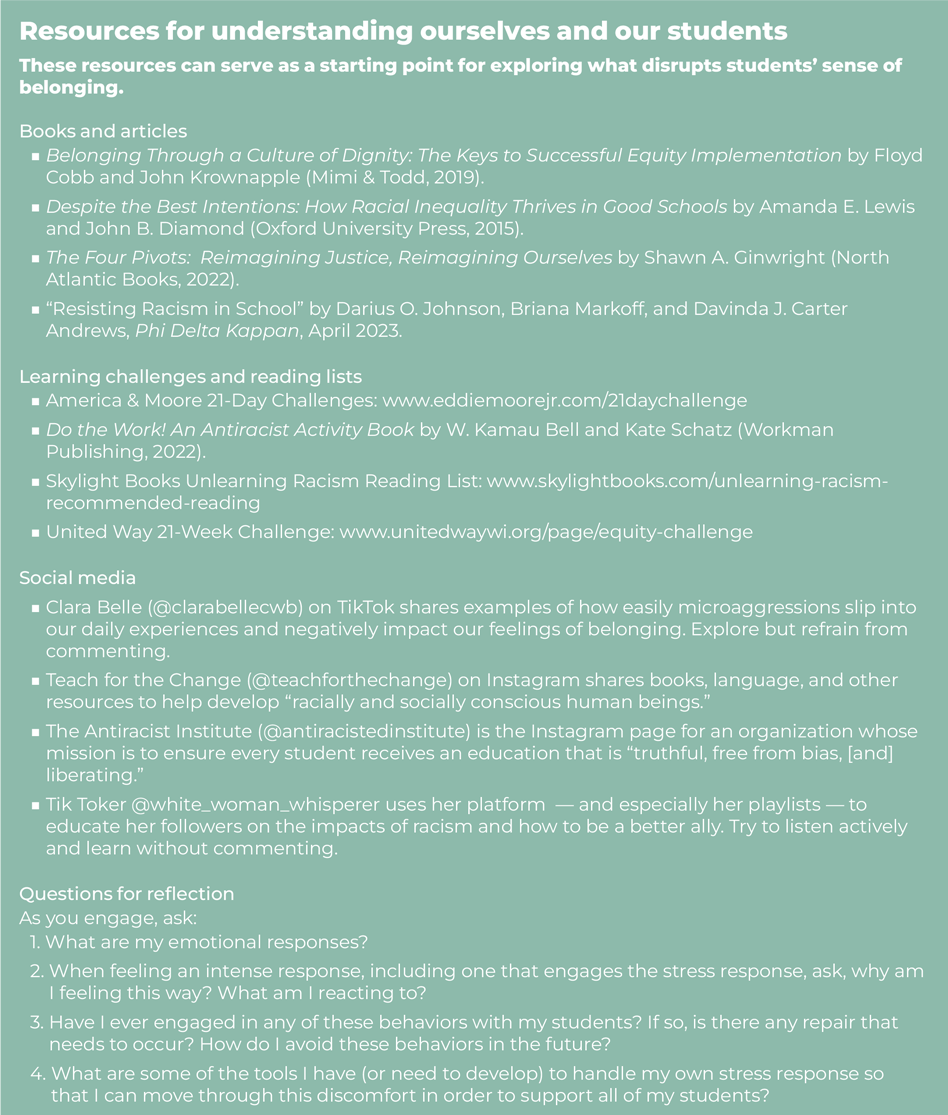
The reality is that all educators, especially white ones, have deeply internalized implicit biases that come from media and personal interactions. These at times manifest in words and actions that are racist, ableist, or classist. Whether because we are unaware of the history of a common phrase — as was the case with the teacher who used the phrase cotton-picking — or because white, ableist, or classist norms inform what is and is not acceptable behavior in school, most educators will at some point engage in a behavior that marginalizes or excludes some students. If we want our actions to match our intentions, we must shatter the good/bad, racist/not racist dichotomy and be willing to hear when our words and behaviors have created a barrier to students’ sense of belonging. The resources listed on page 23 can help us understand how our actions might affect our students, despite our best intentions. We also must build our awareness of and an ability to regulate our stress response so that we can do the work of dismantling what we have internalized. As we decenter ourselves, we can better turn our attention to our students and learn from and with them.
Beyond superficial acts
As we engage in this work, it is vital to remember that change is transformational. Building the capacity of school personnel to create a sense of belonging for all students and adults cannot be another “buzzword.” Adding language to our handbook or mission, hosting a daylong training, engaging in a book study, including “diverse” books in our curriculum, or hiring more people of color is insufficient. In fact, the act of bringing Black and brown (or disabled, Asian American, or bilingual/bicultural) people into a space without deeply examining how its policies and structures promote inequity could actually be bringing them into spaces that cause harm (Cormier, Bettini, & Stark, 2023).
To build belonging, we must look inward as well as outward, altering our way of thinking, reflecting, and acting; holding each other accountable for not only learning, unlearning, and relearning, but also acting on this knowledge to rebuild our policies, procedures, and systems top to bottom through the lens of equity, access, and belonging.
Belonging is invaluable. It recognizes our students’ inherent dignity and humanity and ultimately helps facilitate learning. Due to a cultural mismatch between many schools, teachers, and students, belonging can be elusive for many students. We must all “be courageous and selfless on behalf of students” (Young, 2022). We owe it to our students and ourselves to build a space where we all are safe and seen, valued, and honored, a space where we can learn and belong.
References
Coles, J. (2019). The Black literacies of urban high school youth countering anti-Blackness in the context of neoliberal multiculturalism. Journal of Language & Literacy Education, 15 (2), 1-35.
Cormier, C.J., Bettini, E., & Stark, K. (2023). Untying the double bind. Phi Delta Kappan, 104 (8), 19-24.
DiAngelo, R. (2016). White fragility. Public Science.
Eberhardt, J.L. (2019). Biased: Uncovering the hidden prejudice that shapes what we see, think, and do. Viking.
Hammond, Z. (2014). Culturally responsive teaching and the brain: Promoting authentic engagement and rigor among culturally and linguistically diverse students. Corwin.
Hattie, J. (2008). Visible learning. Routledge.
Howard, J.R., Milner-McCall, T., & Howard, T.C. (2020). No more teaching without positive relationships. Heinemann.
Jenkins, D.A. (2022). Feeling Black: Black urban high school youth and visceral geographies of anti-Black racism. Equity & Excellence in Education, 55 (3), 231-243.
Lewis, A. & Diamond, J. (2015). Despite the best intentions: How racial inequality thrives in good schools. Oxford University Press.
Taie, S. & Goldring, R. (2020). Characteristics of public and private elementary and secondary school principals in the United States: Results from the 2017-18 National Teacher and Principal Survey. U.S. Department of Education, National Center for Education Statistics.
Think PBS. (2020). Stress, trauma, and the brain: Insights for educators [Playlist]. YouTube.
Vasquez-Salgado, Y., Greenfield, P.M., & Guan Shu-Sha, A. (2021). Home-school cultural value mismatch: Antecedents and consequences in a multi-ethnic sample transitioning to college. Frontiers in Psychology, 12.
Young, E. (Host). (2022). The Young family [Audio podcast episode]. In “Belonging.” www.soundsofbelonging.com
This article appears in the April 2024 issue of Kappan, Vol. 105, No. 7, pp. 20-25.

ABOUT THE AUTHORS
Gloria McDaniel-Hall
Gloria McDaniel-Hall is an associate professor of educational leadership at National Louis University, Chicago, IL.

Nina F. Weisling
Nina F. Weisling is a chair and assistant professor of education at Carthage College, Kenosha, WI. She is a co-author of Responsive Mentoring: Supporting the Teachers All Students Deserve (Rowman & Littlefield, 2020).