In this week’s newsletter: The delicate art of changing district reading programs. The race to recover what students lost before time runs out. Journalists debate school culture wars coverage. A(nother) call to make education news more useful. And a reporter leaves journalism to become a teacher.
GO SLOW TO GO FAR
The big story of the week
The big education story of the week is the delicate art of changing literacy instruction. Districts that have successfully overhauled reading instruction have detailed their rationale for change, limited expectations of rapid progress, got veteran teachers on board early, and carefully crafted messages to principals, teachers, and families (New York Times).
But attempts to revamp instruction like the current one in New York City face challenges including reluctant building administrators, recalcitrant teachers, heavy-handed program rollouts, overly simplistic application of the “science of reading” label, retention debates, lack of available instructors, and chronically absent students (AP, EdNC, Bridge Michigan, School Library Journal).
📍Correction: Apologies for the error in last week’s newsletter, which mistakenly included a 2022 Chalkbeat story about students refusing to go to school.📍
Other big education stories of the week:
📰 UVALDE ANNIVERSARY: Remembrances and reflections of the tragic school shooting in Uvalde last year poured in from outlets across the country. The Uvalde Leader-News put together a 50-page tribute to the victims. Other standout stories include profiles of family members struggling with grief (ABC News, NBC News), the story of one family whose kids left school early that day and are haunted by what happened next (Texas Tribune), and a look at how the tragedy went from uniting the town to dividing it (New York Times).
📰 A WARNING LABEL FOR SOCIAL MEDIA: After what feels like a long delay, the U.S. surgeon general issued a public warning about the risks of social media use to young people (New York Times, PBS NewsHour, US News). Several school districts have sued social media companies over the toxic effects of their products and limited use of cellphones in school. Just this week, Massachusetts officials encouraged districts to restrict students’ cellphone use in schools, floating a possible statewide mandate in the future (Boston Globe, State House News Service).
📰 BOOK BAN SETTLEMENT: The U.S. Department of Education announced a settlement with Forsyth County Schools in Georgia over the district’s 2021 removal of books by and about LGBT people and people of color. The department stated the removals created a “hostile environment” and possibly violated their civil rights (New York Times, Washington Post, The Hill, U.S. News, NPR).

RACE TO RECOVER
The best education journalism of the week
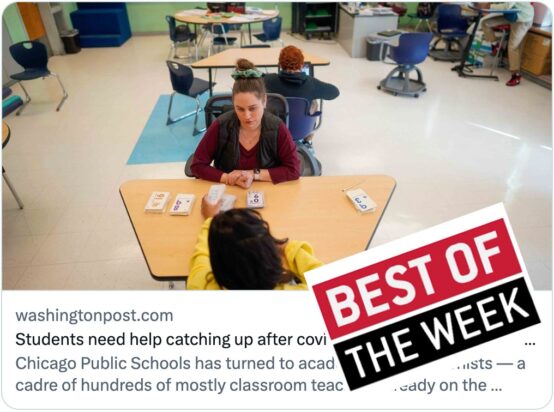
The best education journalism of the week is Students need help catching up after covid. Are interventionists the solution? by Chalkbeat’s Mila Koumpilova, co-published in the Washington Post
Focused on a handful of schools in Chicago, the piece details how the district has added “interventionists” to help struggling kids catch up. They’re making progress, many of them — but they have a long way to go and time is running out.
Among many things to like about this piece, it addresses an urgent education issue, features abundant first-hand observations of the work being done in classrooms, and includes a mix of successes and failures along the way.
Additional elements that I admire include the mix of big-picture statistics and up-close details, the decision not to name individual students, and the inclusion of intriguing data showing that Chicago students fare as well or better than students in other big city districts.
Other great education stories this week:
🏆 Analysis of book challenges shows the majority were filed by just 11 people (Washington Post)
🏆 ‘Culture wars’ candidates for Oregon school boards mostly lost (Oregonian)
🏆 Black kids face racism before they even start school. It’s driving a major mental health crisis. (AP)
🏆 NYC school suspensions spike 27% during the first half of the school year (Chalkbeat NY)
🏆 Chicago promised students would do better after closing 50 schools. That didn’t happen. (Sun Times)
🏆 Many young kids missed early special ed services due to COVID, compounding work for schools (Chalkbeat)
🏆 Less than half of Alabama school COVID relief money has been spent (AL.com)
DELICATE WORK
Our latest columns and commentary
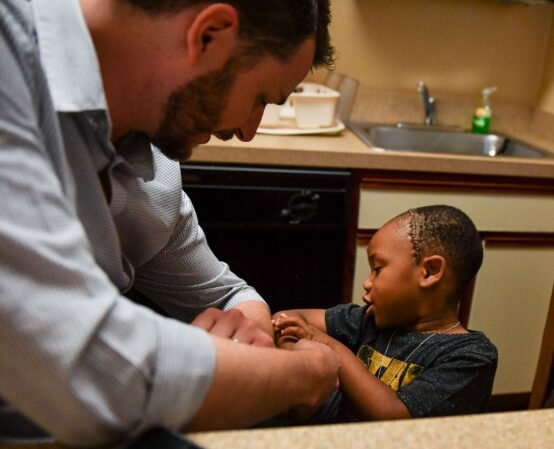
Above: The Washington Post’s John Woodrow Cox (left) and Cleveland gun violence survivor Carter Hill, then 4, pointing out the freckles on the reporter’s arm. Image used by permission. Credit: Ricky Carioti.
The Washington Post’s John Woodrow Cox has been writing about young survivors of gun violence for six years now, and so on the anniversary of last year’s Uvalde school shooting here’s a deeply personal interview with the award-winning journalist about how he produces his stories — and how his coverage is changing.
“I’m not sure I have ever heard someone put so many practical suggestions to ‘do no harm’ when interacting with children who have been victimized,” tweeted The 74’s Beth Hawkins.
Cox was also on WAMU’s A1 to talk about the families still searching for answers one year after the Uvalde tragedy.
TEACHER MENTORS ON THE TUNDRA
Coverage of promising school innovations & signs of progress
💡 Through a program that’s based in part on the research finding that high-quality mentoring can improve teacher retention, retired educators in Alaska travel the state by bush plane to provide one-on-one guidance and feedback to rookie teachers (NPR).
💡 Public schools in Massachusetts saw an encouraging drop in chronically absent students this year, but the rates are still high and districts are hoping to reduce attendance barriers by investing in more social workers and enhancing collaboration between departments and with parents (Boston Globe).
💡 At a Dallas community college where half of the students are first-generation and about a fifth are parents, coaches who help with everything from mapping out study plans to securing child care are giving some students the support they need to graduate (Dallas Morning News).
💡 Since 2017, five states have established programs that promote spending time in outdoor classrooms as another way of doing preschool, an approach that experts say can be of huge benefit following the locked-down pandemic years — but that also remains inaccessible to most students of color (Hechinger Report).
Read more about the importance of covering promising innovations and preliminary successes.

PEOPLE, JOBS
Who’s going where and doing what
Above: Palm Beach Post education reporter Kati Kokal “is a force of nature but like, the good and benevolent kind that makes things better wherever she goes,” according to Poynter’s Kristen Hare.
🔥 Kudos: Palm Beach Post education reporter Kati Kokal was recognized in Poynter for her mutual aid network for laid-off journalists, which started when Gannett cut about 400 employees last year. The effort has grown into a 23-person volunteer team and won her a Poynter-Koch Media and Journalism Fellowship. Amazing work!
🔥 Collaboration: We love to see a good ed news collaboration, and this one from the Hechinger Report, AP, and Dallas Morning News on how success coaches can help college students doesn’t disappoint.
🔥 Debate: “Book challenges and restrictions are demonstrably up,” tweeted Chalkbeat’s Patrick Wall in response to my concerns about media fear-mongering and amplification. “All seems very newsworthy.” He’s not alone in defending school culture wars coverage. “When the so-called culture war has tangible/outsized/real impact, we’d better be covering and contextualizing it,” tweeted ProPublica’s Nicole Carr. “It’s absolutely necessary.”
🔥 Meantime, at least one news outlet has added a clarification to its book ban coverage noting that some “banned” books are returned to the shelves after review. Another news outlet described a Florida school’s relocation of poet Amanda Gorman’s book as a “restriction” rather than a ban. (Gorman and PEN America strongly disagree.)
🔥 Awards: Congrats to the Chicago Tribune’s Jennifer Smith Richards, ProPublica’s Nicole Carr and Jodie Cohen, NYCity News’ Amaya McDonald, WHRO’s Lisa Godley, and others who are among the nominees for NABJ’s Salute to Excellence Awards for their education journalism. Awards will be announced in August.
🔥 Job openings: CalMatters is hiring a K-12 reporter. The Lincoln Journal Star in Nebraska is hiring an education reporter. And Nieman is hiring a digital and audience engagement editor.
🔥 Welcome back: Chalkbeat’s Matt Barnum is back and looking for tips and story ideas after spending a year as a Spencer fellow. Good to see you back!
APPEARANCES, EVENTS, & NEW RESOURCES
What’s happening and new research
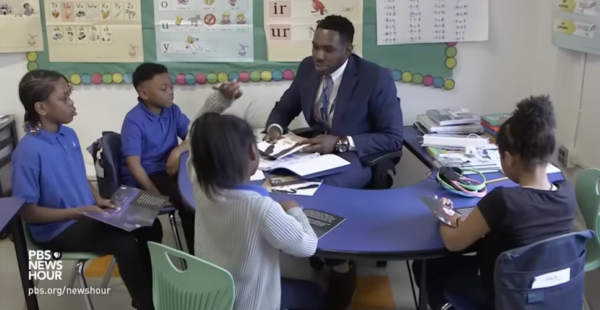
Above: As part of its Rethinking College series, PBS NewsHour profiled an organization that mentors Black teachers to counteract the dropout rate among Black students.
⏰ Segments: ProPublica’s Nicole Carr was on Scripps TV talking about book bans and other attacks on public education. Miami Herald education reporter Sommer Brugal was on WNYC’s Brian Lehrer Show talking about Florida education culture war issues. Five years after a wave of teacher strikes spread nationwide, NPR’s All Things Considered talked to teachers about what has and hasn’t changed.
⏰ Media survey: “People don’t just want education policy stories,” according to the American Journalism Project survey of 5,000 people about what they want from local news. “They want to know, step by step, how they’re supposed to choose programs for their children and get them in.” Read the full results here. This is not the first time lack of usefulness has been flagged as a core challenge for education coverage.
⏰ Upcoming: Next week, catch the Hechinger Report’s Tara García Mathewson leading a discussion on how schools can work with parents to support students’ mental health. The 74 and the Progressive Policy Institute are hosting a webinar on the future of high school. The EWA national seminar is happening in June in Atlanta. I spot two panels on education in the annual IRE convention, both on investigating inequities in education.
⏰ Appearances: The Hechinger Report’s Tara García Mathewson was on the Educational Triage podcast talking about equity and school discipline. And several ed journalists were well-represented at the Reagan Institute Summit on Education, with appearances by EdSurge’s Emily Tate Sullivan, EdWeek’s Alyson Klein, and the Washington Post’s Laura Meckler. Documentary filmmaker Jenny Mackenzie was at the NYC premiere of Right To Read, her latest feature.
⏰ Podcasts & videos: A new podcast episode by former Washington Post and Ed Trust journalist Karin Chenoweth tells the story of an Indiana community that came together to support their schools against extremism. Boston’s “Last Night at School Committee” podcasts distill hours-long public meetings into half-hour episodes — and got a recent write-up in Nieman Lab. APM Reports’ “Sold a Story” released a guest episode from “Brains On,” a show for kids about learning how to read. “It’s a good listen, for kids — and adults too,” says journalist Emily Hanford.
⏰ New research: The annual Report on the Condition of Education was released this week, showing that school enrollment has fallen, national test scores are down, and about half of students were below grade level in at least one subject when the school year started (Washington Post). And a new education working paper has found that students who attended virtual charter schools have worse labor market outcomes as adults.
THE KICKER
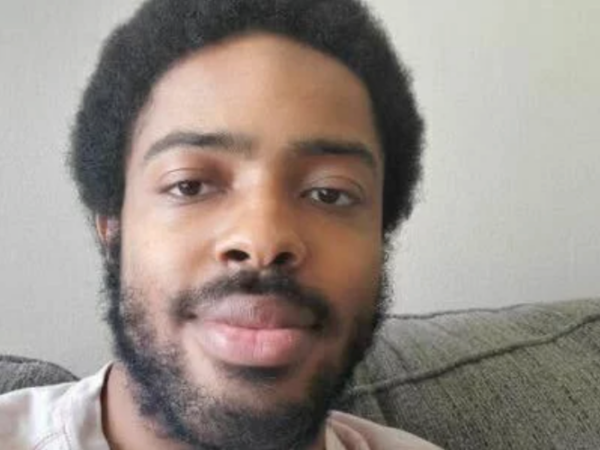
“I wanted to go into something where I felt like I could really just continue to do great work,” said former Cleveland reporter Cameron Fields, who spent a year covering Cleveland schools before becoming a teacher.
ABOUT THE AUTHORS

The Grade
Launched in 2015, The Grade is a journalist-run effort to encourage high-quality coverage of K-12 education issues.
Alexander Russo
Alexander Russo is founder and editor of The Grade, an award-winning effort to help improve media coverage of education issues. He’s also a Spencer Education Journalism Fellowship winner and a book author. You can reach him at @alexanderrusso.
Visit their website at: https://the-grade.org/