Education journalism is uniquely positioned to show the industry how to cover the news in a way that doesn’t demoralize and alienate readers.
By Alexander Russo
The world is on fire. Inflation is spiraling out of control. A new variant of COVID is roaring back. The Supreme Court has gone rogue, and the Jan. 6 hearings have uncovered morale-crushing news about the former administration.
So it’s understandable that some readers might have been surprised to see Amanda Ripley’s Washington Post opinion piece denouncing the news industry for being unnecessarily negative.
In her July 8 op-ed, the author and longtime journalist confessed that she had been actively avoiding the news — not because the world is in such bad shape, but because media coverage has become unnecessarily and relentlessly negative.
Ripley had begun actively avoiding the news because media coverage has become unnecessarily and relentlessly negative.
Ripley is not alone among journalists who don’t read as much news as they used to or as you might expect them to. I know of several who feel alienated about the news they see — and sometimes about the coverage that they’re producing.
In the meantime, many non-journalists (i.e., readers) have also begun avoiding the news, a trend that should worry even the most fervent adherents of how journalism is currently being practiced.
Last month’s Reuters Institute report showed that 4 in 10 Americans sometimes or often avoid the news, a higher percentage than 30 other countries. A new Axios report also shows declining readership for news as readers increasingly tune out. And Gallup reports that public confidence in journalism continues to decline — down five percentage points in just the past year.
While most people may just avoid the news they find depressing — or leave the beat or the profession — some journalists like Ripley have become advocates for a new kind of news reporting that gives readers hope and a more balanced view of the world around them.
And, hard as it may be to believe, Ripley’s column suggests that the education beat is well positioned to steer journalism towards a new, better, and more reader-popular way of informing the public.
Some education reporters, teams, and outlets are already showing how it can be done. And if they’re right, then perhaps the education beat can help save journalism.
Some education reporters, teams, and outlets are already showing how it can be done.
While many things are objectively bad in the world, at this point it seems pretty obvious that journalism is often overly negative.
A Dartmouth report showed that U.S. pandemic coverage was not only relentlessly negative even when things were going better, but also much more negative than English-language news in other countries.
Too many newsrooms seem to be operating from an outdated theory of change, based on generating outrage as a way to prompt action.
The New York Times’ David Leonhardt calls it the “Bad News Bias.”
But it doesn’t seem to be working. Apparently, you can’t scare large numbers of people into reading coverage that is consistently or even pervasively fear-generating — at least not in the long run. And it’s certainly not good for readers’ mental health (or for reporters’ well-being).
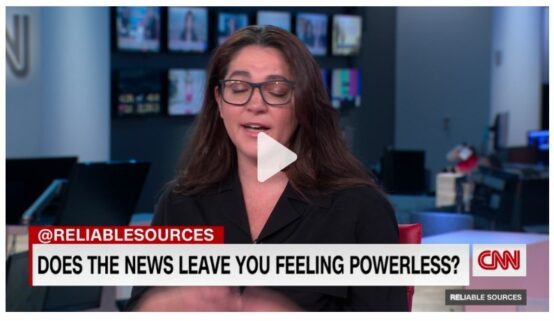
“We need to be thinking about our product differently,” said Vox founder Melissa Bell on a recent CNN segment. “[We] are not actually helping [readers] navigate the world… what we are doing is telling them horrible, frightening news.”

Above: On CNN, Vox’s Melissa Bell describes how relentless negativity makes readers feel powerless and eventually turns them off to news consumption.
In terms of overstating how badly things are going, education journalism may be the worst offender.
Stories about schools, kids, and the controversies that often surround their education are dominated by hyper-negative, needlessly adversarial, and often quite superficial coverage.
In education journalism, the sky is nearly ALWAYS falling. And it’s not just tabloids, ideological news sites like Salon, and local TV news operations. Education coverage from prestige outlets like ProPublica and the New York Times often amp up negative emotions and suggest that schools are on the verge of destruction.
What percentage of education stories give readers a sense of hope and possible improvement? I don’t have any data, but I’d guess the number is very small. A series of studies from Calvin University found that parents generally found education news too negative and that regional or national outlets were less solutions-oriented than local or community outlets.
Context, nuance, and possible alternatives are often left out. The scary anecdotes, chilling quotes, and heightened language have become all too common.
The scary anecdotes, chilling quotes, and heightened language have become all too common.
The good news is that there are already a handful of teams and outlets that have committed to doing things differently. And, unlike many other beats, education features huge amounts of comparative data, allowing reporters to show readers what works — and investigate why that might be.
Here’s the thing that Riley’s column reminds us:There are already good things going on in education and a smattering of “good news” stories about them: A small town in New Hampshire turned back conservative school budget-cutting efforts. Georgia voters rejected anti-CRT school board candidates who’d opposed DEI instruction in schools and hounded an educator out of a job. California is moving towards later school start times for high school students, which researchers have recommended for years. A teacher noticed that many of her students were grieving the loss of a parent and started a classroom club for grieving students.
And there are also already handfuls of stories that offer balanced looks at controversial topics rather than giving us simplistic fear-including ones: As Ripley noted, a Georgia TV station produced a 2021 series of stories asking questions about parents concerned about DEI and CRT in schools that was much less extreme than most stories you’ve seen on the topic. While attendance has been a problem, students participating in a tutoring pilot in Indiana’s largest school district have shown gains. KPCC LA’s Kyle Stokes recently took a nuanced look at the promise and challenges of the community schools model that California is adopting.
The handful of outlets and organizations trying to forge new paths include Ripley’s Good Conflict initiative, the Solutions Journalism Network, and the Trusting News project. The Hechinger Report and education labs in Seattle, Alabama, Dallas, Fresno, and South Carolina are all showing the way. The Christian Science Monitor has adopted a new approach as well.
The hope, agency, and dignity that Ripley calls for aren’t all that difficult to provide — and are already happening in a small but growing number of places.
The hope, agency, and dignity that Ripley calls for are already happening in a small but growing number of places.
Nobody’s calling for superficial feel-good stories or for journalists to begin downplaying bad news. Where schools or systems are failing vulnerable kids, the story needs to be told and told again.
And nobody’s saying that it’s going to be easy for most journalists and many readers to rethink their traditional focus on things that are going badly. The bias towards negativity and danger is a strong one.
However, if you step back from the daily mess and look around, it’s hard not to see that some schools and districts are meeting the same awful challenges as their peers more effectively than others, and their success should be used to give readers hope and challenge others to follow suit.
Journalists rightly reject bad-faith attacks and ideological criticism. But they should pay much closer attention to everyday readers’ concerns. And they should take immediate action to respond to concerns from among their own ranks. If you can’t bear to read the stories you or your colleagues are producing, you’re not alone.
The only question is whether journalism — and education journalism in particular — will stand up and meet the challenge.
Related commentary from The Grade:
The rise of ‘conflict’ journalism (Interview with Amanda Ripley)
People are fighting. Is that news? (Greg Toppo)
5 bad habits education journalists need to break
Back to school coverage has been unnecessarily alarmist — again. But there’s still time to improve.
‘Complicating the narratives’ in education journalism
Education journalism is stuck. What’s holding it back?
The culture war is the easy, less important story (Nic Garcia)
ABOUT THE AUTHOR

Alexander Russo
Alexander Russo is founder and editor of The Grade, an award-winning effort to help improve media coverage of education issues. He’s also a Spencer Education Journalism Fellowship winner and a book author. You can reach him at @alexanderrusso.
Visit their website at: https://the-grade.org/