The 36 nominees for EWA’s 2016 awards include some great work — but also miss some big stories.
By Alexander Russo
There are tons of big-name journalism awards each year – Pulitzer, Polk, IRE, the Ellies – but the Education Writers Association (EWA) Awards are the only one that’s focused exclusively on coverage of education.
This year, as in the past, many admirable pieces have been named as 2016 EWA Awards finalists, including a handful that have been recognized in other contests.

The biggest story among the finalists is probably the Houston Chronicle’s special education series, which was a Pulitzer finalist, a Polk award winner, and an Investigative Reporters and Editors (IRE) prize winner.
And there is lots more great, widely-recognized work on the EWA finalists list.
However, it’s curious that some notable work –a Pulitzer winner, a Pulitzer nominee, and a New York Times magazine piece that may have been the most-discussed piece of the year, among others – didn’t make the EWA finals.
Reuters – which was a Pulitzer finalist for its series on systematic cheating on college admissions tests – is not among the EWA finalists. Neither is the Salt Lake Tribune, which won a Pulitzer for local reporting on mistreatment of sexual assault victims at Brigham Young.
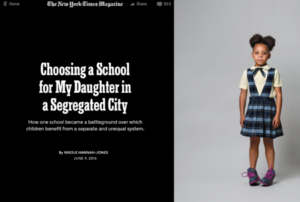
Perhaps the most notable absence is Nikole Hannah-Jones’ June 2016 New York Times magazine piece, Choosing a School for My Daughter in a Segregated City. The story the American Society of Magazine Editors public interest award earlier this year.
These absences – mirroring some of the hits and misses of last year’s list of finalists – suggest the possibility that the EWA contest either isn’t drawing in all the best education reporting of the year or that its judging process isn’t picking some pieces of real heft that deserve a place among the finalists.
It’s a bit of a mystery.
However, there are few things that the organization might consider that would help ensure that the EWA awards attract entries from all the best examples of mainstream education coverage that have been produced – first and foremost among them figuring out if some outlets aren’t submitting all their best work and adding options for nominating them.
First, the basics:
Earlier this week, EWA announced the 2016 EWA Awards finalists, “recognizing the top education stories in online, print and broadcast media across the country.”
There are 36 finalists in all, from a wide range of outlets, characterized by “compelling writing, high-impact visuals, and illuminating data.”
The judging process includes a panel of judges – current and former journalists – submitting picks to an awards board for selection of finalists and winners. The process is funded in part by the College Board.
From a starting tally of 330 eligible entries, the winners – in 16 categories – will be announced at the end of next month during EWA’s National Seminar, held this year at Georgetown University. That’s an increase from last year’s reported 310 entries, according to EWA.
With more than 300 entries, there is no shortage of submissions to the contest. On average, each category received 20 entries.
The finalists list includes many of the nonprofit and education-focused outlets you’d expect to see – Education Week, Hechinger Report, NPR and several local NPR stations, Chalkbeat, APM Reports, and ProPublica.
A much-discussed series that made the list is EdWeek’s investigation of cyber charter schools, called Rewarding Failure. Another well-known project is the NPR School Money series, which included both the national team and numerous local affiliates.
Some of the names – the Boston Globe’s Laura Krantz, a finalist for beat reporting at a large outlet – might be unfamiliar. Krantz has covered higher education there since 2015, according to her bio. At least one of the finalists – WNYC’s Beth Fertig – is no longer covering education.
Other favorites among the finalists include The Connecticut Mirror’s Jake Kara and Jacqueline Rabe Thomas for Troubled Schools on Trial; Chalkbeat Detroit’s Erin Einhorn for beat reporting; Slate/The Teacher Project for Single-Topic News or Feature (Race in America’s Classrooms); ProPublica’s Annie Waldman for Investigative Reporting (Who Keeps Billions of Taxpayer Dollars Flowing to For-Profit Colleges? These Guys); the Washington Post’s Jessica Contrera and Caitlin Gibson for Single-Topic News or Feature (The Screen Age); and of course Brian Rosenthal for Investigative Reporting (How Texas Keeps Tens of Thousands of Children Out of Special Education).
Still, a large number of outlets and notable stories are not included among the EWA finalists.
The long list of absentees includes the New York Times, the Wall Street Journal, the Associated Press, Vox, BuzzFeed, Reuters (a Pulitzer finalist for its test cheating coverage), the LA Times, Chicago Tribune, Politico, and The 74.
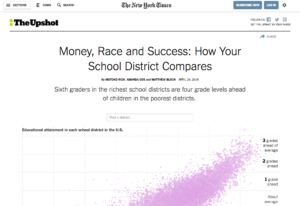
Also missing, in particular: The New York Times’ Money, Race and Success data visualization was impressive and widely-read, as was its controversial coverage of Success Academy. The Boston Globe produced impressive coverage of a big charter school ballot issue. WNYC’s “School Integration 2.0” series was thought-provoking and in depth. The Seattle Times looked long and hard at why Washington was spending Massachusetts-level money but not getting Massachusetts-level results.
Other stories that received recognition in other contests: Announced in February, the Polk Awards recognized the Arizona Republic’s Craig Harris in the category of state reporting. He uncovered “wholesale termination of women, minorities and those over the age of 40 without cause by Arizona state agencies” including an award-winning teacher fired after she was diagnosed with breast cancer. And WTVF Nashville was an IRE broadcast finalist for its “Making the Grade” series about “questionable testing and grading practices inside one of the most highly applauded school districts in the nation.”
So what’s going on? It’s not entirely clear.
At least some of those missing from the finalists list did not enter the contest this year. The Times’ Hannah-Jones says she didn’t enter the EWA contest, and the Boston Globe says it didn’t enter its K-12 reporting in order to focus on its higher education coverage.
But we don’t know about the others. The New York Times says it doesn’t comment on which awards contests it enters. Two of the Reuters reporters involved in their big education story say they are not sure whether the story was entered or not. The EWA keeps that (and several other parts of the process) confidential.
Asked about the process and the missing entries, EWA’s Caroline Hendrie declined to talk specifics but said, “We’ve taken steps to expand the pool of judges quite dramatically and added checks and balances to ensure that the best of the best does get elevated.”
Several judges and award advisory members contacted for this piece said that Hendrie sent out an email asking them not to comment on the process of how the finalists were determined.
But it seems clear that at least some of those missing pieces should have been on the finalist list. They were big, important pieces.
So the problem is that either publications aren’t entering some of the most noteworthy pieces of the year, or that EWA isn’t recognizing them.
Either way, this could be understood and improved.
First and foremost, EWA may need to figure out how to draw in more and/or different submissions to the contest. Perhaps 331 entries for a contest whose top prize is $10,000 is not as much as it should be? Are larger outlets busy with Pulitzer submissions forgetting about EWA?
Maybe EWA could actively recruit outlets and journalists to submit, or persuade other organizations to remind newsrooms to participate or to click a box to enter the EWA contest. Perhaps there should be a cost-free option for reporters who want to submit their work but aren’t getting any funding from their newsrooms and don’t feel they have the application fee money to spare.
The awards process would also probably benefit from a lot more interactivity with journalists and readers interested in education. There could be a “Peoples’ Choice” category, for example, or readers could help recommend or winnow down the submissions along the lines of South By Southwest’s panel selection process. Right now, the process is very genteel and hush-hush, which is the traditional way to do things but has obvious drawbacks.
It’s possible that the funding for EWA in general and for the awards in particular are functioning as an obstacle. This year, the College Board is the main sponsor of the contest. Do the funding sources for the EWA, organizations that are sometimes controversial themselves, inhibit reporters and newsrooms from participating in the contest?
EWA’s Hendrie says she is not aware of the fee or the sponsorship of the contest inhibiting news outlets from participating in the contest, and that the College Board only came on board as the contest sponsor quite recently.
As for the idea of allowing the inclusion of pieces that have not been self-nominated, she said, “I think that’s an interesting idea. No one else has ever suggested that.”
Related Posts:
Pulitzers 2017: Education Journalism Did Better Than You Think
Best Education Journalism Of The Year (2016)
Hits, Misses, Snubs, & Mysteries Among This Year’s EWA Awards Finalists (2015)
ABOUT THE AUTHOR

Alexander Russo
Alexander Russo is founder and editor of The Grade, an award-winning effort to help improve media coverage of education issues. He’s also a Spencer Education Journalism Fellowship winner and a book author. You can reach him at @alexanderrusso.
Visit their website at: https://the-grade.org/