This is #CoveringCOVID19, a daily update from The Grade to help education journalists cover the shutdown of the nation’s schools.
THE TOP FIVE
Here are five great education stories about how schools are responding to the COVID-19 crisis:
 NYC schools told to squelch info on staff with coronavirus – The City
‘I need you to be patient with me’: For this Chicago teacher, working remotely is a balancing act – Chalkbeat
Hundreds of Cincinnati area students have fallen out of contact with teachers – Enquirer
Texas coronavirus school closings shred teacher-student bonds – Texas Tribune
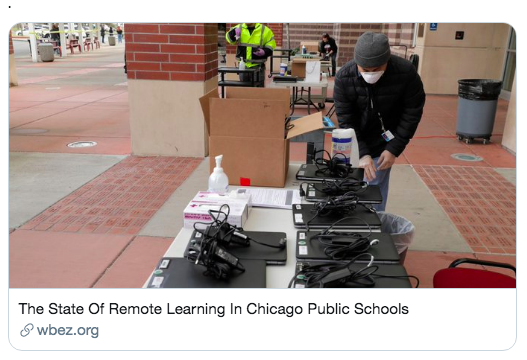
The State Of Remote Learning In Chicago Public Schools – WBEZ Chicago (pictured above)

THE DANGERS SCHOOL STAFF FACE
However tempting it may be to focus on kids, parents, and classroom teachers, it’s crucial for education journalism to include in their coverage the uncertified school staff who are such a big part of education.
Thanks to Chalkbeat, we know that teachers aides have been hardest hit among New York City educators who have died because of COVID-19. Paras there make roughly $26,000 a year and represent more than 44 percent of the city school workers who have died.
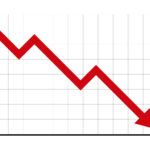
But immediate physical danger is not the only issue here. Roughly 3 million low-salary school staff (clerks, aides, custodial staff, cafeteria workers) are at risk of losing their jobs, according to the above chart included in a recent Vox article.
“There are 3.3 million private sector production and non-supervisory (P&NS) jobs in education in the U.S.,” Daniel Alpert, who helped compile the data used in the chart, told me via email. They include workers at elementary and secondary schools, as well as postsecondary institutions.
The vast majority of these jobs are low-paying. However, Alpert made clear, the index does not include low-paying public school jobs. “There are millions more of those.”
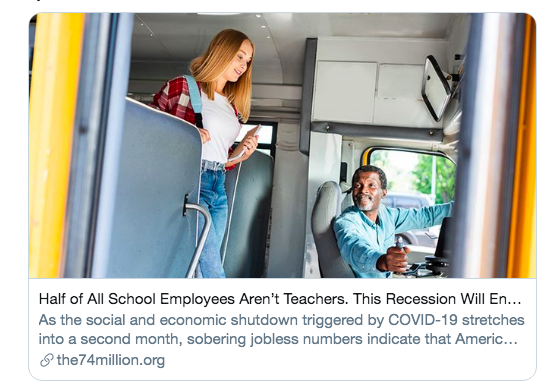
With a new story this week, the 74’s Kevin Mahnken focuses even more attention on these vulnerable workers, noting that half of all school employees are not teachers, and these non-teachers are especially at risk. The piece, which features Utah, North Carolina, Virginia, and Chicago, focuses on issues such as job modifications, emergency leave, layoffs, furlough, dismissal, and delayed bonuses — and unemployment benefits. These workers are much more likely to be people of color, and to lack postsecondary degrees. Get the full story in Matt Richmond’s 2014 book, “The Hidden Half: School Employees Who Don’t Teach.”
If you haven’t already written a piece about what’s happening to school staff in your coverage area — in terms of health challenges or economic ones —you should be sure to sometime soon.
TIDBITS
 heir
heir
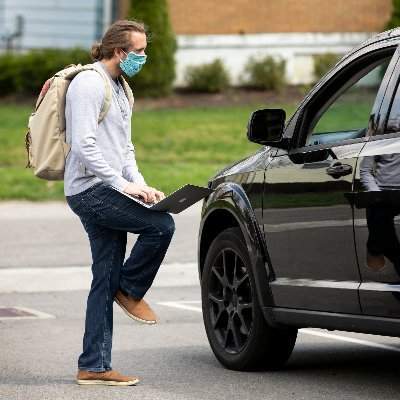
The Cincinnati Enquire’s Max Londberg (above) has an updated Twitter picture showing him in action. How about you?
 Over half of schools are in districts now encouraging one-on-one contacts with students, through either synchronous learning platforms or individual outreach via emails and phone calls, according to the new round of information from AEI’s district database. And the percentage of districts that have now mounted remote learning programs has increased dramatically over the past two weeks, to 70 percent.
Just 14 of 82 big districts in the CRPE database are formally monitoring student attendance, notes Chalkbeat. NYC is one of them. Education Dive reports that educators in many states report low e-learning attendance.
A month in, how are school food distribution programs holding up? Are they overwhelmed, or under-used, or does it vary? “Here in Chicago they continue to see heavy use,” reports Maureen Kelleher. “CPS consolidated somewhat–at first every school was offering meals (500+ schools). Now it’s 306.”
Some amazing pieces are being written without in-person access, and in a new piece for The Grade freelancer Amber Walker explains how Chalkbeat, New York Times, Boston Globe, and NPR reporters are producing detailed pieces while keeping a safe distance.
Teacher shortages due to the pandemic are not very likely, according to Tulane’s Doug Harris, who explains that “teaching is counter-cyclical—turnover & retirements slow when econ times get tough.” Harris was responding to a Hechinger Report oped speculating about possible future shortages.
That’s it! See you back here tomorrow. Sign up for the weekly email, Best of the Week, which comes out Fridays around noon Eastern.
ABOUT THE AUTHOR

Alexander Russo
Alexander Russo is founder and editor of The Grade, an award-winning effort to help improve media coverage of education issues. He’s also a Spencer Education Journalism Fellowship winner and a book author. You can reach him at @alexanderrusso.
Visit their website at: https://the-grade.org/