In this week’s newsletter: The return of school cell phone restrictions. Schools that exceed expectations. Why Massachusetts kids can’t read. A new podcast from the folks who brought you “Southlake.” A journalists-only listserv to promote high-quality literacy coverage. Plus: APM Reports’ Emily Hanford as a first grader.
CELL PHONE RESTRICTIONS
The big story of the week
The big education story of the week is the growing number of U.S. schools and districts restricting use of cell phones.
In the U.S., the restrictions — let’s not call them bans, OK? — vary widely and are being implemented at the school or district level. Meanwhile, the U.K. is planning a nationwide ban starting early next year (Independent, Guardian, BBC).
Partly a response to post-pandemic behavior and learning challenges reported by educators and parents, the new restrictions are also a response to the continued growth in distracting alerts and notifications, which teens experience hundreds of times a day and contribute to a daily average of 43 minutes of in-school cell phone use, according to Common Sense Media (NBC News, Scripps News).
In addition, there’s also 2016 research suggesting that limits on cell phones in class provide the equivalent of adding five days of school, with particular benefits for kids who are furthest behind academically. “Holy Toledo,” tweeted former USA Today education reporter Erin Richards about the new study. “Get those hanging things with the individual clear pouches for 30 phones up pronto in more classrooms.” Or read what Center for Analysis of Longitudinal Data in Education Research’s Dan Goldhaber has to say.
Other big education stories:
📰 MIGRANT STUDENTS: The recent influx of migrant students in cities across the U.S. has given at least one much-needed benefit to some districts: increased enrollment (Chalkbeat Colorado). But despite the good news, the fact remains that many districts are struggling to properly enroll and support these students, many of whom are juggling school work during the day and dangerous jobs at night (Boston Globe, The Public’s Radio).
📰 BANNED BOOKS WEEK: Tomorrow marks the end of Banned Books Week, which saw a slew of education stories on book challenges in schools across the country (AL.com, Boston Globe, Atlanta Journal-Constitution). Under a new law in California, schools could be fined for banning books based solely on the inclusion of race, gender, or other identity groups (LAist). One district in North Carolina even went as far as to ban Banned Books Week — and then un-ban it after facing backlash (The Guardian).

BEATING THE ODDS
The best education journalism of the week
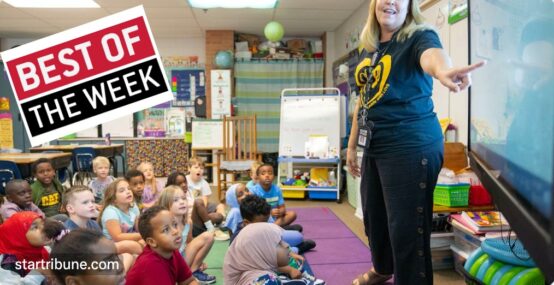
The best education story of the week is Eder Campuzano and MaryJo Webster’s Some high-poverty schools in Minnesota are beating the odds for the Minneapolis Star Tribune.
Featuring lots of in-school details, the story describes how teachers at two local schools — among the 20-30% that score higher than expected — help students get comfortable, build relationships, and get additional services and support they may need.
“The keys, educators and researchers say, are building connections to support families and constantly finding ways to introduce concepts into different kinds of lessons.”
I’m a sucker for stories like this. They’re solutions stories — but they’re also accountability stories. I could read stories like this all day if only I saw them that often. This story was published Sept. 29.
Other great stories we saw this week:
🏆 Baltimore’s school building program could offer model to close gaps in Massachusetts (Boston Globe
🏆 NYC Schools Began to Recover From the Pandemic. Now a New Crisis Looms (New York Times)
🏆 Can Seattle close literacy gaps for kids of color with science of reading? (Seattle Times)
🏆 Too Many Vermont Kids Struggle to Read. What Went Wrong — and Can Educators Reverse a Yearslong Slide in Literacy? (Seven Days)
🏆 Blizzard of state test scores shows some progress in math, divergence in reading (Chalkbeat)
🏆 Many schools went all in to fight chronic absenteeism. Why are kids still missing so much class? (Chalkbeat)
🏆 California’s Math Misadventure Is About to Go National (Atlantic)
🏆 Black special needs students struggle in Sacramento schools. A new plan wants to change that (Sacramento Bee)
NEW EFFORT TO COVER LITERACY
Our latest columns and commentary
Written by APM Reports’ Emily Hanford, our latest piece includes a call for high-quality literacy coverage — Hanford lists three key characteristics — and announces the launch of a new listserv for reporters interested in joining together to cover this important topic.
The leading force behind the blockbuster “Sold a Story” podcast series, Hanford calls on education reporters to talk to teachers, understand the research, and avoid dumbing down the story to phonics. Read the story (and sign up for the new listserv) here.
Also be sure to check out Mandy McLaren and Naomi Martin’s Lost in a world of words, the kickoff to the Boston Globe’s new series on Massachusetts’ struggle to improve its literacy results. Next week we’ll finish out our own literacy series with a column from McLaren.
TEEN CLIMATE ACTIVISTS
Coverage of promising school innovations & signs of progress
💡 Teenage activists at a South Baltimore high school are working to prove that a massive freight company is polluting their air with coal dust (Code Switch/NPR).
💡 This story profiles a handful of programs helping immigrants who earned teaching degrees in their home countries get jobs in places like South Sioux City, Neb., and Tulsa (The 74).
💡 As some raise alarms over California’s efforts to do away with differently leveled “tracks” of coursework, Texas has a bureaucratic fix that seems poised to get more Black and Hispanic students into advanced math classes (Dallas Morning News).
💡 While it highlights free housing for educators, this piece doubles as a primer on the low wages and disproportionate impact on Black women of the U.S. primary care system (New York Times).
Read more about the importance of covering promising innovations and preliminary successes.

PEOPLE, JOBS
Who’s going where and doing what
🔥 Career moves: Former Dallas Morning News education reporter Meghan Mangrum has a new job as city editor at the Bozeman Daily Chronicle in Montana, where she says she’s not planning to leave the ed beat completely. Former Washington Post education editor Phyllis Jordan has a new job launching the nonprofit EdFund, which looks at how public schools are financed. And Rhode Island Current education reporter Kevin Andrade announced he’s returning to freelancing full time. Congrats to all!
🔥 Throwback: In honor of Matt Drange’s follow-up investigation this week for Insider on sexual predators at his alma mater, here’s our 2022 interview with him about how to report on the heavy topic. Keep an eye out, too, for part 3 of the series, which will look into how serious misconduct allegations against teachers are kept secret.
🔥 Sound off:
“I have seen A LOT of lip service and injustice while parenting Josh over the years, and very few solutions, which is what parents want more than anything,” said parent Jennifer Berger, who recently wrote an essay for Chalkbeat about students with disabilities. “I think keeping that in mind would go a long way for a lot of journalists.”
“Education does not and cannot shape many of the more proximate factors that directly and indirectly affect jobs and wages,” said Neil Kraus, a political science professor at the University of Wisconsin-River Falls, in response to a recent Hechinger Report article raising concerns that American students’ low math skills are a national security threat.
High school journalist Eyitemi Odusola wrote about the importance of extracurriculars in high schoolers’ busy schedules for The Bullhorn, saying extracurriculars make “the high school journey richer, more fulfilling, and ours.” A good tip on where ed journalists can look for untold school stories.

APPEARANCES, EVENTS, & NEW RESOURCES
What’s happening and new research
⏰ Podcasts & segments: In addition to the debut of NBC News’ new “Grapevine” podcast, CBS News had two good ed-focused segments this week on the rise in chronic absenteeism and lessons learned from Mississippi’s approach to improving literacy. NPR’s 1A podcast took on banned books and censorship in schools.
⏰ Media appearances: ProPublica’s Nicole Carr, The Atlantic’s Adam Harris, and the CT Mirror’s Jessika Harkay were on Connecticut Public Radio’s podcast “The Wheelhouse” talking about how school boards became political flashpoints. The Hechinger Report’s Jill Barshay was on the podcast “Tests and the Rest” talking about controversies over “growth mindset.” The New York Times’ controversial science and health reporter Apoorva Mandavilli was on EWA Radio talking about the importance of air quality in keeping schools open. And the good folks at Ballotpedia were kind enough to have me on their podcast to geek out about school board elections and media coverage.
⏰ Research: In 2021-22, districts had about 20,000 more teachers than they did five years ago but 1.9 million fewer students, which could spell financial trouble in the future, according to Chad Aldeman in The 74. (For another perspective on teacher shortages, listen to this New York Times opinion piece on the “great American teacher crisis.”) Education Next has a new report out on what we know about teacher race and student outcomes. According to a new Lumina Foundation-Gallup study, about a quarter of Hispanic students said they experience being “discriminated against, harassed, disrespected, and physically and psychologically unsafe at their institutions” — a higher rate than any other group.
⏰ Reporting resources: Capital B reported on a new tool that shows climate risks across the country, which disproportionately impact Black neighborhoods. The Harvard Graduate School of Education unveiled the new Black Teacher Archive, an open-access digital portal on the history of education and Black history. And a new Ed Working Paper looks at the colleges attended by reporters who write about student loans, finding “evidence of a stark status hierarchy … (and) a negative relationship between that hierarchy and an innovative practice, the use of racialized language in student loan news articles.” Fascinating stuff.
THE KICKER

That’s all, folks. Thanks for reading!
Reply to this email to send us questions, comments or tips. Know someone else who should be reading Best of the Week? Send them this link to sign up.
Using Feedly or FlipBoard or any other kind of news reader? You can subscribe to The Grade’s “feed” by plugging in this web address: http://www.kappanonline.org/category/the-grade/feed/.
Read more about The Grade here. You can read all the back issues of The Grade’s newsletter, Best of the Week, here.
By Alexander Russo with additional writing from Colleen Connolly, Will Callan, and Greg Toppo.
ABOUT THE AUTHOR

The Grade
Launched in 2015, The Grade is a journalist-run effort to encourage high-quality coverage of K-12 education issues.