In this week’s newsletter: Florida AP Psych drama. A near-doubling of chronic absenteeism. More states offer free meals. Week 2 of back to school. Social media and teen violence. And NABJ23 award winners.
AP TEMPEST IN A FL TEAPOT
The big story of the week
The big education story of the week in terms of media attention is whether or not the AP Psychology class can be taught for credit in Florida. However, I’m not at all convinced that this is a national education story of any great significance. Every school culture wars story distracts from stories about much larger issues like social media’s role amplifying youth violence or the 6.5 million more students missing weeks of school. And, after a period of confusion, it now turns out that the course may be taught after all (Washington Post, Tampa Bay Times, AP, Palm Beach Post).
Other big stories of the week:
📰 BACK TO SCHOOL: About a third of U.S. kids are back in classrooms as of this week, according to Burbio, including schools in the Bay Area, Las Vegas, many parts of Florida, and Louisville (Mercury News, Las Vegas Review-Journal, WUSF Public Media, Louisville Public Media). Not everything has run smoothly: New bus routes created chaos and closed schools in Kentucky the first week back (Courier Journal). Heat and the high cost of school lunches and supplies are two of the most pressing concerns returning families face (Seattle Times, KUT Austin, USA Today, LA Times). However, nine states including Connecticut and Massachusetts have expanded their universal meal programs (Hartford Courant, Chalkbeat).
📰 CYBERSECURITY SUMMIT: The White House held its first ever summit on cybersecurity in K-12 schools, elevating attention to an issue that has become increasingly ubiquitous and dangerous (AP, The 74, Axios, CNBC). At least 48 districts have suffered from ransomware attacks this year, making schools among the most likely targets. Just this week, New Haven schools report that they lost $6 million to hackers (New York Times). For more on cybersecurity in schools, follow The 74’s Mark Keierleber, who as far as we know is the only reporter dedicated to this beat.
📰 HOUSTON TAKEOVER: Following the state takeover of Houston ISD, new superintendent Mike Miles is coming in hot with plans to shake things up, including consolidating more power for his position and overhauling instruction — worrying and angering some parents and teachers (Houston Landing). There’s little evidence that state takeovers really help students (Hechinger Report). And while states become gradually more involved in districts, cities — and their mayors — are gradually losing it (Governing).

POOR TEST RESULTS IN A CELEBRATED SCHOOL
The best education journalism of the week
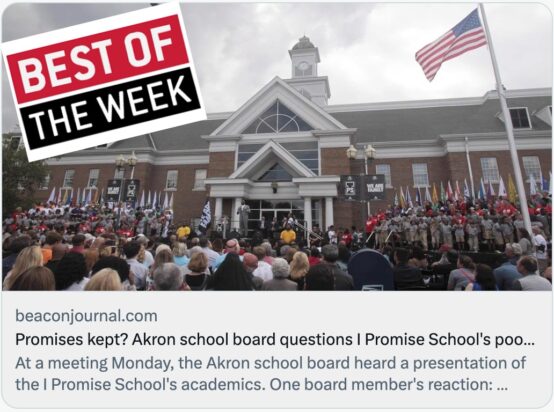
The best education journalism of the week is Jennifer Pignolet’s Akron Beacon Journal story Promises kept? Akron school board questions I Promise School’s poor test scores, which came out in late July but is still reverberating two weeks later.
Beginning with the startling revelation that none of this year’s 8th grade class had passed the state math test over the past five years, the piece takes a tough but fair-minded look at how students are faring at the much-celebrated Akron school created by hometown hero LeBron James.
As reported in the story, some comparable students who attend other Akron schools have scored better than kids who attend I Promise, which is focused on early intervention and wraparound social support services. But the results are mixed, and staff turnover has been a chronic problem.
In a perfect world, we’d learn more about attendance, enrollment, and student well-being. However, I appreciate the effort to find comparable results for similar students at other schools, to look past single-year test results, and to give context to the results.
A handful more great education stories:
🏆 Millions of kids are missing weeks of school as attendance tanks across the US (AP) See also EdSource, LA Times
🏆 Use a different address for your kid’s school placement? In some states you’ve committed a crime (USA Today)
🏆 Colleges Spend Like There’s No Tomorrow. ‘These Places Are Just Devouring Money.’ (Wall Street Journal)
🏆 St. Louis Schools Face One of the Steepest Post-Pandemic Climbs Anywhere (The 74)
🏆 How Social Media Apps Could Be Fueling Homicides Among Young Americans (ProPublica)
🏆 How a Sexual Assault in a School Bathroom Became a Political Weapon (NY Times Magazine)
🏆 How do we teach Black history in polarized times? Here’s what it looks like in 3 cities (Hechinger)
🏆$30 water bottles. $20 for paper. The sticker shock is real this school shopping season (LA Times)
RETHINKING GIFTED COVERAGE
Our latest columns and commentary
In this week’s new column, the Fordham Foundation’s Mike Petrilli argues that high-achieving students from disadvantaged backgrounds are among the most under-covered groups of kids out there — and that education reporters should reconsider the ways that gifted education is often described.
Petrilli praises coverage that rejects the frame “that gifted education and the like is inevitably inequitable,” including examples from The 74, the Wall Street Journal, and Education Week.
This is the third in an occasional series about coverage of gifted education that includes previous pieces from Inside Schools founder Clara Hemphill and independent education journalist Holly Korbey.
MAKING 2 SYSTEMS TALK
Coverage of promising school innovations & signs of progress
💡 This profile of a recent high school graduate who’s still entangled with the law is an uncommonly nuanced success story about how Colorado is trying to improve communication between education and criminal justice (Denver Gazette).
💡 This engaging but critical story about a “grow your own” teacher program targeting rural school employees like bus drivers and custodians follows well-depicted characters through their coursework but also acknowledges that such programs don’t yet have solid research behind them (Hechinger Report).
💡 A clear window into the messy world of enrollment decline, this piece details Indianapolis’s retention of a recruiting firm to make its public schools more attractive and features a debate about whether the money was wisely spent (Chalkbeat Indiana).
💡 Two beats — science and education — merge seamlessly in this story about a Bronx high school whose AP environmental science students are helping university researchers study air quality, a timely endeavor given the disproportionate impact of recent wildfire smoke on their neighborhoods (Palabra).
Read more about the importance of covering promising innovations and preliminary successes.

Above: The New York Times’ Erica Green (bottom right) moderated a panel on HBCUs at the NABJ23 conference in Birmingham, Ala., last week.
PEOPLE, JOBS
Who’s going where and doing what
🔥 Awards: NBC News’ Antonia Hylton, Mary Godie, and Eric Salzman won a Salute to Excellence Award from NABJ for their coverage of racist bullying in a Texas school district. And in case you missed it, the Washington Post’s Arelis Hernández and others won a Third Coast International Audio Festival award for their Post Reports episode “It started in the fourth grade building” about the Uvalde tragedy.
🔥 Career moves: Chalkbeat’s Matt Barnum is taking on a new role as interim national editor but assures his followers he’s still going to be writing and reporting regularly. Capital B News rural reporter Aallyah Wright was awarded a grant from Grist and the Center for Rural Strategies to report on the digital divide in rural, Black communities in Alabama, Georgia, and Mississippi. Congrats to both!
🔥 Job openings & opportunities: The Austin American-Statesman is looking for a higher education reporter. (DM previous reporter Megan Menchaca for more if you’re interested.) Check out previous editions of the newsletter for more jobs that may still be open.
Hot takes:
🔥 Chronic absenteeism in U.S. public schools has nearly doubled, according to researcher Thomas Dee, who says that the “magnitude, breadth, and implications” of the 6.5 million student increase “are sobering and merit serious national attention.”
🔥 The AP’s Annie Ma wrote a Twitter (X?) thread on a controversial piece in The Charlotte Observer about a high school volleyball player’s crusade against allowing transgender athletes to compete in girls’ sports, describing it as “lazy and harmful journalism.”
🔥 Researcher Vladimir Kogan criticized the lack of coverage of California’s attempts to muzzle two prominent Stanford professors, saying that the story “should be getting a lot more attention.” EdSource education reporter John Fensterwald tells us that the case is a clear free speech violation and a dangerous precedent. He urges everyone to “watch your states and districts to make sure the practice doesn’t spread.“

Above: Zeynep Tufekci’s New York Times piece on classroom air ventilation would be a “great story for (education journalists) to localize,” according to veteran journalist Linda Wertheimer.
APPEARANCES, EVENTS, & NEW RESOURCES
What’s happening and new research
⏰ Segments & podcasts: WMFE’s Danielle Prieur was on Friday’s Morning Edition talking about so-called nickname forms required to allow Florida teachers to call students by anything other than their given names. PBS’s Amanpour and Company featured a segment on Mississippi’s huge strides in education with the New York Times’ Nick Kristof. WBUR’s Here & Now ran a piece from North Country Public Radio’s Amy Feiereisel on high school students choosing trade schools over traditional colleges. And APM Reports’ Emily Hanford was on the Reach Out and Read podcast talking about efforts at changing literacy instruction.
⏰ Events: Next Thursday, Aug. 17, the Atlanta Journal-Constitution is hosting a virtual event on politics in the classroom with education reporters Vanessa McCray and Ty Tagami and a panel of experts. Join EdSource’s Betty Márquez Rosales and Anne Vasquez for a webinar on the sharp rise in chronic absenteeism on Aug 24. Mark your calendars for the EWA Higher Education Seminar Sept. 7-8 at the University of California, Riverside. And in case you missed it, Attendance Works held a webinar on Wednesday about ensuring kids show up to school post-pandemic.
⏰ Research: The Hechinger Report’s Jill Barshay looks into the research on the “Google effect” and its impact on education (hint: it’s not making students smarter). New research featured by PBS shows that moms lose more sleep than dads during the school year. New York University literacy education professor Susan Neuman says that “there’s tremendous consensus” about revamping literacy instruction among the 223 state laws she examined. And a new report in Available to All shows that parents who use an address other than their own to enroll their children in public school can be charged as criminals and even sent to jail in at least 24 states.
⏰ Resources: Denise-Marie Ordway of The Journalist’s Resource wrote a piece for the Global Investigative Journalism Network on ways that journalists can access academic research for free. Han Vu, a 2023 Reynolds Journalism Institute Student Innovation Fellow, is testing out the American Press Institute’s source tracking tool and finding some not-so-surprising results on who’s being quoted the most. Also for RJI, Ariel Zych makes the argument for hiring sensitivity readers in newsrooms.
THE KICKER

Congrats to CUNY journalism graduate student Amaya McDonald, who won NABJ’s Salute to Excellence Award for Collegiate Online News Reporting at the NABJ conference last week!
“I am honored to be recognized alongside so many other talented and deserving winners and nominees,” she tweeted.
ABOUT THE AUTHOR

The Grade
Launched in 2015, The Grade is a journalist-run effort to encourage high-quality coverage of K-12 education issues.