In the aftermath of the pandemic, a broader approach to school shutdown coverage includes family-focused priorities like daycare, food distribution, and special education services.
By Alexander Russo
Covering school system shutdowns is extremely difficult to do, regardless of whether they’re related to weather, disease, or labor negotiations. The disruption is immense. There’s a lot going on. Nobody’s particularly comfortable. Things can get heated.
Too often in the past, coverage of school system shutdowns related to labor negotiations has been abundant but not particularly helpful, focusing on district and employee priorities. The teachers and the district get nearly all the attention. The experiences of families — students, parents, and caregivers — are downplayed.
But as I’ve written in the past, school system shutdowns aren’t just about administrators and staff. Parents and kids are equally important, even if they’re not at the bargaining table, holding events, or shaping decisions.
So you can imagine my surprise to see a small but noticeable shift in the coverage of last week’s three-day shutdown in Los Angeles. Striking school staffers got the attention they deserved. But parents and children received much more coverage than in the past.

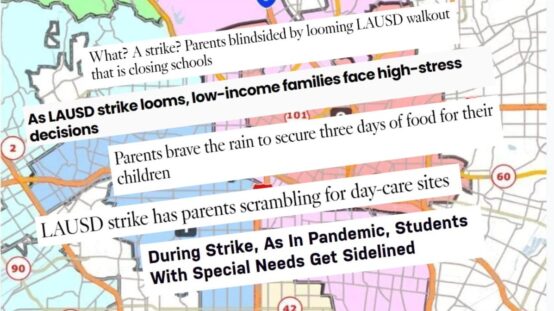
Above: Parent- and family-focused school shutdown coverage from the LA Times, LAist, and the LA Daily News.
Last week’s shutdown was somewhat atypical because it was brief, planned ahead of time, and called by the union representing school staff rather than teachers. But it was also a dry run — one editor called it a “stress test” — for future shutdowns.
If and when schools shut down again, I hope that the LA coverage will serve as a new, more inclusive model.
If and when schools shut down again, I hope that the LA coverage will serve as a new, more inclusive model.
Now under the leadership of section editor Stephanie Chavez, the LA Times education team (and other reporters) produced a number of high-quality stories about last week’s school shutdown, gathered together in a single location.
The breaking news and notable events were all well covered, including offers and counter-offers between the district and the union representing classified staff, who are notoriously under-appreciated and under-paid.
But the LA Times coverage was much broader than what you might have seen in the past. In particular, there were a lot of LA Times stories focused on the needs and experiences of LAUSD parents, focused on food, daycare, and other family-related priorities.
One focused on food shortage challenges for families that usually rely on schools for their children’s meals. Another featured how surprised and dismayed some parents were finding out that the strike was really going to happen. The scramble for day care was a big theme in the LA Times coverage, even before the strike began. As were the child-care spots that the district promised in the runup to the strike, which turned out not to be as plentiful or as easy to acquire as hoped.
There were a lot of LA Times stories focused on the needs and experiences of LAUSD parents, focused on food, daycare, and other family-related priorities.
In all, I count 26 stories between Wednesday, March 15 (the week leading up to the strike), and Saturday, March 24 (when the SEIU and the district came to an agreement). All together, it’s an impressive lot, not just in terms of quantity but also breadth.
“What was most important for us to emphasize in our coverage was that we really needed to put a face on these essential workers,” said Chavez in a recent interview. Her goal in making parents’ experiences so prominent was “to explain the impact and reach of the strike on those who are also greatly affected.”
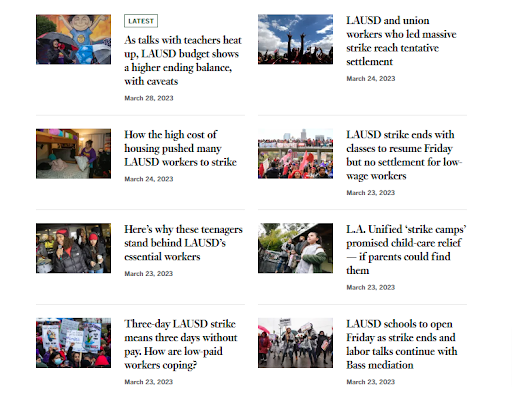
Above: A sampling of the LA Times’ recent coverage.
Nobody covered the story as thoroughly as the LA Times. But there were some other notable outings from local outlets, which include the LA Daily News and KCRW.
The education team at LAist (formerly known as KPCC) probably came closest to matching the LA Times’ output, even though it’s down a lead reporter right now.
“We wanted to know what readers needed: what their level of communication was from the school and district, and where they were getting their news from,” said LAist education editor Ross Brenneman about the team’s coverage goals were.
But the team also wanted to know how well the district was going to perform, given past experiences during the pandemic. Brenneman called the three-day strike a “stress test” for any other closure that might happen again in the future — another strike, perhaps one that lasts longer, or even another pandemic.
LAist’s coverage featured a helpful explainer about limits on the district’s $5 billion budget reserve, which was a bit of a topic of confusion. Far as I saw, LAist was also the only outlet to put out a story explicitly linking the recent shutdown to the pandemic. The district struggled to provide services to special education students during the pandemic, and it struggled again last week. This seemed like a smart connection, given that we’re just past the third anniversary of the pandemic.

Above: A sampling of LAist school shutdown coverage.
It’s a balancing act, covering a massive shutdown like last week. There’s no perfect way to do it. It’s tough to depict all the different experiences and perspectives. I don’t want superficial coverage that makes one group or another into villains or heroes. And I don’t want coverage that focuses narrowly on the back and forth, focusing on press conferences and personality conflicts.
So last week’s effort from local education teams shows some promising progress when it comes to evening out the coverage between politics, educators, and families. My hope is that this kind of broader approach is applied in future strikes and in other places where schools shut down.
Previously from The Grade
Cover teachers unions like you cover school districts (2022)
New York City 1968 wasn’t a teachers strike; it was a community insurrection (September 2018)
What really happened in Chicago? (2022)
Untold stories behind the Chicago teachers strike (October 2019)
How to cover a protest (December 2019)
Much-improved coverage of the Los Angeles teachers strike (January 2019)
Teacher strike coverage illustrates need to amplify parent, student voices (August 2018)
ABOUT THE AUTHOR

Alexander Russo
Alexander Russo is founder and editor of The Grade, an award-winning effort to help improve media coverage of education issues. He’s also a Spencer Education Journalism Fellowship winner and a book author. You can reach him at @alexanderrusso.
Visit their website at: https://the-grade.org/