In this week’s newsletter: A boost for literacy coverage. The special vibe of classroom-based stories. How schools handle an influx of migrant kids. Pushback against right-wing school board takeovers. AP snags a top Washington Post reporter. And a front page about Harvard signals the death of local news.
LITERACY BOOST
The big story of the week
The big education story of the week is state and local efforts to revamp literacy instruction.
How’s it going? Will it take root? Those are some of the big questions in cities and districts like New York City, Portland (Ore.), Anne Arundel County (Md.), and Dayton (Chalkbeat, NY Daily News, Baltimore Banner, Dayton Daily News) as well as states like Massachusetts and Indiana (Boston Globe, Indiana Capital Star) that are contemplating policy changes. Meanwhile, a widely used reading assessment is being discarded in places like San Francisco (APM Reports).
The odds are stacked against major improvements. Nobody can predict whether these changes will succeed. But there’s little argument that reading is a core function of schools, or that the implementation of literacy reform is one of the biggest stories in education. There’s room for more education teams and outlets to step up and cover this story with the depth and frequency it warrants.
Other big stories of the week:
📰 LOOMING CUTS: Federal ESSER funds will run out next year, and some districts are already making tough choices to account for it. San Francisco Public Schools announced it will likely cut 900 jobs (San Francisco Chronicle). Boston might have to lay off 600 staffers (Boston Globe). LAUSD will enact a hiring freeze and floated the idea of school closures (LA School Report, Los Angeles Daily News). In other parts of the country, state aid is set to kick into gear and offset the loss of the federal aid (Boston Globe). Meanwhile, some district budgets are already stretched thin due to inadequate state funding (Houston Landing, Colorado Sun) and missing FEMA checks (NJ.com).
📰 MODERATES FIGHT BACK: Moms for Liberty and their ilk are facing pushback from more moderate parents — and grandparents — in Idaho and other parts of the country (Vanity Fair/Hechinger Report, The 19th, KERA Texas). How’s that for a counter-narrative?

MIGRANT INFLUX
The best education journalism of the week
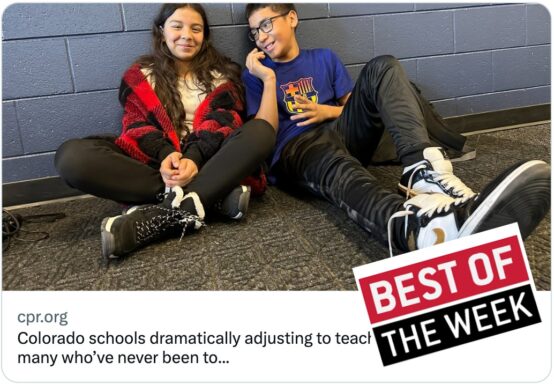
The best education story of the week is Jenny Brundin’s Colorado Public Radio story, Colorado schools dramatically adjusting to teach migrant students – many who’ve never been to school before. NPR aired a shorter version of the feature last weekend.
Roughly 5,000 migrant kids have entered Colorado schools since the summer, and Brundin’s seven-minute story focuses on one Denver school facing an influx of more than 100 additional unexpected students this year.
The school is set up to work with newcomer students, but it needed more bilingual teachers and new offerings to work with kids who haven’t been in school for at least two years. Art and PE teachers who lacked Spanish-language skills struggled, as did students who are far behind in learning to read or do math.
It’s a dynamic story full of sounds and voices — in English and Spanish — and vignettes from the students’ journeys to the U.S. Students’ hopes and dreams are included, along with their struggles.
Other great education stories this week — and why we liked them:
👏 A heartbreaking story from Christopher Peak uses careful pacing to capture the uneasy feeling of a mother discovering that her son’s school district is failing to accurately measure his reading progress (APM Reports). KQED’s Brian Watt also interviewed Peak.
👏 While many families look forward to winter break, Jenny Gold’s detailed piece depicts some families’ struggles to provide three weeks of childcare and meals (Los Angeles Times).
👏 Former teacher Emily Piper-Vallillo revisits the classroom to describe new efforts to make it easier and less costly for paraprofessionals to become special education teachers (WBUR).
👏 Offering a new angle on the immigrant student story, Rommel H. Ojeda and Giulia McDonnell Nieto del Rio speak with enthusiastic players and inspiring coaches at a popular soccer academy in Long Island City (Documented).

Above, left to right: Hechinger Report’s Christina Samuels, the Boston Globe’s Naomi Martin, and Chalkbeat’s Kalyn Belsha.
CLASSROOM VIBES
Our latest columns and commentary
There’s “a certain vibe” that reporters get when they visit school hallways and classrooms, writes contributor Will Callan, who talked to three education journalists about how they get access, what to do when reporting inside a school, and the importance of engaging with students.
Being on campus is different from relying on a telephone call or video interview, or even a sit-down conversation. The stories that result from in-school reporting “portray students as real people with distinct personalities and important opinions,” Callan writes.

Above: Veteran education reporter Moriah Balingit shared this adorable baby pic in which she’s roughly the age of the kids she’ll soon be covering for the AP.
PEOPLE, JOBS
Who’s going where and doing what
🔥 Career moves: Moriah Balingit is moving to the AP from the Washington Post, taking on a new early childhood beat. “What a get for the AP,” noted the New York Times’ Erica Green. Chalkbeat Colorado bureau chief Erica Meltzer is moving over to the national team as an editor. Reporter Melanie Asmar will take over her old position and continue to cover Denver schools as well. Meanwhile, Jeremy Bauer-Wolf is leaving Higher Ed Dive after more than four years covering college admissions, leadership, and policy.
🔥 Sound off:
“I will go on the record in disagreeing with this analysis,” the Hechinger Report’s Jill Barshay tells us about a recent New York Times op-ed downplaying U.S. test score results. “It’s a bit like saying our homeless crisis isn’t so bad here because there are even more people without shelter elsewhere in the world.” Barshay’s take on the results is here.
“Our love of iconoclasts privileges the voices of skeptics,” writes Ed Yong in a New York Times op-ed that is full of insights relevant to education coverage. How different would coverage be if the beat was reconceived as being part of a care-taking profession?
“As student journalists, we really are the people who are experiencing these debates firsthand. We are the people who are walking by the protests when we occasionally go to class and aren’t purely writing for the newspaper,” said The Daily Pennsylvanian co-news editor Molly Cohen in a Vanity Fair article praising student journalists for their excellent coverage of campus antisemitism scandals.

APPEARANCES, EVENTS, & NEW RESOURCES
What’s happening and new research
Above: A striking data visualization shows the slow rate that kids are catching up from the pandemic inThe 74’s 14 Charts that Changed the Way We Looked at America’s Schools in 2023.
⏰ Appearances: APM Report’s Christopher Peak appeared on KQED to talk about his story on the flawed Benchmark Assessment System reading test. K-12 Dive’s Kara Arundel was a guest on the Education Gadfly Show podcast where she talked about private school choice in D.C. AP’s Cheyanne Mumphrey talked about the College Board’s African American AP class on NBC Washington. And The Markup’s Tara García Mathewson stopped by Tech News Weekly to talk about her investigation into how colleges track students.
⏰ Podcasts, documentaries, & segments: The New York Times’ The Daily covered the antisemitism and free speech controversies happening on college campuses. The Bell and Chalkbeat New York are officially launching a new youth-led podcast about NYC schools — and they’re looking to hire an executive producer. And ProPublica took a look at the new documentary “Uprooted,” about how university expansion and eminent domain led to Black land loss.
⏰ Year-end rankings: Cheers to St. Louis Public Radio’s Kavahn Mansouri and Kate Grumke and the Detroit Free Press’ Lily Altavena for being named in Mike McShane’s annual list of great education writing. A podcast about the troubled history of the Alabama Industrial School for Negro Children gets an honorable mention in Vulture’s best podcasts of 2023. Stories about school shootings and the New York Times’ story about “the Instagram account that shattered a California high school” are featured on Chartbeat’s most engaging stories of 2023. And Edutopia is out with its 10 most significant education studies of 2023, highlighting research ranging from AI’s role in the classroom to how to improve student writing.
⏰ Events: The LA Times hosted a panel event on preschool behavior and expulsion, and you can read their five takeaways here. The Aspen Economic Strategy Group hosted an event on the economic impacts of pandemic learning loss and the solutions to address it, including high-dosage tutoring. Watch the replay here. EWA hosted a webinar earlier this week on the promises and pitfalls of teaching during out-of-school time. And coming next year, the organization Brown’s Promise announced it will be presenting at SXSW EDU about the legacy of Brown v. Board of Education.
⏰ Research & reports: A report from Education Reform Now CT shows that efforts to hire a more diverse teacher workforce in Connecticut are not keeping up with the student population, widening the diversity gap (CT Mirror). Connecticut has among the highest diversity gaps in the country (District Administration). A new Stanford study showed that fears about ChatGPT fueling a big increase in cheating were overblown (New York Times). And another new study showed that students who learned remotely during the pandemic reported lower academic self-efficacy and school connectedness as well as higher cigarette use.
THE KICKER

“I can think of little that’s less relevant to residents of Thibodaux, LA,” wrote former journalist Richmond Eustis in a tweet accompanying the image of a local newspaper. “This is what happens when you gut local reporting.”
That’s all, folks. Thanks for reading!
Reply to this email to send us questions, comments or tips. Know someone else who should be reading Best of the Week? Send them this link to sign up.
Using Feedly or FlipBoard or any other kind of news reader? You can subscribe to The Grade’s “feed” by plugging in this web address: http://www.kappanonline.org/category/the-grade/feed/.
Read more about The Grade here. You can read all the back issues of The Grade’s newsletter, Best of the Week, here.
By Alexander Russo with additional writing from Colleen Connolly and Will Callan.
ABOUT THE AUTHOR

The Grade
Launched in 2015, The Grade is a journalist-run effort to encourage high-quality coverage of K-12 education issues.