In providing remote learning to students, charter school challenges mirror those of district providers.
By Stephen Ruiz
Remote learning that’s being provided by districts to more than 50 million traditional public school students has received substantial attention from the media since schools shut down in March.
However, much less coverage has chronicled the impact of the shutdown on the 3.1 million charter students and the quality of the remote learning that they have been receiving.
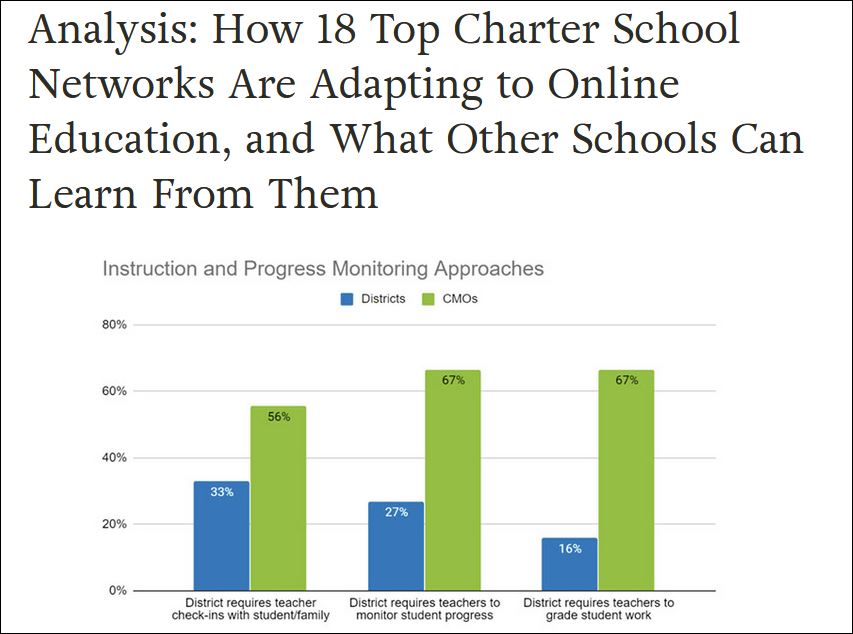
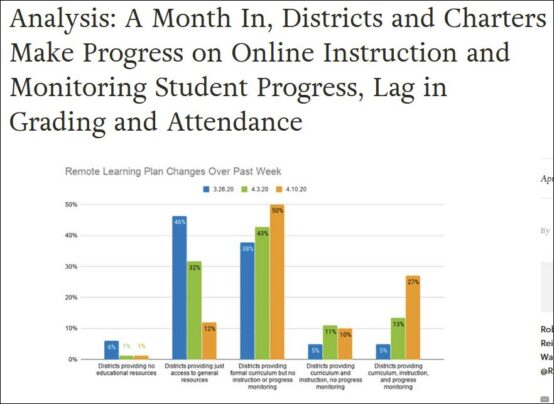
Above: Since early April, database created by the University of Washington’s CRPE has charted the response of 18 charter management organizations to the COVID-19 crisis (in green), and compared it to the district response (in blue). Published in The 74.
There are some key differences between how charters and district schools are serving students during remote learning.
While discouraging direct comparisons between charter and district schools, CRPE editorial director Travis Pillow said charters in CMOs tended to follow students’ academic progress more closely.
The CRPE database shows that 78 percent of the reviewed CMOs produced feedback on student work and required teachers to check in, and 56 percent tracked attendance. More than two-thirds graded some students. Roughly half graded all students.
While discouraging direct comparisons between charter and district schools, CRPE editorial director Travis Pillow said charters in CMOs tended to follow students’ academic progress more closely.
And, according to the National Alliance for Public Charter Schools (NAPCS), 20 percent of charter schools students attend schools in “low connectivity tracts,’’ compared to 13 percent of traditional district school students.
In other areas, charter school operators report having some advantages over district providers. For example, they don’t always have to worry about providing meals for students during their shutdown, instead directing learners to get free breakfast and lunch items at public schools.
Students’ families were given a list of zoned schools in the county where they could receive free meals, said Michelle Nunez, the principal at the Galileo School for Gifted Learning in Sanford, Fla. If those meals aren’t sufficient, “we do our collections of [food] and deliver to those families in need over and above what they would get at the meal sites,’’ Nunez said.
Chicago charters also follow this model, relying on the district for meal distribution.
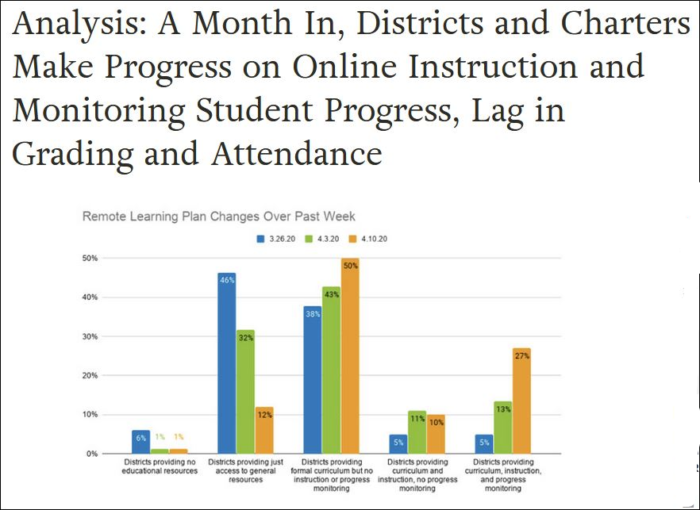
Above: In an April 21 follow-up published in The 74, CRPE highlighted progress and challenges for district and charter school remote learning programs.
Overall, however, the challenges facing charter school operators and families mirror those of district schools and families.
“I don’t think the problems our families are facing are much different than the ones traditional families are,’’ Nina Rees, president and CEO for NAPCS, told The Grade in a telephone interview. “If you have one laptop, that’s a problem.”
“I don’t think the problems our families are facing are much different than the ones traditional families are,’’ Nina Rees, president and CEO for NAPCS, told The Grade in a telephone interview. “If you have one laptop, that’s a problem.”
Like district schools, charter providers have made efforts to provide devices and internet access to students who need them. In Chicago, partnerships with Xfinity and other companies increased Wi-Fi access, said Ariel Johnson, director of government affairs for the Illinois Network of Charter Schools. “Making sure all students have devices has been one of the bigger challenges,’’ Johnson said.
Johnson admitted the degree of instruction that students receive through remote learning is not the same as they would under normal circumstances.
“It’s not going to be the same level of instruction as directly in a classroom eight hours a day, but we have to be OK with that as much as we can,’’ Johnson said. “We’re all trying to figure out how to get kids as much education as possible but also remembering constraints that parents are under … and constraints teachers are under to deliver the same type of lesson via virtual learning.’’
Charter or public, some students still have trouble making the transition to learning online, said Chris Baehrend, chair of the Chicago Teachers Union’s charter division. He called charters’ efforts on remote learning “uneven.’’
Disclosure: While retaining sole control over content and all editorial decisions, The Grade is supported by foundations and nonprofits including the National Alliance for Public Charter Schools. Read more about its funders here.
Previous coverage:
20 days and counting: extended downtime for big-district students
Four hours a day; how teacher contracts are shaping remote learning
What reopening schools is going to look like
The COVID database everyone’s relying on
Grading remote learning students; too vulnerable to fail?
ABOUT THE AUTHOR

Alexander Russo
Alexander Russo is founder and editor of The Grade, an award-winning effort to help improve media coverage of education issues. He’s also a Spencer Education Journalism Fellowship winner and a book author. You can reach him at @alexanderrusso.
Visit their website at: https://the-grade.org/