
Before the curtain rises on the school year, the newest teachers should have practiced time and again what they will encounter their first days of school.
Rookie teacher Noel Borges is taking the reins of a middle school class for the first time. Like many an eager new teacher, he stands before his students with equal parts purposefulness and trepidation.
Yet this is no ordinary middle school class Borges is about to teach. For one thing, it’s not September, but mid-August. And for another, the “students” aren’t middle school students at all: They’re the 10 other rookie teachers joining middle schools in his network this fall, led by principal Serena Savarirayan.
Borges begins his first greeting to his students. “All right, I need everyone to look at me in 3, 2, 1 . . . I need Marcellus’ eyes . . . 1,” he tells them. “Excellent. All right, good morning, class. I need all of you to immediately take your seats, quietly, and begin the morning activity, which is on your desks. You will have four minutes.”
Savarirayan asks him to pause. “Try that same thing again,” she says, “but with fewer words. Just say, ‘Eyes up here, morning activity’s on your desk, let’s go.’ Fewer words, shorter amount of time.”
Borges nods and starts again. “Eyes up here!” he begins, much more confidently. “Excellent. I need everyone to sit down and start your activity. You have four minutes.” Borges’ students file in and begin their activity.
The summer professional development (PD) session that we just witnessed was the dress rehearsal for Borges’ real first day of teaching. In many other industries, such a rehearsal would be considered natural. Actors would never perform a play without running it successfully many times before opening night. Surgical residents would not perform surgeries until they practiced and mastered each detail of preparation, such as how to remain sterile while getting dressed for the operating room. Teachers need the same thing — especially rookies. Getting them to practice teaching in advance makes the difference between accepting them as they come to us or making them better.
The first choice, to be sure, is more common. Deborah Ball and Francesca Forzani underscore in an American Educator (2011) article that it’s common practice in the United States to focus more on hiring “better” teachers up front than on guiding teachers as they dive into their work. But that choice, Ball and Forzani say, is a gamble: It bets each teacher’s actual success in the classroom on qualifications that don’t necessarily mean he or she is a “better” teacher.
If we don’t coach our rookie teachers, at least one of them will fail. For our students, that’s one too many.
Savarirayan is not a gambler. Her rookies are all intelligent, capable, and qualified. And she knows that if she doesn’t show them what to do when the curtain goes up, at least one of them will fail. And for her students, that’s one too many.
Let’s get behind the scenes of Savarirayan’s summer PD. First, we’ll see which skills are the most powerful for new teachers to build before they meet students. Then, we’ll examine Savarirayan’s process for making sure every rookie learns them.
Setting the stage for success
The New Teacher Project (2013) recommends focusing new teachers’ growth on the basics by narrowing the focus to no more than 10 essential competencies that first-year teachers can practice and improve quickly. The intent is to avoid the trap of overwhelming rookie teachers with everything they need to know and to be able to do to be a master teacher, with the result often being that they don’t know where to begin.
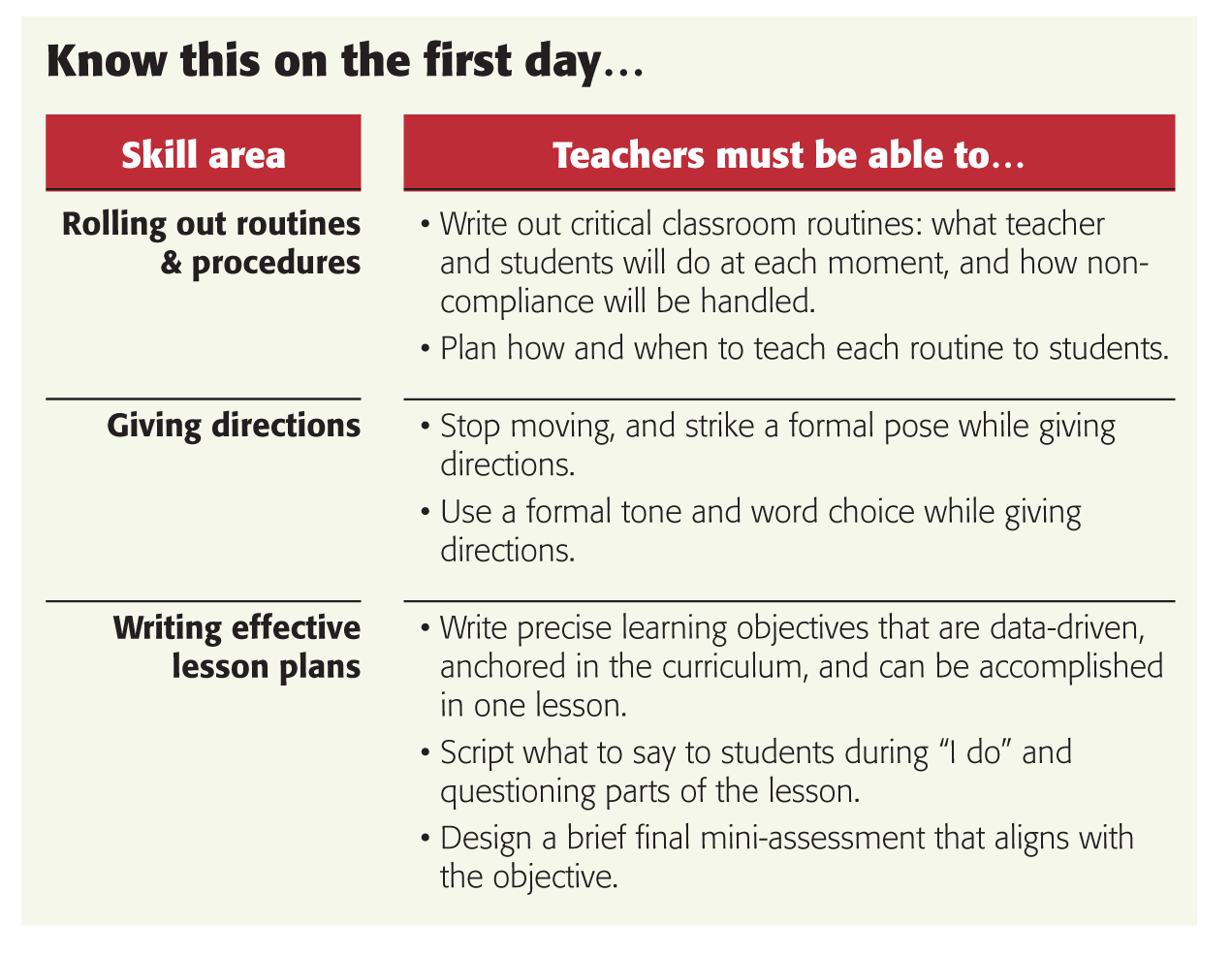
This is especially true when it comes to summer PD — except that since the PD takes place over such a short period of time that you need to keep your list of essential competencies even shorter. Here are three skill areas that Savarirayan has found most fruitful to cover during her summer. (See chart above.)
Savarirayan’s list of skills to teach during summer PD is brief and focused, but it’s still ambitious. How can you and your rookie teachers cover that much ground in the time you have for summer PD? The answer: many opportunities to practice.
Avoid the trap of overwhelming rookie teachers with everything they need to know and be able to do to be a master teacher. Too much information often means they don’t know where to begin.
Think back to the moment we witnessed earlier when Borges role-played his first greeting to his students. What if, instead of facilitating a role play, Savarirayan had simply delivered a PowerPoint presentation on giving students directions? What if she had shown a model of effective routines and then just asked teachers to plan on their own? Even if she had specified that directions should include as few words as possible, Borges would never have done what Savarirayan was describing, and he wouldn’t have actually known what words to use when addressing students for the first time. Practice is how Savarirayan’s rookies are able to learn more skills in a shorter amount of time and, by extension, become better teachers faster.
Here’s how Savarirayan sums up her approach to facilitating practice with her rookie teachers:
Practice it correctly multiple times. In performing arts, there are many dress rehearsals, not just one. The actors need to practice successfully more than once to be able to replicate that success before an audience. Getting a rookie teacher to practice something just once correctly isn’t effective, either. Multiple strong run-throughs are necessary for real learning to happen.
Rehearse success first; then, add the challenge. After Borges has perfected his greeting to students, Savarirayan may have him do it again with some of his fellow rookie teachers playing the parts of disruptive students. But first, she has to make sure he learns how to deliver a great greeting unchallenged.
Go granular. Consider the specificity of Savarirayan’s feedback to Borges: Reduce the number of words in his greeting. Why sweat something that small? Because every detail your rookies can get right in August makes them more likely to succeed with the added challenge of students in September. If Borges knows how to deliver his greeting succinctly, warmly, and effectively, he’ll almost certainly be able to do it on the first day of school — no matter what unforeseen circumstances arise when he meets students the first time.
Lights, camera, action
As Borges’ fellow rookie teachers move to their desks, Savarirayan joins them in pretending to be one of Borges’ students. She shakes Borges’ hand at the door, just as everyone else has. “Good morning Serena,” Borges says. Then he follows her inside, taking his place, for the first time, at the front of the classroom.
Just a few weeks later, Borges did all of this again with real students. He knew what to do when they talked out of turn and how to tell when they misunderstood concepts. He knew how to hold their attention, welcome them into his classroom, and get them to start learning. This year may be Borges’ first year of teaching, but Savarirayan made sure that from his first day in the classroom, teaching was happening.
References
Ball, D.L. & Forzani, F.M. (2011, Summer). Building a Common Core for learning to teach, and connecting professional learning to practice. American Educator, 35 (2), 17-21, 38-39.
The New Teacher Project. (2013). Leap year: Assessing and supporting effective first-year teachers. Brooklyn, NY: Author. http://tntp.org/assets/documents/TNTP_LeapYear_2013.pdf
Citation: Bambrick-Santoyo, P. (2013). In practice| Leadership: Rookie teachers need dress rehearsals, too. Phi Delta Kappan, 95 (2), 72-73.
ABOUT THE AUTHOR

Paul Bambrick-Santoyo
PAUL BAMBRICK-SANTOYO is managing director of Uncommon Schools, Newark, N.J., and author of Great Habits, Great Readers: A Practical Guide to K-4 Reading in Light of the Common Core .