Despite recent progress, we need more parent voices and more varied parent viewpoints in education coverage. Part of a new series.
By Alexander Russo
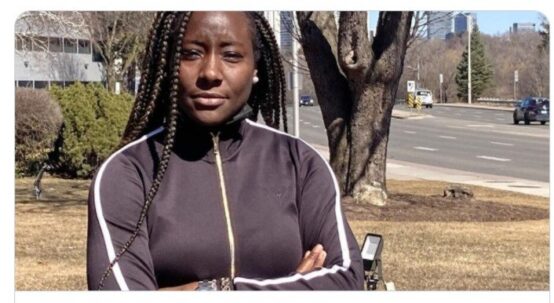
Towards the end of a recent panel hosted by the Education Writers Association, the Powerful Parent Movement’s Sarah Carpenter shared some sharp views about how journalists too often rely on school districts to tell the story of what’s going on in schools:
“Everybody tells our story except for us. And we need to tell our own story,” said the Memphis-based grandmother. “We need you all to get our story out there about what’s going on — what’s really going on, not just the district.”
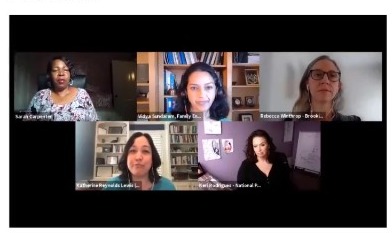
Above: You can watch a replay of the panel, thanks to EWA, or read the transcript.
But the panel conversation wasn’t enough, she told me afterwards.
“I felt like it was kind of dressed up, like the real story wasn’t told,” said Carpenter in a phone interview. “I’m used to telling the truth about things, and I felt like I just hadn’t gotten the opportunity.”
So she wrote an open letter to education journalists, a searing indictment of media coverage that tends to dismiss caregivers rather than treating them as core subjects:
“Don’t write about us until you’ve talked to us,” wrote Carpenter. “You are powerful and, as a result, you are either a part of the problem or a part of the solution.”
How and when to include parents in education coverage is a pressing challenge for education reporters as schools finish out the year and begin to announce plans for 2021-22. Which parents? What voices? Where to find them? There are no easy answers. No two parents may see things quite the same way.
What seems clear, however, is that parents are clamoring for a stronger voice in education decisions about their children’s schooling, and that media coverage must change to reflect their growing roles more regularly and with greater depth.
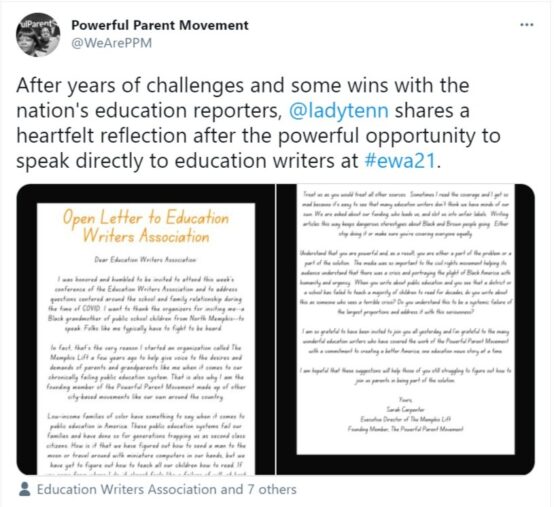
Above: An open letter to education writers
I was hoping that the Carpenter letter would prompt a healthy public discussion among education journalists about the role of parents in education news coverage.
In its urgency and focus, it reminds me of the 2015 admonition from Nikole Hannah-Jones to education journalists: “I write about school segregation because I must. Because we all must.”
So far at least, that hasn’t happened.
Some reporters have written articles about parents’ views on schools in the past few weeks. US News’ Angry White Parents is a notable example. The Atlanta Journal Constitution’s Kristal Dixon wrote Parents demand Cobb schools remove student mask mandate just last Friday. But best as I’ve been able to discern, they have not addressed the letter publicly.
Still, the panel and the open letter have produced a handful of reactions:
One reporter responded to the letter with some self-reflection on the dynamics between him and many of his sources.
“What’s obvious even from just a year in this field is that, especially covering schools, the folks writing the stories by and large do not look like the characters and stakeholders being written about,” The 74’s Asher Lehrer-Small told me on Twitter. “That means that reporters like me have blind spots and need to work to overcome them.
“Some of what I consider my best stories have come when conversations with sources helped me realize there were voices I hadn’t previously thought to include,” wrote Lehrer-Small. “I have work to do to combat my own biases, and using that recognition as my starting point has been helpful…”
Another education reporter has engaged with parent advocates about the lack of parents in one of his pieces:
“What parent that has opted out of St. Louis Public Schools was quoted in this piece?” asked the Powerful Parent Movement Twitter account about a recent Ryan Delaney story for St. Louis Public Radio. “What parent w/ a child that falls in the 88% of children not reading at grade level was quoted? #DontWriteAboutUsWithoutUs.”
“I don’t disagree and will try to be better next time,” responded Delaney. “While there are two people in this story who are parents, they’re not ones who have ‘opted out.’ Thanks for pushing me to improve!”
“Thanks so much for engaging, Ryan,” responded the PPM account, which is run by Vesia Hawkins. “Who are the parents you’re referencing? Are they board members quoted as board members? If so, that doesn’t count. They’re showing up first and foremost as district reps. This is a constant battle for us.”
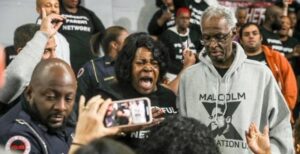
Above: Parent protesters including Sarah Carpenter disrupted Elizabeth Warren’s speech in Atlanta.
The Powerful Parents Movement’s Carpenter is not alone in being concerned about the lack of focus on parents, and the implicit narrative in some of the coverage that’s being produced.
“While I have seen more coverage of families especially during the pandemic, when I see coverage specifically about student learning (e.g. learning loss, test scores, etc.), I do not typically see parents’ perspectives featured prominently,” EWA panelist and Family Engagement Lab head Vidya Sundaram told me via Twitter.
“The subconscious narrative that may result is ‘Kids were home, kids don’t learn at home, and the achievement gap is growing because families experiencing economic hardship or families of color aren’t capable of supporting their kids’ learning.’”
How to cover parents is a challenging issue whose complexities have come up in the past.
There are some bright spots, however. Carpenter praises the Memphis-based Commercial Appeal reporter Laura Testino for regularly reaching out for parent voices. The Christian Science Monitor’s Sara Miller Llana recently wrote a powerful piece called Racism in schools, and a group of mothers battling for respect.
More and more education reporters are featuring parent (and even grandparent) voices in their stories. But more still needs to be done before parents are reliably included in stories about their kids and the schools that they’ve chosen to educate them.
Up next in this series: Ways to find and include more parents in your coverage, and what makes parent-centered education journalism so powerful and important.
RELATED FROM THE GRADE
An open letter to education writers (Sarah Carpenter)
Nice White Parents: a different way of covering school inequality
Teacher strike coverage illustrates need to amplify parent, student voices
New York City 1968 wasn’t a teachers strike; it was a community insurrection.
No, asking questions about remote learning isn’t ‘teacher bashing’
ABOUT THE AUTHOR

Alexander Russo
Alexander Russo is founder and editor of The Grade, an award-winning effort to help improve media coverage of education issues. He’s also a Spencer Education Journalism Fellowship winner and a book author. You can reach him at @alexanderrusso.
Visit their website at: https://the-grade.org/