Kappan has long been a forum for discussion of education policy, so it only makes sense that we would seek to inform our readers on how politics affect what happens in schools. Today, we do much of that work through Maria Ferguson’s Washington View column, as well as other policy-related features, but from 1980 to 2012, we made a deliberate effort to get readers up to speed on what presidential candidates had to say about education.
In October 1980, this involved asking a series of questions, to which only Democratic candidate Jimmy Carter, then running for reelection, responded. Freelance writer Shirley Boes Neill wrote a summary of Ronald Reagan’s positions, drawing on his record as governor of California. In most years, however, the candidates or their campaign offered a few pages laying out their education agenda. These articles were usually presented as part of a package, with freelance writers George R. Kaplan (1984, 1988) or Denis Doyle (1992, 1996, 2000, 2004, 2008) providing
an overview of the landscape.
The education presidents
In the first election package of this type, George R. Kaplan (“Hail to a chief or two: The indifferent presidential record in education,” September 1984) stepped back to look at how the presidency had, in recent decades, affected U.S. education policy. His conclusion? The presidency hadn’t done much for education. Kaplan noted that “Education’s pipeline to the Oval Office has always been cracked and leaky” (p. 10) and that few presidents took enough of an interest in education to warrant the title “Education President”:
With rare exceptions, the range and intensity of Presidential involvement in education have been so negligible as to render comparison among Presidents futile. The bully pulpit has seen almost no sustained service in the interests of education, whether connected to federal responsibilities or not. Only a small percentage of our chief executives have backed their rhetoric with hard cash. The idea that the U.S. could ever have an Education President — let alone two within a generation — would have drawn catcalls throughout much of our history. (p. 7)
In Kaplan’s view, Thomas Jefferson, Lyndon Johnson, and Ronald Reagan were the only presidents who could really call themselves education presidents. Jefferson earned the title by bringing education into the federal spotlight, although it was, as Kaplan observed, “two centuries too early” (p. 8). Johnson did so by pouring money into schools to support equity and access through the Economic Opportunity Act of 1964, which included Head Start, the Elementary and Secondary Education Act of 1965, and the Higher Education Act of 1965. And Reagan used his position to influence public opinion about schools, although his positions regarding, for example, school discipline were often not palatable to educators and not supported by the best research.
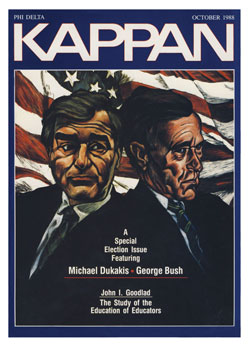
Four years later, however, Kaplan (“New beginnings, new limits: Education and the 1988 presidential election,” October 1988) noted that Reagan had more or less abandoned the role of education president after November 1984, when he won reelection in a landslide victory against Walter Mondale, and much of his education agenda had not held up. Federal spending on education had increased, the Department of Education hadn’t been eliminated, and prayer hadn’t been returned to school. Yet Reagan’s influence wasn’t totally lost: His secretary of education, William Bennett, had emerged as a major presence, and 1983’s A Nation at Risk report had made students’ dismal academic performance a point of national concern.
In the same article, Kaplan identified both Bill and Hillary Clinton, then the governor and first lady of Arkansas, as potential heads of the Department of Education if Michael Dukakis were elected. In fact, he said “the Clintons could prove to be the Democrats’ answer to the Republicans’ versatile duo, Robert and Elizabeth Dole” (p. 126). However, George H.W. Bush won the 1988 election, and that alternate history never had the opportunity to come to fruition. But Kaplan was prescient about the Clintons’ potential as a major political force.
Records and rhetoric
When Bill Clinton first ran for president, his pitch in Kappan (“The Clinton plan for excellence in education,” October 1992) touted the record in Arkansas that brought him to Kaplan’s attention in 1988. In that respect, Clinton was not so different from other candidates. Former governors, vice presidents, and presidents running for reelection all used their space in Kappan to share what they’d accomplished. In October 2000, George W. Bush wrote (“Gov. George W. Bush’s plans for education in America”) about his success reforming education while governor of Texas, a success that he hoped to replicate at the federal level while still enabling states to retain control of their schools. In the plan he presented in Kappan to tie Title I funding to results of tests selected and administered by states, we can see the beginnings of No Child Left Behind.

Former governors like Clinton and Bush tended to have more specific accomplishments to point to in their initial runs for president. These specifics were welcome because, without them, the candidate statements tended to cover similar ground, the main difference being in emphasis. Again and again, candidates of both parties wrote of the importance of preschool education, the need to boost student achievement (often specifically pointing to the STEM subjects), the lack of equitable opportunities, the value of excellent teachers, the role of standards, and so on.
A few candidates had areas of special interest that were unique to them, however. In his September 1984 article (“Excellence and opportunity: A program of support for American education”), Reagan said that he wanted to bring God back to schools in the form of daily prayer and the teaching of moral values. Most of the time, however, the differences between candidates were less clear, requiring voters to read between the lines. For example, most candidates endorsed some form of school choice, but Democrats tended to decry offering vouchers for private school tuition and to praise public magnet and charter schools, while Republicans took a more expansive view of potential choice options that the government should fund. And Republican candidates consistently wrote of the importance of state and local governance of education, while this was less of a concern to Democrats.
In general, candidates of both parties were ready and willing to provide school funding at the federal level, but again, there are nuances in their rhetoric. In October 1992, George H.W. Bush (“A revolution to achieve excellence in education”), then running for reelection, pointed out that his administration had actually increased funding to education while making it clear that the federal pocketbook would not necessarily remain open if schools did not deliver:
No one has suggested to me that this [increased funding] was a misguided commitment, that we were spending too much on our schools, or that education is not important.
At the same time, many are legitimately concerned with what that additional expenditure has produced. Like me, they are concerned about results. (p. 132)
In October 2004, Denis Doyle (“The presidential sweepstakes 2004”) found that the candidates (George W. Bush and John Kerry) were, in fact, more alike than different:
Both call for higher standards for teachers and students, both call for more money, both call for great teaching, and both reflect on the centrality of education to our economic and national well being. There are differences between them, but those are less significant than the similarities. (p. 113)
End of an era
In 2008, candidates Barack Obama and John McCain and their campaigns chose not to write original pieces for Kappan, although the Obama campaign sent the text of a speech, which Kappan published alongside excerpts of speeches from the McCain website. For the 2012 election, we published articles by Jack Schneider and Rick Hess, exploring the positions of Barack Obama and Mitt Romney, respectively.
It seemed that the well had dried up. And with candidates’ positions easily available online, Kappan chose not to pursue pieces for the 2016 and 2020 elections. We do, however, always encourage our readers to carefully read any policy pieces we publish and take the ideas presented there into account when deciding how to vote.
ABOUT THE AUTHOR

Teresa Preston
Teresa Preston is an editorial consultant and the former editor-in-chief of Phi Delta Kappan and director of publications for PDK International, Arlington, VA.
Visit their website at: https://prestoneditorial.com/