Despite agreement among scholars about the importance of early childhood education, long-sought reforms have yet to come to pass.
Over its 103 years, Kappan has been devoted mainly to discussions and debates about K-12 education. However, the magazine has featured numerous articles on early care and preK education, as well, particularly since the creation of Head Start in 1965. Most have focused on the same few key themes, including the effects and outcomes of early childhood education programs, how best to fund those programs, and what indicators should be used to determine their quality. The authors have often emphasized different details, but they’ve tended to echo each other on one core point: Providing high-quality early care and education is essential, but it’s challenging to make that happen.
A head start for kids who need it
In March 1967, William Brazziel (“Two years of Head Start”) examined how the Head Start program was faring after its first two years. At the time, 1.3 million children from low-income families were enrolled, with 171,000 attending year-round and receiving not just education but also health and psychological support as part of the program’s effort to link families and children to community resources. Studies were underway to determine results, but, Brazziel said: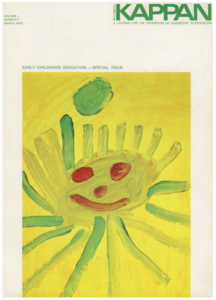
[B]oth tangible and intangible gains are hoped for by Head Start planners. Readiness for formal schools is the prime wish; gains in achievement and achievement motivation are important corollaries. It is also hoped that parents and other adults will know more and do more about preparing underprivileged children for school by providing the psychological, social, and physical support necessary for achievement motivation and success. Put differently, it is hoped that a change in community ethos will result. (p. 346)
In March 1969, Kappan published a special issue on early childhood, looking this time at the landscape beyond Head Start. In the issue, Harold Shane (“The renaissance of early childhood education”) explained that although considerable support for early education existed before the 1960s, “the importance of early childhood was honored more by words than by actions in the schools” (p. 369). However, growing societal awareness of poverty in inner cities and rural areas, the success of Head Start, and a developing understanding of the importance of the early years to later development had led to increased interest in doing something to help children whose home environments were believed to be lacking. Action was not just beneficial, it was essential, Shane attested:
The research cited, as well as analogous studies, which space precludes listing, are beginning to form a mosaic of data suggesting that these years of early childhood are more critical than any other stage of human development. In other words, if society, through its educational planning, does not vigorously begin to foster facilitating environments for very young children, it may be too late or immensely expensive to remove the psychological scar tissue that has long since formed on the personalities of certain young children before they enter school at the age of six. (p. 412)
The importance of early childhood was honored more by words than by actions in the schools. — Harold Shane, March 1969
But what should a proper education for young children look like? In the same issue, Robert Anderson (“Schools for young children: Organizational and administrative considerations”) proposed a more seamless relationship between preschool programs and public schools, a heterogenous mix of students, diversity of expertise and personalities among teachers and staff, a mix of large-group, small-group, and individual learning, and lots of play, with some structured learning that increases as children get older. Building such programs would be a challenge, he noted, because it was new and potentially costly, but a gradual expansion starting with kindergarten and moving down as resources became available would be realistic, especially if the largely male leaders in education could be encouraged to pay attention to a sector of education that was generally considered a realm for women.
A more expansive view
 By the 1980s, the benefits of early childhood education were well established, and, as Lawrence Schweinhart, Jeffrey Koshel, and Anne Bridgman explained in March 1987 (“Policy options for preschool programs”), “A growing constituency, which includes chief executive officers as well as welfare mothers, considers public spending for such programs worthwhile” (p. 524). The authors looked at the research into early childhood programs for insight into how governments might best spend any funds provided for these programs. For example, research showed more benefits for programs geared toward preschoolers than for infants and toddlers and more benefits for children from low-income families than for children from middle- and high-income families. However, they also recognized that communities would need to consider not just the research, but also the political and logistical implications of their choices. (For example, part-day programs might show the most positive effects, but they were not helpful for parents needing full-day childcare.)
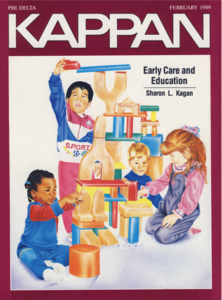
In the February 1989 issue, Sharon Kagan (“Early care and education: Tackling the tough issues”) offered an overview of the early education landscape, noting that despite clear research showing the benefits of early education, the obvious need for childcare as more women entered the workforce, and a consensus about what good programs for young children would look like, “the hoped-for promise of a new era in childcare and early education faced complex, deeply rooted challenges” (p. 432).
Kagan explained that in the 1960s, efforts to improve early childhood education were rooted in a “deficit orientation” that had since been replaced with the recognition that quality childcare was “a universal workforce issue” (p. 433) and that every child can benefit from early education to prevent a wide array of problems before they appear:
Generally, current thinking suggests that, although very young children are fragile, vulnerable, and in need of protection, their early years represent a period of great opportunity for parents and service providers. Irrespective of income level, race, or locale, getting infants and young children off to a good start is a universally accepted goal. Preventing problems before they begin and strengthening families and communities are concepts that also reflect our current sociocultural view. These are our beliefs about what is wise and just for children and families, as well as for the collective societal good. (p. 435)
However, although the benefits of early education crossed class boundaries, children from low-income families had to rely on subsidized programs, while other children attended paid programs. Thus, early education was economically (and, by extension, racially) segregated. And the discontinuity and fragmentation of the childcare system led to a lack of consistent standards, lack of alignment between preschool and kindergarten, and competition among programs. Kagan urged states and communities to seek ways to promote collaboration across the entire early childhood sector, including childcare programs, schools, families, community organizations, and governmental bodies.
Irrespective of income level, race, or locale, getting infants and young children off to a good start is a universally accepted goal. — Sharon Kagan, February 1989
Kagan expanded on these ideas as guest editor of Kappan’s October 1989 issue. In a feature article titled “Early care and education: Beyond the schoolhouse doors,” she argued that the time was ripe for schools to reach out to families and communities and any organizations that serve young children to push for an expansion of early education. Such an expansion, she explained, aligned with the interests of school reformers and policy makers across the political spectrum.
In the same issue, Robert Granger (“The staffing crisis in early childhood education”) concurred that there was considerable consensus in the field on the need for widely available early childhood education, and consensus as to what high-quality education looks like, yet there was little traction for building the kind of well-trained teaching force that was necessary. One possible reason was the cost:
If the price of early childhood programs goes up precipitously, parents will either stop working or seek cheaper, lower quality programs. This will happen because many parents of young children are only marginally employed — or at least are at the point in their lives where their expenses are relatively high and their earnings relatively low. Moreover, parents do not necessarily understand enough about the ingredients of high-quality programs to choose reliably. (p. 133)
Yet, when Granger looked at the numbers, he concluded that the cost was not as great as was commonly assumed. However, he added, pressure from workers through unionization and collective action might be needed to make such an increase happen.
Has the time come?
 In November 1994, Sharon Kagan (“Early care and education: Beyond the fishbowl”) once again reflected on the state of early education, which once again appeared poised for transformation and expansion, this time as a result of the Goals 2000: Educate America Act:
In part, interest in young children has been piqued by the surprising, if not stunning, first national education goal — by the year 2000, all children will start school ready to learn — and by its three attendant objectives that call for education and support for parents, attention to health and prenatal care, and universal access to appropriate preschool environments. In a marked departure from most policies of the past, the first education goal and its objectives have set the stage for a national commitment to all young children. (p. 185)
The desire for an increased investment in early childhood education was a response to a variety of concerns, Kagan explained. Businesses had an interest in developing their future workforce, media were calling attention to abuses in childcare facilities, and professionals in the field had begun speaking with one voice about the needs. But, Kagan wondered, would these coalescing forces be enough?
Recall that at other moments in our history when young children became the subjects of national attention, the focus was the by-product of a national emergency. For example, the Great Depression and World War II heralded federal involvement in child care. A single national crisis yielded a single national response. Today, by contrast, there is no single crisis that precipitates one organized response. To the contrary, interest in young children is increasingly widespread, and so are the challenges to be addressed and the strategies to address them.
Today, we can look back and see that, in past decades, the challenges to expanding access to high-quality early care and education often proved to be too difficult to surmount. However, we have seen significant new state and federal investments in preK education in recent years, and we are now at a crisis moment much like the ones that have spurred progress in the past, as Kagan described. Might the COVID-19 pandemic be the catalyst for offering families and young children the educational support they need?
This article appears in the October 2021 issue of Kappan, Vol, 103, No. 2.

ABOUT THE AUTHOR

Teresa Preston
Teresa Preston is an editorial consultant and the former editor-in-chief of Phi Delta Kappan and director of publications for PDK International, Arlington, VA.
Visit their website at: https://prestoneditorial.com/