Lessons from other nations and previous school reopenings in recent American history.
This will end. We will leave our homes. Schools will reopen.
We don’t really know what reopening will look like — past outbreaks and natural disasters don’t compare to the breadth and length of the COVID-19 disruption — but we know it likely won’t happen all at once.
Schools must decide when and how it’s safe to return, how to recover what was lost, and what changes, if any, they want to hold onto.
“Reopening is going to be harder than it was to close,” said Don Austin, superintendent of Palo Alto Unified School District in California, at a recent virtual panel. People are going to be scared to come back. The learning loss “is going to be the most pronounced by the students who could afford it the least.”
Early reports from other countries that have begun a tentative return to in-person schooling offer a peek into the potential future. Reporters and researchers who cover school closure and reopening in the wake of hurricanes offer some helpful insights into how massive disruption has reshaped education in the past.
Among the issues ahead for reporters: whether or not to stagger students’ returns to school, how to address attendance and funding, and a renewed focus on social and emotional learning.
Reopening is going to be harder than it was to close
— Palo Alto Unified superintendent Don Austin

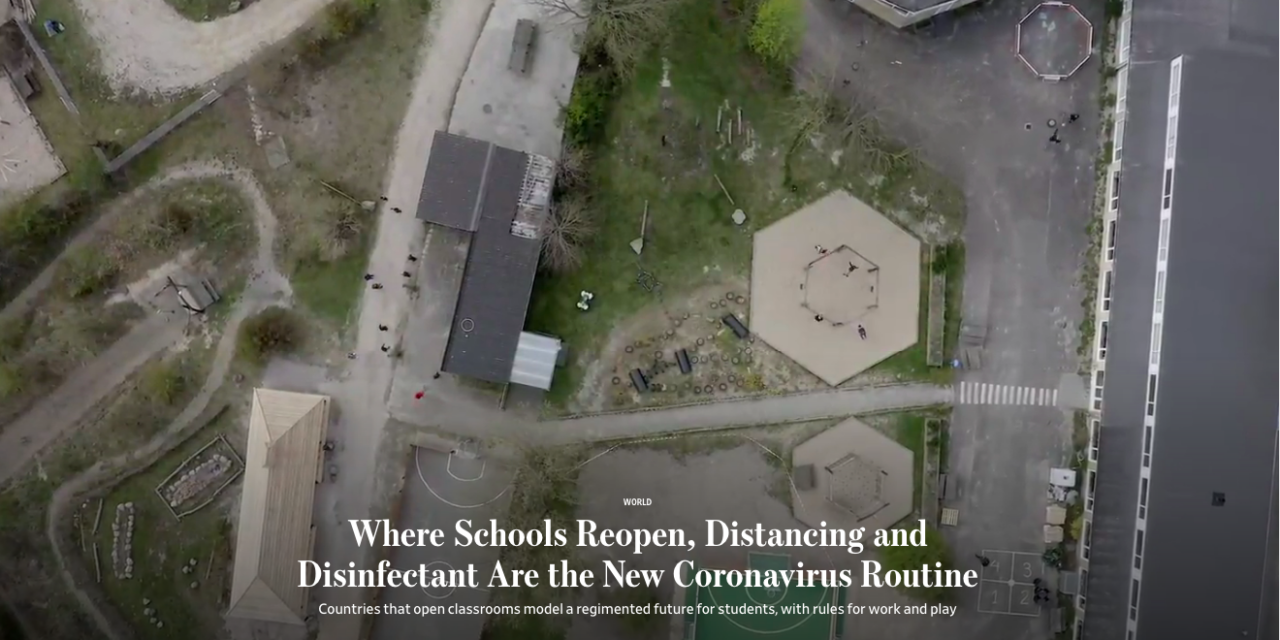
Above: The Wall Street Journal’s Where Schools Reopen, Distancing and Disinfectant Are the New Coronavirus Routine
STAGGERED RETURN
The first order of business is to get kids back into buildings. But which kids, when, and under what new rules?
The Jerusalem Post reported that special education schools in Israel will reopen following Passover, and the country will begin phasing in all students, starting with limited hours, three days per week. A phased reopening limits some exposure and stress-tests health and safety protocols, according to researchers at Johns Hopkins University.
After announcing a “fragile interim success “ in combating the virus, the New York Times’ Katrin Bennhold reported that Germany is considering a return for older students in May, with small group instruction and strict health protocols. Younger students and those in nursery schools, who are less likely to grasp and abide the new rules, will take longer to return.
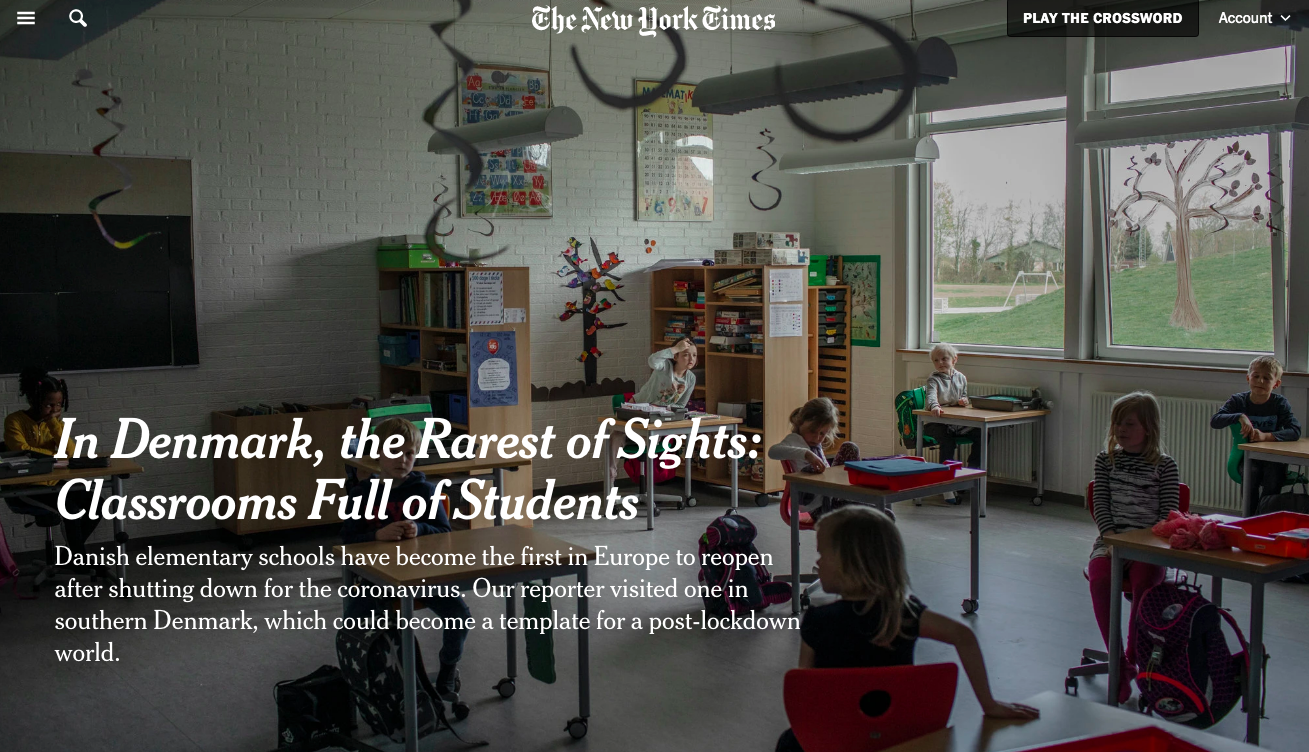
Denmark took a different approach and reopened this week for children up to age 11, according to the BBC, though some sources said guidelines on who should return and when were unclear.
The Wall Street Journal peeked inside one of the reopened schools and offered a portrait of post-coronavirus schooling that included twice-daily disinfections, widely spaced desks, and classrooms limited to just 10 children.
Education reporter Shelby Webb, who has covered several school disruptions for the Houston Chronicle, has not seen this sort of staggered small group return after the hurricanes she’s covered. While each school had to wait out its own repairs, once the buildings were open, she said, they were open to everyone.
Education reporter Shelby Webb has not seen this sort of staggered small group return after the hurricanes she’s covered. While each school had to wait out its own repairs, once the buildings were open, she said, they were open to everyone.
ATTENDANCE, FUNDING, & SEL
In the wake of nearly every disaster, Webb explained, schools struggle with attendance as families have been displaced or are dealing with further economic disruption. She said she would not be surprised to see districts in states with attendance-based funding advocate for a sturdier measure, like enrollment, as they come back from coronavirus closures.
After hurricanes, Webb explained, every storm in the forecast puts families and schools on high alert. With the risk of resurgent outbreaks, new viruses, and economic crises swirling in the news, Webb expects schools to be dealing with more social and emotional volatility, which leads to instructional and attendance issues.
Schools will already have to deal with “the emotional trauma that students are going to be experiencing even after they return,” she said. Webb cautions reporters to keep this front of mind when interviewing families, students, and teachers. “Ask if they are OK,” she advised.
Schools may also have to consider additional instruction time for some groups, especially students who are missing out on therapies and interventions.
REMOTE LEARNING
“The things we’re being forced to do now may stick,” said Douglas Harris, director of Tulane University’s Education Research Alliance for New Orleans, in a recent phone interview.
The education researcher’s Twitter feed has been heavy with threads comparing Hurricane Katrina and COVID-19. Many seem to wonder if school-as-we-know-it is in for an overhaul similar to what happened in New Orleans. For the most part, Harris’ conclusions are less grim…or less auspicious, depending on what side of the reform debates one is on.
Coronavirus is unlikely to spark the type of charter revolution seen after Katrina, Harris pointed out on Twitter, as there have not been mass teacher layoffs or complete residential displacement of student populations.
As families moved back into New Orleans after Hurricane Katrina, he said in an interview with The Grade, they did not cluster in preexisting attendance zones. They had to follow restoration efforts scattered across the city. Open enrollment was an early piece of pragmatism that became permanent with heavy ideological backing.
Only one element of the current scenario seems as likely to endure: Significant district investment suggests remote learning is more likely to stick. Harris doesn’t predict homeschooling or competency-based learning to spike immediately, but one-to-one tech opens plenty of doors. Reformers love blended learning.

Above: The Associated Press story, American schools may look radically different as they reopen
Even with past history as a guide and a few new examples of schools reopening in other countries, so many questions remain. “Will students be asked to wear face coverings?” asked a recent Associated Press story. “Will class sizes be cut in half?”
Teachers may also find that some of what worked during distance learning actually works well when they return to class.
In her 2018 story Gulf Coast schools get a lesson in perseverance, Webb depicted how Orangefield Independent School District outside of Houston adopted co-teaching in the aftermath of Hurricane Harvey. Ultimately, those teachers embraced creative possibilities for curriculum and instruction that continued after the crisis was over.
ABOUT THE AUTHOR

Bekah McNeel
McNeel is a freelance journalist who has been covering education for eight years. Her education reporting has appeared in The Hechinger Report, The 74 Million, The Christian Science Monitor, The Texas Tribune, Edutopia, and Texas Public Radio. Based in San Antonio, she also covers immigration, currently for Christianity Today. You can follow her on Twitter at @BekahMcneel.