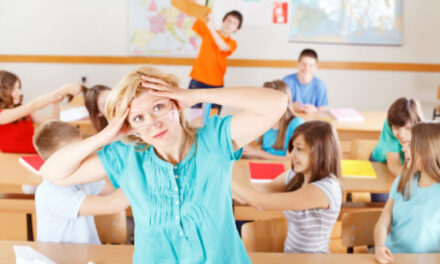
Q: I’m self-conscious about asking this because I worry that I may be more noise-sensitive than other teachers. I am fine with the normal sounds of a school building. And while I do keep a fairly calm and quiet classroom myself, I doubt my students would notice much of a difference between my class and their other classes. Well, other than the classroom next door. The art teacher in there is loud. Loud with a capital “L” loud. She’s always yelling something. It might be an enthusiastic “OK, all, go ahead and get started!” It might be an admonishment to clean up their mess. It might be instructions. It might be frustration that they’re talking over her, which is funny to me because that would be impossible. She sets the tone for her students, who are the loudest kids I’ve ever heard. You’d think she was refereeing competitive bungee jumping in there! I can’t concentrate with all the hullabaloo. I tried asking her nicely to keep it down, and she apologized and said “of course.” But the next day, it was back to the usual shrieking, clattering, and booms. I don’t want to be a pain or a chronic complainer or go over her head. She’s not a bad teacher or a bad person; I just can’t teach with all that going on. It’s not like I can wear noise-canceling headphones while I teach, and it’s so disruptive to the overall learning environment. What else can I do?
A: Don’t feel self-conscious about being noise sensitive. Different people work best in different environments. That’s why Amtrak offers commuters a quiet car and why some people work in libraries while others prefer the ambient noise of a coffee shop. I suspect that most people, however, would find it hard to concentrate in the presence of shrieking or loud clattering noises.
Don’t feel self-conscious about being noise sensitive. Different people work best in different environments.
Plus, this isn’t only about you. You don’t mention your students, but it might be worth checking in with them to see if they’re struggling with the cacophony next door. If they are, you might feel less self-conscious using that as an excuse to make another plea to lower the volume. (And if it helps, some of her own students might find the volume less-than-ideal, too.) Talk to her when she’s not surrounded by students or distracted so you can be sure your request registers. Approach from a stance of curiosity rather than criticism and ask to brainstorm solutions — or at least stopgap measures — together. For instance, perhaps she (or you) could rearrange the classroom furniture — perhaps by putting a bookshelf against the shared wall to create a physical sound barrier. She might appreciate a heads-up on days your students are taking a test or giving presentations or be open to a creative signal, such as a special knock on the wall, when the volume is particularly distracting.
If nothing changes after that second conversation, talk to your administrator. Not to get the other teacher “in trouble,” but to bring the matter to their attention and find out they can take any other steps to address the noise level. They might suggest things you haven’t tried, such as white noise machines or sound-absorbing panels. Depending on the availability of space, they might even be able to accommodate a classroom (or schedule) change. Solicit ideas from colleagues, too. This is a relatively common complaint, and other teachers might have good suggestions. In the meantime, try wearing noise-canceling headphones when you’re not teaching so you’re calmer and less over-stimulated at the end of each school day.
Click here for more Career Confidential
Have a question that you’d like Career Confidential to answer? Email contactphyllisfagell@gmail.com. All names and schools will remain confidential. No identifying information will be included in the published questions and answers.
ABOUT THE AUTHOR

Phyllis L. Fagell
Phyllis L. Fagell is the school counselor at Landon School in Washington, D.C., a therapist at the Chrysalis Group in Bethesda, Md., and the author of the Career Confidential blog. She is also the author of Middle School Matters and Middle School Superpowers, available at https://amzn.to/3Pw0pcu.