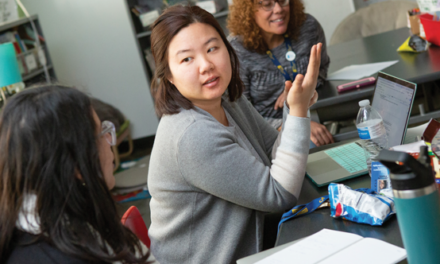
In spring 2020, much of what parents, students, and teachers knew about schooling was upended, as the COVID-19 pandemic forced schools to make a sudden shift to remote instruction. Parents became part-time teachers, often setting aside their own work to help their children learn. Teachers plunged into entirely new forms of teaching, while racing to master new technologies, revamp their schedules, and provide emotional support to students and parents. And for students, the implications are still unclear — millions could not access online instruction at all, while millions more faced a daily struggle to stay engaged with their classes and homework.
From late April through June 2020, the education nonprofit Cognia conducted three surveys (including a total of 63 questions) designed to better understand the effects of this abrupt shift to online instruction. (A full report of the survey findings is available here.) Respondents included more than 74,000 students, parents, and teachers from the United States and 22 other countries. The U.S. sample alone (79% of the total number of respondents) included students, parents, and teachers from a geographically and socioeconomically diverse set of 335 schools in 35 states and Puerto Rico, which makes this the largest study to date of Americans’ experiences with K-12 education during the pandemic. (Readers should keep in mind, however, that this was not a nationally representative sample. It’s possible that the results were influenced, to some extent, by the fact that all 335 schools have a connection to Cognia via the organization’s accreditation, assessment, and consulting services.)
The focus and scope of this research differs significantly from a recent survey described in Kappan’s November issue. That study, conducted by David Marshall, David Shannon, and Savannah Love, provided an in-depth look at the experience of 328 teachers to identify the specific instructional challenges they faced in the early days of the pandemic. By contrast, Cognia’s three surveys — which received responses from 2,890 teachers, 32,486 parents, and 38,739 students — focused on the academic, emotional, and personal impacts of the sudden shift to remote learning. (Note that neither study was designed to explore the pros and cons of remote teaching and learning per se. Based on its experience accrediting roughly 500 digital learning schools, Cognia recognizes that online learning can be highly effective. However, the sudden, unplanned shift that took place in spring 2020 was not an ideal circumstance for remote instruction.)
You’ve accessed your three free articles for this month.
If you are a PDK member, login to read more.
If you are not a PDK member, join for full access, in addition to other benefits. Complete our membership form to join.
Forgot your password? Visit the Member Portal to reset your password.
Having trouble? Contact our member services team at memberservices@pdkintl.org or 800-766-1156.