A conversation with Rebecka Peterson
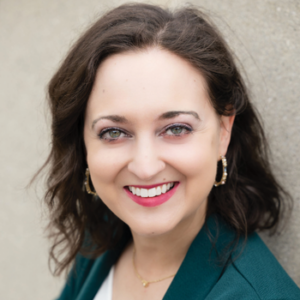
Lily Chris Photography
Rebecka Peterson, the 2023 National Teacher of the Year, is an immigrant to the U.S., the daughter of Swedish and Iranian medical missionaries. Born in Sweden, Peterson moved with her family to Oklahoma when she was in preschool, but they traveled extensively during her childhood. They returned to Oklahoma permanently during Peterson’s high school years, where she was home-schooled. She took community college math classes and majored in mathematics in college. She then taught college courses, and her professor encouraged her to try teaching high school.
Twelve years ago, Peterson started her public school career teaching 10th- to 12th-grade mathematics at Union High School in Tulsa, Oklahoma. At Union, 72% of students qualify for free and reduced-price lunch, and 62 languages are represented. “I really didn’t think I could teach high school because my high school experience was so nontraditional,” she said. “But now I see how some of my nontraditional experiences growing up prepared me to teach at this beautifully diverse and culturally rich district. A lot of my students have similar backgrounds to me. They are immigrants, or they are first-generation Americans. They know what it’s like to infuse different cultures.”
This is not toxic positivity. This is not looking for the silver lining. This is taking ownership of our story.
Like many teachers, she struggled during her first year. “I was going from a classroom where students were paying to hear what I was teaching to a classroom where students were more or less forced to hear what I was teaching,” she said. “It was a really rough transition, and I didn’t think I was going to make it that first year.”
The power of story, she said, rewired her brain and saved her high school teaching career.
PHI DELTA KAPPAN: What kept you going that first year?
PETERSON: It was really the One Good Thing blog. I was applying for other jobs, and I started applying to doctoral programs, thinking, “It’s public high school; what was I thinking? I never experienced it myself. I can just go back and be a college professor.” Serendipitously, I stumbled upon this community blog. It was a brand-new blog started by a couple of math teachers who were feeling the same things I was, even though they had taught in public school longer. They said, “We’re just going to start naming the good.” They lived by this mantra: Every day may not be good, but there’s one good thing in every day. They didn’t ignore how hard the job was.
The ownership aspect really hit me. I’m the author of this story. I get to decide who has the final word every day. The practice of ending the day focusing on what went well resonated with me. Even if it wasn’t a good day, could I find one good thing?
I went from reader to writer of the blog halfway through my first year at Union High School. I decided to write one good thing and hit publish. And the next day I opened the blog’s platform, logged in, and wrote another good thing and hit publish again. The third day I did the same, and I just kept going and going until after a decade of writing good things, I had written 1,400 posts.
There’s two pieces to this practice: the intentional gratitude and the reflection aspect. At first, I didn’t see the power of carving out time to reflect and be grateful. I was in a reactive frame of mind. I would sit by my computer and mentally go through my day until something good popped into my head, and I’d write about that. At some point, there was a shift. I would notice good things throughout the day. Johnny asked a question today — one good thing. I started writing them down throughout the day so that I wouldn’t forget.
Brain science backs this up: I was initiating my reticular activating system, which is the brain’s filtering system. When I took the time to notice the good, the part of my brain that filtered the good expanded and allowed me to see more good things. Eventually, I reached a turning point where I wanted to not just actively notice the good. I wanted to proactively create the good. I wanted to be the one good thing for my students. I went from reactive to active to proactive. One good thing, one step at a time, one day at a time, one blog post at a time. And it changed my life.
I hearken it back to math. If we increase by just 1% a day, we can graph that equation like 1.01 to the X. The increase is exponential, but it’s going to start out really flat. In this first phase, it feels like you’re not moving at all, but if you just keep going, you see you’ve got this exponential growth. If I could sum up my teaching philosophy, it’s the power of incremental change. We don’t always feel that change right in the beginning, but what a shame to stop those practices in the beginning, and not experience that uptick.
KAPPAN: How is this different from toxic positivity, where we don’t acknowledge the negative?
PETERSON: This is not toxic positivity. This is not looking for the silver lining. This is taking ownership of our story. If you go back and read my posts, they’ll say, “Today was not a good day.” I want to be very real and authentic. I wrote: “It sucked, but one student said ‘good morning’ in a way that melted me. I looked in those eyes and I saw why I’m here.” It’s ownership. It’s recognizing that the lesson plan didn’t go as I expected, or we lost 20 minutes because someone pulled the fire alarm. Now, this section is behind and we’re in the middle of AP testing.
It’s so easy to focus on the bad, and if we’re not careful, we will start a downward spiral. Gratitude jolts us out of that spiral. Gratitude gave me eyes to see what I was missing before. Most of my posts are not big moments. Most are small, everyday moments that I was missing before I was intentional about noticing them and documenting them. It’s making room for the good things to land. No one is going to make that room for us. If we want them to land, we must make that space ourselves.
KAPPAN: You ask your students to do this as well?
PETERSON: Every Friday we get out our math notebooks, and we turn to the very last page, which we’ve named “One Good Thing.” We put the date and we write just one good thing from the week. It can be a word or phrase, sentence, or paragraph. I play music. I ask them not to talk so everyone can think and reflect and allow their brains to grab on to that good thing because, again, we must jolt ourselves out of that downward spiral. Students will often say that this was the best thing from calculus class. Several continued it beyond graduation. Every now and then I’ll get a message from one of them saying, “I finished my 1,000th good thing.” It’s something that they keep doing because they see the power as well.
My hope is that teachers are empowered to share more stories and that students are empowered to share more stories.
KAPPAN: You started the practice of having one-on-ones with your students to hear their stories. How did that come about?
PETERSON: When I first started teaching calculus, I had also been teaching precalculus. I was looping with a decent proportion of the students. They had a 100% pass rate on the Advanced Placement exam. Then I needed to step out of teaching precalculus for one year. The next year, it dawned on me that I’m not going to know any student in my calculus class. I never started calculus without this subgroup of kids who know me, and I know them. They would help tell the rest of the class, “She’s going to push us, but it’ll be fine.” Selfishly, I was thinking if you take the subgroup out that had a 100% pass rate, what does that do to my overall pass rate?
But then I realized that this subgroup of my former students was not smarter than the other students. They didn’t have a better precalculus background because we all teach the same stuff in the building. It dawned on me that these students trusted me, and their scores reflected that. Without this subgroup helping the entire group, how do we get everybody to this level of trust? So that’s how “Unit 0: The Calculus of Connection” was born. I ditched the first day of school practices and instead shared my story, which I hadn’t revealed yet. I realized once I started telling it, my story was very relatable to my students. Whether you’re new to the country or whether you were born and raised in Tulsa, Oklahoma, every high schooler knows what it’s like to feel they’re on the outside looking in. I shared what it was like growing up as a third-culture kid and the emotions I experienced because of that. Even if the experiences aren’t always shared, the emotions are.
I said, “Now I would like to hear your story.” I wasn’t sure how it was going to be received. I passed out a signup sheet for them to pick a time to tell me their story, before school, after school, during lunch or other noninstructional time. I was blown away by the response. I gave them the option of just typing out their story if they’d prefer. Almost everybody wanted to come and spend that one-on-one time. They were craving that one-on-one time with an adult. I said, “Whatever you want to tell me — like, as much or as little — I’m here. This space is yours.”
It turns out that every kid has a story. Every kid had some kind of trauma even at the age of 16 or 17. It softened me. When we learn each other’s stories, we carry a piece of each other with us. I carried my students with me every time I stepped into that classroom. My patience and my grace grew tremendously because I knew their backgrounds. It changed everything. It takes 10 weeks to sit with over 100 teenagers one-on-one. But after those 10 weeks, after doing this for many years now, I can feel the difference in the classroom. I can feel this atmospheric shift. Because everyone’s in. Everyone belongs. Everyone has a seat at the table. There’s this inherent trust, and it allows me to push them mathematically. And then they soar; they just soar.
KAPPAN: We tend to focus on what’s going wrong with public schools. How are these stories affecting teachers and students and even public education as a whole?
PETERSON: We get to choose what we listen to and what we talk about. I’ve been telling teachers that we’re the ones in the classroom, we hold the chalk. We are the ones who should be talking about what’s going on in the classroom. We shouldn’t be allowing other people to direct that narrative because we’re the ones on the ground. My hope is that teachers are empowered to share more stories and that students are empowered to share more stories. We need to be listening to their voices. I hope I can elevate more teacher and student voices.
Now, more than ever, we must celebrate our own work. Think about the power of a teacher. If asked to name a teacher who was impactful to us, we could all think of someone. And we’re not just thinking about them; we’re holding them in our hearts. What other profession is like this? People don’t just think about us. Years and decades down the road, they hold us in their hearts. I want teachers to remember the impact of their work and the power of this profession.
I want teachers to share their stories. How we as teachers talk about teaching really matters. It matters how we talk about our students, our colleagues, and our administrators. It all matters. I’m trying to encourage teachers to celebrate our profession. At the same time, when someone asks us what we do for a living, we should do what we do best and educate our audience. We should speak about the parts of our profession that we hold so very dear, while also explaining the work that still needs to be done. Nothing is binary.
KAPPAN: Eleven of your former students are studying to be teachers or are current teachers, including a few who work with you at Union High School. Do you have any ideas about recruiting new teachers in the profession?
PETERSON: We need to take it more seriously that we are the recruiters for this job. And a lot of us are also parents. If we want qualified people teaching our kids and our grandkids, we’ve got to take this seriously. It comes back to celebrating the profession and how we talk about education. We’ve got to have these conversations early. We need to have these conversations in elementary, middle school, and high school. I just did a speaking engagement, and I had a 3rd grader come up to me and say, “I want to be a teacher.” A teacher planted that seed in her. Let’s make sure we keep nurturing that seed so that it blossoms.
This article appears in the September 2023 issue of Kappan, Vol. 105, No. 1, pp. 8-12.
ABOUT THE AUTHOR

Kathleen Vail
Kathleen Vail is editor-in-chief of Kappan magazine.
Visit their website at: https://pdkintl.org/