
When one university asked itself how to improve leadership education, the answer took it closer to the real-world, reform-infused environments where its candidates operate.
Schooling has changed dramatically in recent decades, but critics say the universities that prepare school leaders have done little to adjust their curriculum to these changes — the myriad of reforms and the complex political environment in which school leaders now work.
This reality led the educational leadership department of Shippensburg University to ask ourselves this question: What if we just turned every course in our Superintendent’s Letter of Eligibility Program into a form of practicum?
To be sure, there was sarcasm in the question. But we also knew about the calls for overhauling educational leadership programs. Did emerging school leaders really need to spend endless hours in university classrooms far removed from the realities of their school districts? Did the study of such topics as the characteristics of successful leaders or the analysis of best practices in an academic setting really transfer to an educator’s unique work situation?
As the concept emerged, we began describing it as a series of practicum experiences on steroids.
From our initial discussions about alternatives to traditional programs, we emerged with a clear problem of practice and a workable theory of action to guide our reform efforts. We needed to think through how we could maintain program relevance and sustain it over time while increasing the probability that we’re preparing our emerging leaders for the challenges of today’s and tomorrow’s public schools? If we redesigned our program so that it would focus our candidates on issues confronting their own organizations, we believed their training would be more connected to their needs and to the realities of their day-to-day challenges. We would help candidates define problems of practice in their own organizations. Further, candidates also would be better able to link their activities to the big ideas presented by the university faculty and field experts with whom they would be working each semester. As we moved forward, it became clear that a shift from learning about leadership to becoming more fully engaged in the practice of leadership had the potential to be truly transformative. Why not turn every course into a practicum? This question became our point of departure and the beginning of our journey.
Redesigning the program
We began by working with the Pennsylvania Department of Education while simultaneously coordinating our proposed program revisions with the university’s curriculum-related committees. Our approach was evolutionary because we weren’t sure we were asking all the right questions or had a workable format and methodology. Our goal was to transition to an approach that minimized a conventional classroom delivery system based on selected topics to in-district, applied-learning field work supplemented with seminars and Professional Learning Community (PLC) activities. To foster program relevance, we expanded the cadre of content experts who would work with candidates. In addition to members of the educational leadership faculty and the candidate’s school district mentor, we added leadership fellows. They are practicing educators who excelled in one focus area of a particular leadership residency. For example, the leadership fellows for the finance residency were school district chief financial officers who were also active leaders in Pennsylvania’s school business officials’ organization.
The Leadership Residency program, as it has come to be known, now consists of six completely field-embedded, four-credit courses, or residencies, that are cosupervised by a member of our faculty and a leadership fellow who is a practicing expert in the field. Each residency focuses on local district-level leadership areas of interest intertwined with a few “big idea” seminars and PLC sessions. The focus areas are centered on leadership and community partnerships, public school finance, curriculum and technology, school law, facilities, and human resources and negotiations. Candidates also work with their superintendents and/or their designees. They have been accumulating 500 to 700 hours of fieldwork due to the change. In the past, the typical candidate logged between 180 and 360 hours of field work.
Logistics also were a challenge. We wanted to maintain contact with candidates and mentors, even though some candidates worked hours away from the university, and we wanted to provide regular opportunities for the leadership fellows to interact with candidates. Further, we wanted to capitalize on each candidate’s experiences and the unique opportunities in their districts that extended beyond the focus of a particular residency. As the concept of our fully embedded, district-based residency program emerged, we began describing it as a series of practicum experiences on steroids.
The launch
The Pennsylvania Department of Education gave us permission to create an experimental pilot program for superintendent and district-level candidates. The existing program had included a minimum of 360 field hours spread over two practicum and five three-credit, classroom-based courses taught almost exclusively by full-time faculty. However, the experimental, cohort-driven, field-based residency pilot program we devised, as mentioned above, required between 500 to 700 field-based hours spread over six four-credit residencies that would be supervised by full-time faculty and leadership fellows and supported by each candidate’s school district mentor.
The pilot residency cohort began with 11 candidates in fall 2013. Three additional cohorts totaling about 50 candidates soon followed, and they are on track to finish either this summer or next fall. A new cohort launch is also planned for the upcoming school year. In the past, our annual district-level leadership program enrollment rarely exceeded 16 students and, in most cases, they were at various stages in the program, unlike the cohort students who move together as a group.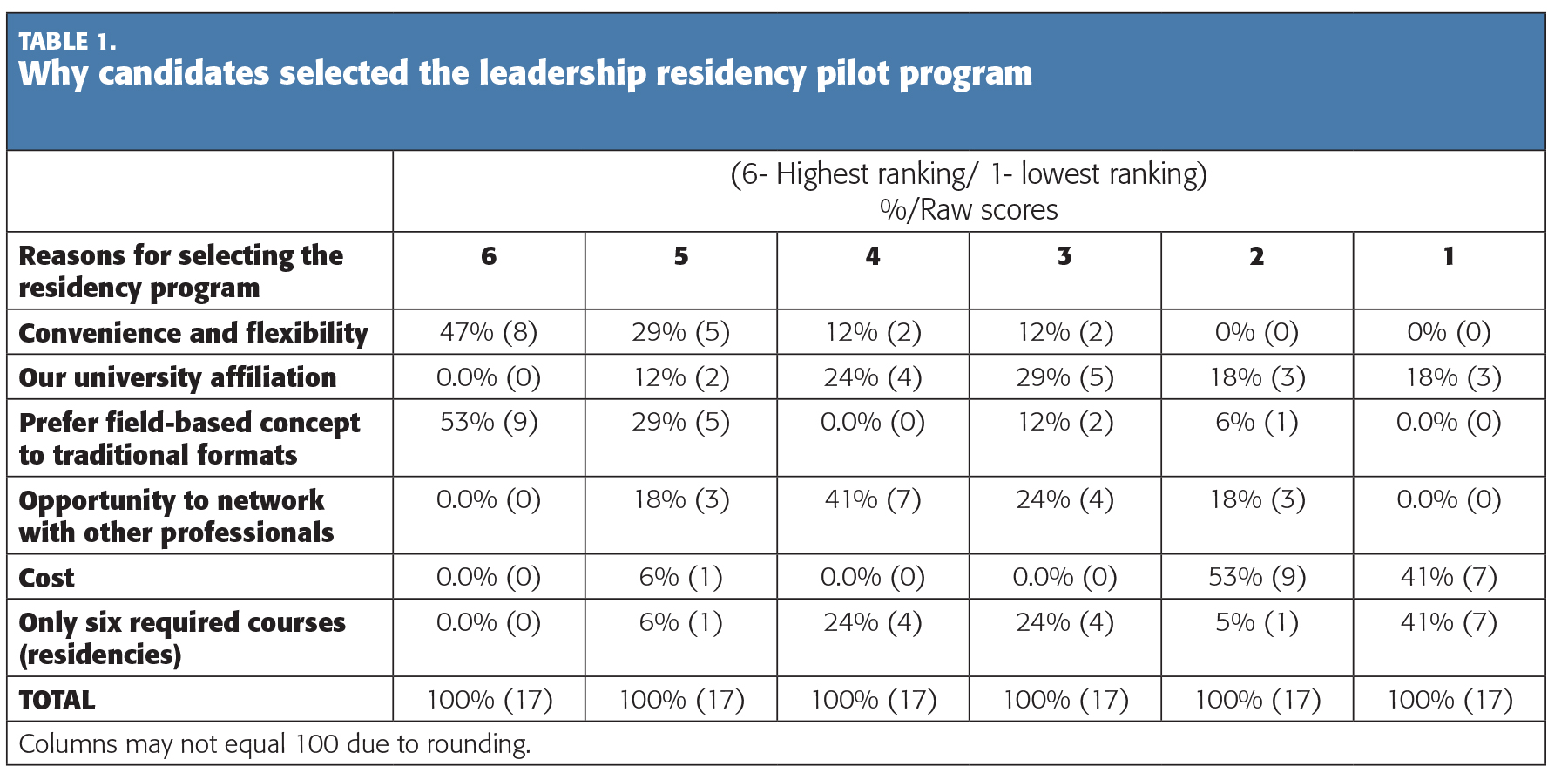
Incorporating “big ideas”
Each residency also integrated seminars into the mix to present big ideas, to encourage collaboration with other candidates, and to spark interaction with additional guest authorities and practitioners. Big idea seminars included such topics as the debate surrounding public school pensions and the role of assessment in the Common Core environment. These seminars also gave us a platform to launch PLC activities and explore other practicum-related topics with smaller groups. Seminars were usually on weekends to accommodate candidates’ work schedules, and the number of seminars varied per residency with no more than four all-day sessions during each residency. This format let us gather group feedback and suggestions for modifying the program. For example, a number of candidates said they needed more time during the finance residency for a deeper review of various approaches for conducting a financial audit of district revenues and expenditures and to develop long-range financial plans.
Addressing standards
The Interstate Leaders Licensure Consortium (ISLLC) standards, which were developed to guide consistent leadership preparation across the country, were critical in designing the program and raising candidates’ awareness about the kinds of activities that should be included. By requiring candidates to maintain an interactive spreadsheet activity log tied to the ISLLC standards and major residency focus areas, the faculty could ensure that candidates were participating in experiences that addressed all of the ISLLC standards and required relevant leadership knowledge, skills, and dispositions. Adhering to the ISLLC standards also helped prepare candidates for the required state superintendent’s exam administered by ETS, which they would be required to pass in order to earn their superintendent’s license.
Mentoring and networking
Since candidates also were required to have their superintendent or a designee serve as a district-based mentor and, at the same time, work with a leadership fellow from outside their district each semester, they had the opportunity to be mentored by as many as six different practicing school leaders by the time they finished the program. In addition, the candidates also worked closely with the university’s educational leadership program faculty.
The collegial network created by the residency structure clearly has had an effect beyond the residency program. This network has evolved into a regional community of academics and expert practitioners supporting the work of each candidate. Candidates discovered that they could call on their field-based experts for advice, even after completing the residency that brought them together. For example, one district was debating the efficacy of permitting high school students to join the interview process for hiring new faculty. One of the field experts, the deputy general counsel for the Pennsylvania School Boards Association, provided a brief written analysis of the issues, including liability considerations. The analysis was a valuable contribution to that district’s deliberations and was made possible because of the residency network. (They decided to table the idea given a number of possible risks to applicant confidentiality.)
Monitoring the residencies
The educational leadership faculty created an online portfolio where candidates posted assignments, outlined residency activities, and logged residency hours. The portfolio served as a valuable repository for all of a candidate’s residency work. All faculty and mentors were provided with editing access to each candidate’s portfolio, enabling them to add comments and share information. The online portfolio, as mentioned earlier, also allowed candidates to record daily activities related to their studies while keeping a running tally of all hours logged throughout the program.
Candidate reactions
Candidates regularly and anonymously responded to surveys — before starting the pilot program and immediately after completing each residency. Open-ended survey responses included such comments as, “I appreciated the assignments that required interaction with district personnel. Those proved to be most meaningful,” or, “The addition of professionals from various entities enhances the…experience.” And, “I also think the networking and collaboration of those between schools is extremely valuable (i.e. comparing and contrasting communication plans, discussing valuable components of the change process and gathering feedback from others).” Such positive comments, along with other ideas about using resources, pacing, and assignments that were most beneficial, suggested that we were making headway. We also were able to collect reactions to some standard program elements.
Preference for a field-based concept was cited as a primary reason candidates were initially drawn to the residency pilot that placed them in an applied science environment rather the more theoretical one that had been the prior program’s mainstay. This preference was followed closely by a desire for “convenience and flexibility.” This did not surprise our faculty. We had been receiving informal feedback over the years that candidates were looking for educational leadership program options other than online and traditional instruction. The residency program allowed candidates to continue their studies close to home and within their places of work as well as to participate in small group seminars or occasional online activities as needed. Candidates also have shown an increasing appreciation for peer interaction as they move through the program. Open-ended survey feedback and unsolicited comments toward the conclusion of the pilot suggested that participants gained an appreciation for the networks they had developed over the course of the program. It is clearly an area we will be monitoring closely with future cohorts.
In somewhat of a blow to our faculty’s collective egos, our “university affiliation” was a distant fourth in preference. We’ve always believed that our program offers a high-quality learning experience, a belief that has been reinforced many times anecdotally over the years. However, the reality suggests that convenience and flexibility trump quality for many candidates, something that all universities should think about as they build programs. Cost was not a significant concern for candidates, even though the cost increased because the program credit requirement grew from 21 to 24. Because most participants received partial to full reimbursement for coursework from their employers, there were no significant out-of-pocket tuition costs for candidates. Course reimbursement practices may change, however, as school district budgets tighten and educators have to assume more costs associated with graduate study. The current leadership residency program takes approximately six semesters to complete; the pilot program was shorter in duration by one semester.
Table 2 suggests a strong positive reaction to key elements of the individual residencies and the overall program. The categories of strongly agree, agree somewhat, and agree combined for almost 100% of all responses on most items.
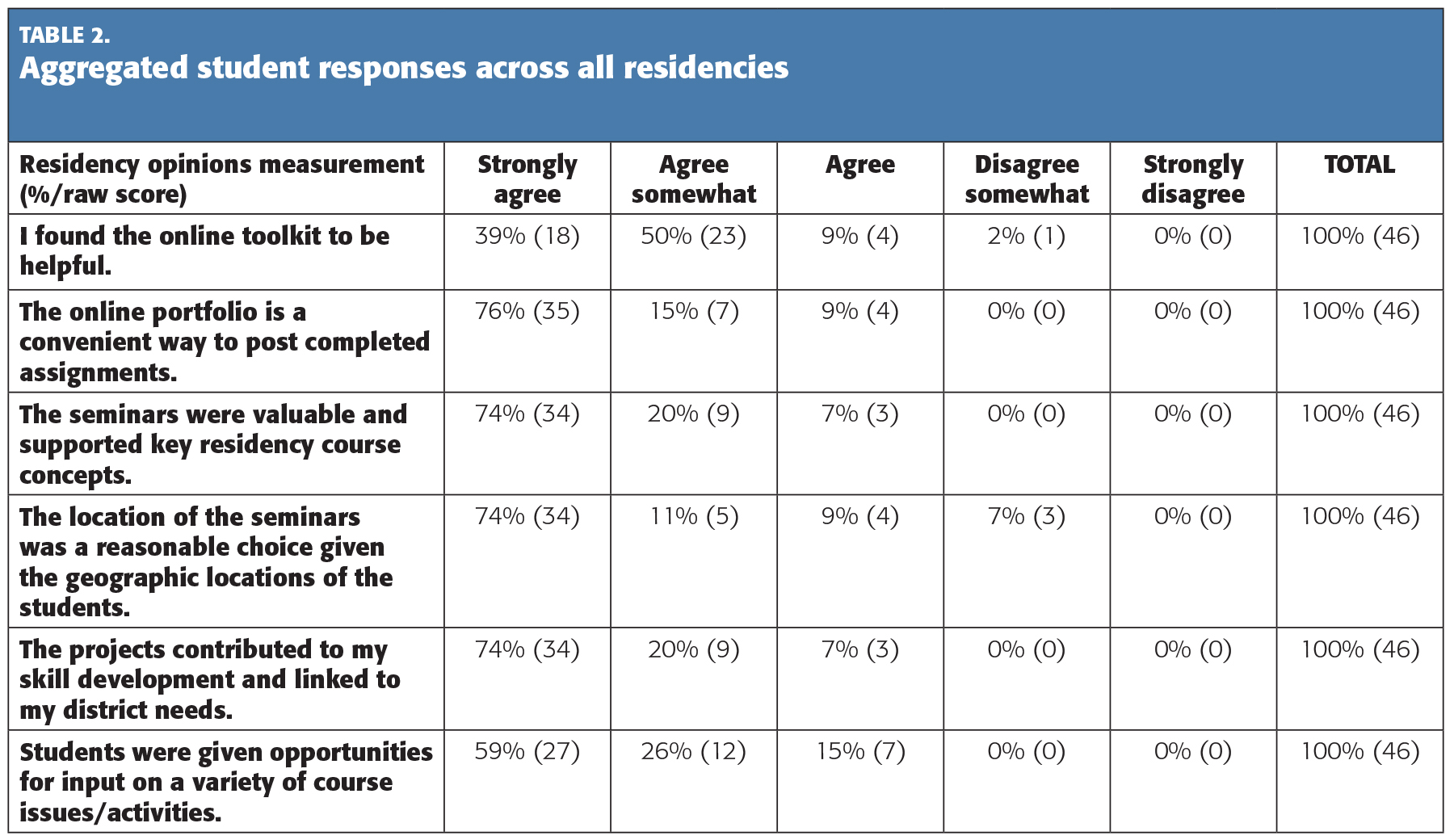
Although the reaction was positive, the online toolkit was rated lower than all other elements, followed by opportunities for candidate input. The toolkit was intended to be a program guide and an online handbook. It included such items as program requirements and how-tos, and it also acted as a repository for various forms and frequently asked questions. The toolkit response was not unexpected. Anticipating candidate needs was difficult when we were building the initial toolkit. A new toolkit based on feedback from candidates has been developed for future cohorts. The desire for more candidate input, however, surprised us, given the residency format and the amount of input regularly solicited. Candidates could select seminar locations and suggest areas of emphasis within the context of the seminar topics. But we didn’t give candidates an opportunity to review a number of the topics before they were introduced in seminars. As a result, the residency faculty will be exploring strategies for enhancing collaboration between candidates and faculty.
Perhaps the strongest indicators of the potential for the residency concept may be inferred. First, the Pennsylvania Department of Education has elevated the Leadership Residency Program from experimental to approved status, thus allowing our program to continue well into the future. Second, since the launch of the pilot, 41 new enrollees have been accepted for participation in three new cohorts. A fifth cohort is currently in the planning stages for fall 2015. And finally, the Board of Governors for Pennsylvania’s State System of Higher Education has approved a partnership Ed.D. program in educational leadership between Shippensburg University and Millersburg University that will include the leadership residency program as one of its key features.
The journey continues
So what if we just turned every course in our Superintendent’s Letter of Eligibility Program into a form of practicum? Well, that’s precisely what we’ve done, and the result is an emerging, evolving program that addresses the key components of many recommendations made regarding executive leadership preparation.
Olivarez suggests that “it is highly important for emerging leaders to be identified and prepared within the context of a well-designed executive educational leadership program. Such a program must provide a combination of a critical, current, scholastic review of research and best practices in effective educational leadership; a highly structured practicum guided by a mentor relationship with an active, effective, successful, experienced executive educational leader; and a rich and varied set of professional networking events” (2013, p.12).
As we continue our evolutional journey with the residency program, we are cognizant of the importance of focusing on preparing candidates for the challenges they’re facing now as well as the challenges they face in coming years. We continue to struggle with several aspects of our new design, and we anticipate that this will require continued adjustments to our residency model. We also know that we’ll need to continue to use a variety of methods for soliciting program feedback from candidates, leadership fellows, and onsite mentors. At this time, we believe that the journey is taking candidates and our program in the right direction.
Reference
Olivarez, R.D. (2013). Preparing superintendents for executive leadership: Combining administrative, instructional, and political theory with real-world applications. Insight: Texas Association of School Administrators Professional Journal, 28 (2).
CITATION: Fowler, G.L. & Cowden, W.K. (2015). Get real — improve leadership learning. Phi Delta Kappan, 96 (8), 43-47.
ABOUT THE AUTHORS

Gerald L. Fowler
GERALD L. FOWLER is an emeritus professor of educational leadership at Shippensburg University, in Shippensburg, Penn. He has served as a teacher, principal, reading supervisor, superintendent, and associate professor in a public education career spanning more than four decades.
William K. Cowden
WILLIAM K. COWDEN is an assistant professor of educational leadership at Shippensburg University, Shippensburg, Pa.